UNITED STATES
SECURITIES AND EXCHANGE COMMISSION
Washington, D.C. 20549
Proxy Statement Pursuant to Section 14(a) of the
Securities Exchange Act of 1934
Filed by the Registrant ☒
Filed by a Party other than the Registrant ☐
Check the appropriate box:
|
☐ |
Preliminary Proxy Statement |
|
☐ |
Confidential, for Use of the Commission Only (as permitted by Rule 14a-6(e)(2)) |
|
☒ |
Definitive Proxy Statement |
|
☐ |
Definitive Additional Materials |
|
☐ |
Soliciting Material Pursuant to §240.14a-11(c) or §240.14a-2 |
|
(Name of Registrant as Specified in Its Charter) |
|
(Name of Person(s) Filing Proxy Statement, if Other Than the Registrant) |
Payment of Filing Fee (Check all boxes that apply):
|
☒ |
No fee required |
|
☐ |
Fee paid previously with preliminary materials |
|
☐ |
Fee computed on table in exhibit required by Item 25(b) per Exchange Act Rules 14a-6(i)(1) and 0-11 |
April 1, 2026
Dear Shareholders:
Together with our Board of Directors and the management team at DiaMedica Therapeutics Inc., we are pleased to invite you to our 2026 Annual General Meeting of Shareholders, which will be held at our corporate offices, located at 301 Carlson Parkway, Suite 210, Minneapolis, Minnesota 55305, USA, beginning at 9:00 a.m. CDT, on Wednesday, May 20, 2026.
At the meeting, shareholders will be asked to consider and vote upon the following proposals:
|
(1) |
to elect seven directors; |
|
(2) |
to ratify the appointment of Baker Tilly US, LLP as our independent registered public accounting firm for the fiscal year ending December 31, 2026; |
|
(3) |
to approve, on an advisory (non-binding) basis, our executive compensation; and |
|
(4) |
to approve an amendment and restatement of the DiaMedica Therapeutics Inc. Amended and Restated 2019 Omnibus Incentive Plan. |
The accompanying Notice of 2026 Annual General Meeting of Shareholders and proxy statement describe these matters in more detail. We urge you to read this information carefully.
The Board of Directors recommends a vote: FOR each of the seven nominees for director named in the proxy statement and FOR approval of each of the other proposals being submitted to a vote of our shareholders.
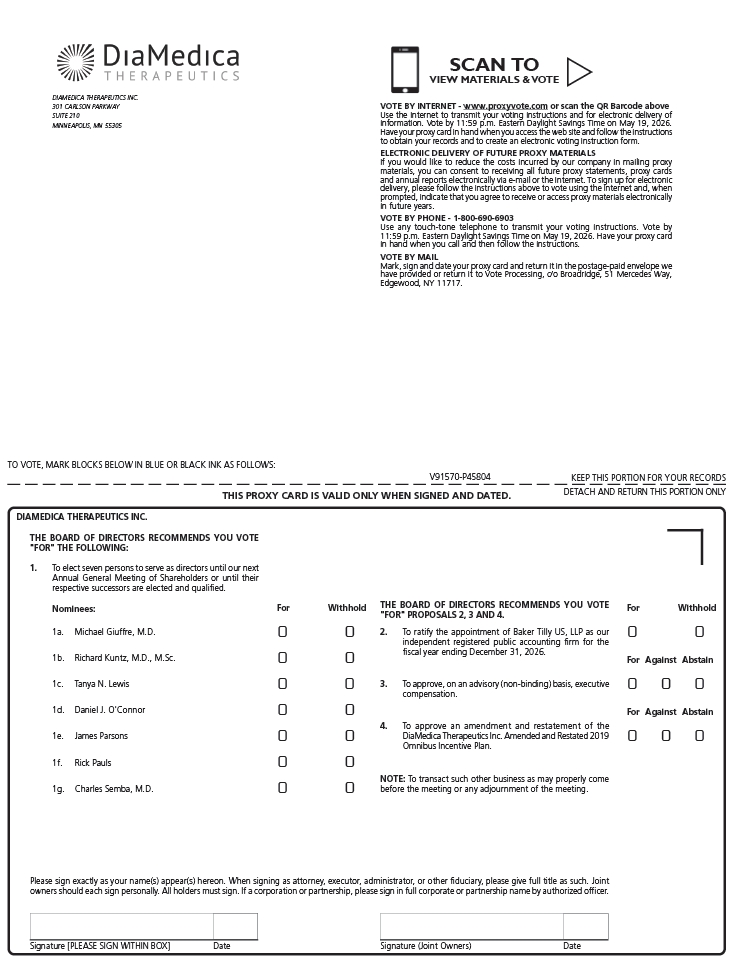
Voting your DiaMedica common shares is easily achieved without attending the meeting in person. Your proxy is important to ensure a quorum is present for the meeting. Even if you own only a few shares, and whether or not you expect to attend the meeting, please vote your shares voting over the Internet, by telephone, or by signing and returning a written proxy as quickly as possible. You may revoke your proxy at any time prior to its exercise, and voting by proxy will not affect your right to vote if you attend the meeting with appropriate documentation.
On behalf of the Board of Directors, we thank you for your participation, investment, and support.
Sincerely,
|
|
 |
|
James Parsons Chairman of the Board |
Rick Pauls President and Chief Executive Officer |
NOTICE OF ANNUAL GENERAL MEETING OF SHAREHOLDERS
to be held on
May 20, 2026
The Annual General Meeting of Shareholders of DiaMedica Therapeutics Inc., a corporation existing under the laws of British Columbia, will be held at our corporate offices located at 301 Carlson Parkway, Suite 210, Minneapolis, Minnesota 55305, USA, beginning at 9:00 a.m. CDT, on Wednesday, May 20, 2026, to receive the audited consolidated financial statements of DiaMedica Therapeutics Inc. for the fiscal year ended December 31, 2025, including a report of the independent registered public accounting firm, and for the following purposes:
|
(1) |
To elect seven directors; |
|
(2) |
To ratify the appointment of Baker Tilly US, LLP as our independent registered public accounting firm for the fiscal year ending December 31, 2026; |
|
(3) |
To approve, on an advisory (non-binding) basis, the compensation paid to our named executive officers; |
|
(4) |
To approve the amendment and restatement of the DiaMedica Therapeutics Inc. Amended and Restated 2019 Omnibus Incentive Plan to increase the number of shares available for issuance; and |
to transact such other business as may properly come before the meeting or any adjournment of the meeting.
Only those shareholders of record at the close of business on March 23, 2026, will be entitled to notice of, and to vote at, the meeting and any adjournments thereof.
|
By Order of the Board of Directors,
 Scott Kellen Corporate Secretary |
April 1, 2026
Minneapolis, Minnesota
DIAMEDICA THERAPEUTICS INC.
PROXY STATEMENT
Page
|
PROXY STATEMENT SUMMARY |
1 |
|
GENERAL INFORMATION ABOUT THE MEETING AND VOTING |
5 |
|
Date, Time, Place and Purposes of Meeting |
5 |
|
Who Can Vote |
5 |
|
How You Can Vote |
5 |
|
How Does the Board of Directors Recommend that You Vote |
6 |
|
How You May Change Your Vote or Revoke Your Proxy |
6 |
|
Quorum Requirement |
6 |
|
Vote Required |
7 |
|
Appointment of Proxyholders |
8 |
|
Other Business |
8 |
|
Procedures at the Meeting |
8 |
|
Householding of Meeting Materials |
8 |
|
Proxy Solicitation Costs |
8 |
|
PROPOSAL ONE—ELECTION OF DIRECTORS |
9 |
|
Board Size and Structure |
9 |
|
Information about Board, Nominees |
9 |
|
Additional Information about Board Nominees |
9 |
|
Penalties or Sanctions |
12 |
|
Corporate Cease Trade Orders or Bankruptcies |
12 |
|
Board of Directors Recommendation |
12 |
|
PROPOSAL TWO—RATIFICATION OF INDEPENDENT REGISTERED PUBLIC ACCOUNTING FIRM |
13 |
|
Effect of Proposal |
13 |
|
Board of Directors Recommendation |
13 |
|
PROPOSAL THREE— ADVISORY VOTE TO APPROVE EXECUTIVE COMPENSATION |
14 |
|
Background and Proposed Advisory Approval of Our Executive Compensation |
14 |
|
Why You Should Vote in Favor of our Say-on-Pay Vote |
14 |
|
Proposed Resolution |
14 |
|
Next Say-On-Pay Vote |
14 |
|
Effect of Proposal |
14 |
|
Board of Directors Recommendation |
15 |
|
PROPOSAL FOUR—AMENDMENT AND RESTATEMENT OF THE AMENDED AND RESTATED 2019 OMNIBUS INCENTIVE PLAN |
16 |
|
Background and Proposed Revisions |
16 |
|
Reasons Why You Should Vote in Favor of the Plan Amendment |
16 |
|
Summary of Sound Governance Features of the Amended 2019 Plan |
17 |
|
Background for Shares Authorized for Issuance |
17 |
|
Summary of Amended 2019 Plan Features |
19 |
| U.S. Federal Income Tax Information | 24 |
| Plan Benefits | 25 |
| Board of Directors Recommendation | 26 |
|
SECURITY OWNERSHIP OF PRINCIPAL SHAREHOLDERS AND MANAGEMENT |
27 |
|
CORPORATE GOVERNANCE |
28 |
|
Corporate Governance Guidelines |
28 |
|
Board Leadership Structure |
28 |
|
Director Independence |
29 |
|
Executive or In-Camera Sessions |
29 |
|
Board Committees |
29 |
|
Audit Committee |
30 |
|
Compensation Committee |
30 |
|
Nominating and Corporate Governance Committee |
32 |
|
Scientific and Clinical Research Committee |
32 |
|
Board and Committee Meetings |
33 |
|
Policy Regarding Director Attendance at Annual General Meetings of Shareholders |
33 |
|
Role of Board in Risk Oversight Process |
33 |
|
Director Qualifications and Nominations |
34 |
|
Code of Business Conduct and Ethics |
34 |
|
Complaint Procedures |
34 |
|
Process Regarding Shareholder Communications with Board of Directors |
35 |
|
Committee Charters and Other Governance Documents |
35 |
|
Delinquent Section 16(a) Reports |
35 |
|
Insider Trading Policy |
35 |
|
Audit and Non-Audit Fees |
35 |
|
Audit Committee Pre-Approval Policies and Procedures |
36 |
|
Report of the Audit Committee |
36 |
|
DIRECTOR COMPENSATION |
37 |
|
Cash Retainers |
37 |
|
Annual Stock Options |
37 |
|
Deferred Stock Units or Restricted Stock Units in Lieu of Annual Cash Retainers |
37 |
|
Director Compensation Table |
38 |
|
Director Indemnification |
38 |
|
EXECUTIVE COMPENSATION |
39 |
|
Summary Compensation Table |
46 |
|
Outstanding Equity Awards at Fiscal Year-End |
47 |
|
Pay Versus Performance Disclosure |
48 |
| Equity Compensation Plan Information | 50 |
|
Anti-Hedging and Pledging Policy |
51 |
|
RELATED PERSON RELATIONSHIPS AND TRANSACTIONS |
52 |
|
Related Party Transactions Disclosure |
52 |
|
Policies and Procedures for Related Party Transactions |
53 |
|
SHAREHOLDER PROPOSALS FOR THE NEXT ANNUAL GENERAL MEETING |
54 |
|
COPIES OF 2025 ANNUAL REPORT AND ADDITIONAL INFORMATION |
54 |
|
HOUSEHOLDING |
55 |
|
ADDITIONAL MATTERS |
55 |
| APPENDIX A - DIAMEDICA THERAPEUTICS INC. AMENDED AND RESTATED 2019 OMNIBUS INCENTIVE PLAN | A-1 |
DiaMedica Therapeutics Inc. is sometimes referred to as “DiaMedica,” “we,” “our” or “us” in this proxy statement.
The 2026 Annual General Meeting of Shareholders is sometimes referred to as the “Annual General Meeting,” “Annual Meeting” or “meeting” in this proxy statement.
Our Annual Report on Form 10-K for the fiscal year ended December 31, 2025 is sometimes referred to as our “2025 Annual Report” in this proxy statement.
Our voting common shares, no par value, are sometimes referred to as our “common shares” or “shares” in this proxy statement.
All dollar amounts in this proxy statement are expressed in United States currency unless otherwise noted.
PROXY STATEMENT SUMMARY
This summary provides an overview of the information included in this proxy statement. We recommend that you review the entire proxy statement and our Annual Report to Shareholders before voting.
2026 ANNUAL GENERAL MEETING OF SHAREHOLDERS
|
DATE AND TIME
Wednesday, May 20, 2026
LOCATION
DiaMedica Therapeutics Inc.
RECORD DATE
Holders of record of our common shares at the close of business on March 23, 2026 are entitled to notice of, to attend, and to vote at the 2026 Annual General Meeting. |
Voting Item |
Board’s Vote Recommendation |
Page |
|
Proposal One: |
FOR ALL |
9 |
|
|
Proposal Two: Independent Registered Public Accounting Firm |
FOR |
13 |
|
|
Proposal Three: Binding) Basis, of Executive Compensation |
FOR |
14 |
|
|
Proposal Four: DiaMedica Therapeutics Inc. Amended and Restated 2019 Omnibus Incentive Plan |
FOR |
16 |
Important Notice Regarding the Availability of Proxy Materials
for the Annual General Meeting of Shareholders to Be Held on May 20, 2026:
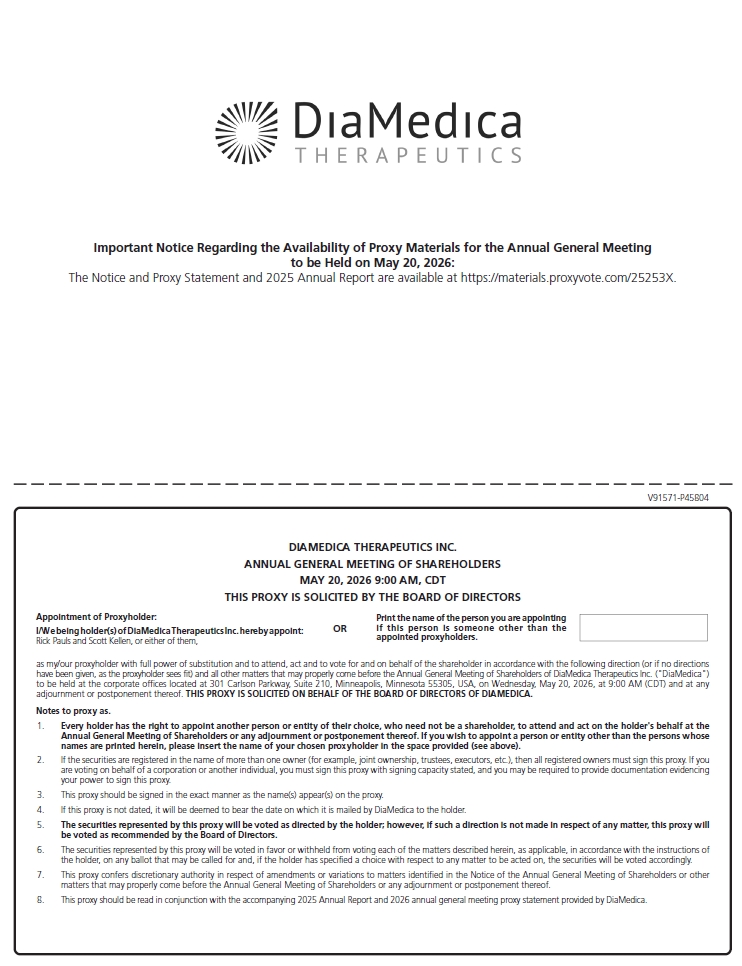
The Notice of Meeting, Proxy Statement, Annual Report to Shareholders, and Form of Proxy, are available at https://materials.proxyvote.com/25253X
On or about April 1, 2026, we expect to begin mailing the Notice of Internet Availability of Proxy Materials to shareholders of record as of March 23, 2026 and post our proxy materials on the website noted above.
CORPORATE GOVERNANCE HIGHLIGHTS
|
✔ Annual election of directors |
✔ Regular executive sessions |
|
✔ Majority of independent directors |
✔ No conflicts of interest |
|
✔ Independent Board Chairman |
✔ Access to independent advisors |
|
✔ Four fully independent Board committees |
✔ Independent compensation consultant |
|
✔ Recent Board refreshment efforts |
✔ Clawback policy |
|
✔ Recent Board leadership rotation |
✔ No guaranteed salary increases or bonuses |
|
✔ Corporate governance guidelines |
✔ No perquisites |
|
✔ Annual review of governance documents |
✔ No poison pill |
DIRECTOR NOMINEES
The following persons were nominated by the Board of Directors, upon recommendation of its Nominating and Corporate Governance Committee, for election by shareholders at the 2026 Annual General Meeting, each for a one-year term. Each is a current member of our Board of Directors.
|
Director |
Age |
Serving Since |
Audit Committee |
Compensation Committee |
Nominating & Corporate Governance Committee |
Scientific & Clinical Research Committee |
Independent Director |
|
Michael Giuffre, M.D. |
70 |
2010 |
Chair |
Member |
✔ |
||
|
Richard Kuntz, M.D., M.Sc. |
68 |
2023 |
Member |
Chair |
✔ |
||
|
Tanya Lewis |
55 |
2023 |
Member |
Member |
Member |
✔ |
|
|
Daniel O’Connor |
61 |
2025 |
Member |
Chair |
Member |
✔ |
|
|
James Parsons |
60 |
2015 |
Chair |
✔ |
|||
|
Rick Pauls |
54 |
2005 |
|||||
|
Charles Semba, M.D. |
66 |
2021 |
Member |
Member |
Member |
✔ |
The Board of Directors recommends a vote “FOR” each of these seven nominees.
SKILLS AND EXPERIENCES OF DIRECTOR NOMINEES
The matrix below summarizes what the Board of Directors believes are desirable types of skills and experiences possessed by DiaMedica’s director nominees because of their particular relevance to our Company’s business and strategy. While all of these were considered by the Board of Directors in connection with this year’s director nomination process, the following matrix does not encompass all skills and experiences of our director nominees.
|
Skills/Experiences |
Pauls |
Parsons |
Giuffre |
Kuntz |
Lewis |
O’Connor |
Semba |
|
Public Company CEO |
✔ |
✔ |
|||||
|
Public Company Sr. Executive |
✔ |
✔ |
✔ |
✔ |
✔ |
✔ |
|
|
Licensing, Bus. Dev., Mergers & Acquisitions |
✔ |
✔ |
✔ |
✔ |
✔ |
||
|
Strategic Planning |
✔ |
✔ |
✔ |
✔ |
✔ |
✔ |
✔ |
|
Clinical and Clinical Development |
✔ |
✔ |
✔ |
✔ |
✔ |
✔ |
|
|
Commercialization and Product Planning |
✔ |
✔ |
✔ |
✔ |
✔ |
||
|
Medical/Scientific/Research & Development |
✔ |
✔ |
✔ |
✔ |
|||
|
Pharmaceutical Industry |
✔ |
✔ |
✔ |
✔ |
✔ |
||
|
Regulatory and Quality |
✔ |
✔ |
✔ |
✔ |
✔ |
||
|
Reimbursement/Payer/Health Outcomes |
✔ |
✔ |
|||||
|
CFO/Financial Expertise and Accounting |
✔ |
✔ |
|||||
|
Capital Markets/Raising Additional Financing |
✔ |
✔ |
✔ |
||||
|
Public Company Governance |
✔ |
✔ |
✔ |
✔ |
✔ |
||
|
Investor Relations |
✔ |
✔ |
✔ |
✔ |
|||
|
Legal and Compliance/Ethics |
✔ |
||||||
|
Manufacturing/Operations |
✔ |
✔ |
✔ |
||||
|
International Experience |
✔ |
✔ |
✔ |
✔ |
✔ |
EXECUTIVE COMPENSATION BEST PRACTICES
Our compensation practices include many best practices that support our executive compensation objectives and principles and benefit our shareholders.
|
What We Do: |
What We Don’t Do: |
|
✔ Emphasize pay for performance |
✘ No guaranteed salary increases or bonuses |
|
✔ Significant portion of executive compensation is at risk |
✘ No repricing of stock options without shareholder approval |
|
✔ Maintain competitive pay packages |
✘ No liberal share counting under our equity plan |
|
✔ Pay significant portion of exec. compensation in equity |
✘ Hedging/pledging of DiaMedica securities prohibited |
|
✔ Maintain a clawback policy |
✘ No perquisites |
HOW WE PAY
Our executive compensation program consists of the following principal elements which are described under “Executive Compensation.”
|
● |
Base salary – a fixed amount, paid in cash and reviewed annually and, if appropriate, adjusted. |
|
● |
Short-term incentive – a variable, short-term element that is payable in cash and is based on annual corporate performance objectives and individual performance objectives. |
|
● |
Long-term incentive – a variable, long-term element that is provided in stock options. |
2025 EXECUTIVE COMPENSATION ACTIONS
Discussion of our executive compensation program in this proxy statement includes the compensation of the following executive officers required to be named in the Summary Compensation Table under “Executive Compensation” and referred to as our named executive officers (NEOs): (i) Rick Pauls, our Chief Executive Officer (CEO), (iii) Julie Krop, M.D., our Chief Medical Officer (CMO), and (iii) Scott Kellen, our Chief Financial Officer (CFO).
The following summarized compensation actions and incentive plan outcomes for our NEOs for the fiscal year ended December 31, 2025:
|
Element |
Key 2025 Actions |
|
Base Salaries |
CEO and CFO each received a base salary increase of 10%.
Julie Krop, M.D. joined DiaMedica as CMO on August 11, 2025 with an initial annual base salary of $525,000.
|
|
Short-Term Incentives |
CEO’s target short-term incentive opportunity was 50% of base salary.
CMO’s and CFO’s target short-term incentive opportunities were each 40% of base salary, respectively.
CEO and CFO target percentages of base salary were unchanged from the prior year.
|
|
Long-Term Incentives |
Our CEO and CFO each received a stock option award in June 2025, with 25% vesting on the one-year anniversary of the grant date and the remaining 75% vesting in 12 equal quarterly installments thereafter.
Dr. Krop received a stock option award on August 11, 2025 under our 2021 Employment Inducement Incentive Plan (the “Inducement Plan”), with 25% vesting on the one-year anniversary of the grant date and the remaining 75% vesting in 12 equal quarterly installments thereafter.
|
|
Other Compensation |
No changes were made to other components of our executive compensation program. |
301 Carlson Parkway, Suite 210,
Minneapolis, Minnesota 55305
PROXY STATEMENT FOR
ANNUAL GENERAL MEETING OF SHAREHOLDERS
May 20, 2026
The Board of Directors of DiaMedica Therapeutics Inc. is soliciting your proxy for use at the 2026 Annual General Meeting of Shareholders to be held on Wednesday, May 20, 2026. The Board of Directors expects to make available to our shareholders beginning on or about April 1, 2026 the Notice of Annual General Meeting of Shareholders, this proxy statement and a form of proxy on the Internet or have these materials sent to shareholders of DiaMedica upon their request.
GENERAL INFORMATION ABOUT THE MEETING AND VOTING
Date, Time, Place and Purposes of Meeting
The Annual General Meeting of Shareholders of DiaMedica Therapeutics Inc. will be held on Wednesday, May 20, 2026, at 9:00 a.m. CDT, at our corporate offices located at 301 Carlson Parkway, Suite 210, Minneapolis, Minnesota 55305, USA, for the purposes set forth in the Notice of Annual General Meeting of Shareholders.
Who Can Vote
Shareholders of record at the close of business on March 23, 2026 will be entitled to notice of and to vote at the meeting or any adjournment thereof. As of that date, there were 53,805,628 common shares outstanding. Each common share is entitled to one vote on each matter to be voted on at the meeting. Shareholders are not entitled to cumulate voting rights.
How You Can Vote
Your vote is important. Whether you hold shares directly as a shareholder of record or beneficially in “street name” (through a broker, bank or other nominee), you may vote your shares without attending the meeting. You may vote by granting a proxy or, for shares held in street name, by submitting voting instructions to your broker, bank or other nominee.
If you are a registered shareholder whose shares are registered in your name, you may vote your shares in person at the meeting or by one of the three following methods:
|
● |
Vote by Internet, by going to the website address http://www.proxyvote.com/25253X and following the instructions for Internet voting shown on the Notice of Internet Availability of Proxy Materials or on your proxy card. |
|
● |
Vote by Telephone, by dialing 1-800-690-6903 and following the instructions for telephone voting shown on the Notice of Internet Availability of Proxy Materials or on your proxy card. |
|
● |
Vote by Proxy Card, by completing, signing, dating and mailing the enclosed proxy card in the envelope provided if you received a paper copy of these proxy materials. |
If you vote by Internet or telephone, please do not mail your proxy card.
If your shares are held in “street name” (through a broker, bank or other nominee), you may receive a separate voting instruction form with this proxy statement or you may need to contact your broker, bank or other nominee to determine whether you will be able to vote electronically using the Internet or telephone.
The deadline for voting by telephone or by using the Internet is 11:59 p.m. EDT (10:59 p.m. CDT), on May 19, 2026, the day before the meeting. Please see the Notice of Internet Availability of Proxy Materials, your proxy card or the information your bank, broker or other nominee provided to you for more information on your options for voting.
If you return your signed proxy card or use Internet or telephone voting before the meeting, the named proxies will vote your shares as you direct.
If you return your proxy card or use Internet or telephone voting, but do not specify how you want to vote your shares, the proxies will vote your shares FOR all seven of the nominees for election to the Board of Directors in Proposal One—Election of Directors, FOR Proposal Two—Ratification of Appointment of Independent Registered Public Accounting Firm, FOR Proposal Three—Approval, on an Advisory Basis, of our Executive Compensation and FOR Proposal Four—Approval of the Amendment and Restatement of the DiaMedica Therapeutics Inc. Amended and Restated 2019 Omnibus Incentive Plan.
How Does the Board of Directors Recommend that You Vote
The Board of Directors unanimously recommends that you vote:
|
● |
FOR all seven of the director nominees; |
|
● |
FOR ratification of the appointment of Baker Tilly US, LLP as our independent registered public accounting firm; |
|
● |
FOR Proposal Three—Approval, on an Advisory Basis, of our Executive Compensation; and |
|
● |
FOR Proposal Four—Approval of the Amendment and Restatement of the DiaMedica Therapeutics Inc. Amended and Restated 2019 Omnibus Incentive Plan. |
How You May Change Your Vote or Revoke Your Proxy
If you are a shareholder whose shares are registered in your name, you may revoke your proxy at any time before it is voted at the meeting by one of the following methods:
|
● |
Submitting another proper proxy with a more recent date than that of the proxy first given by following the Internet or telephone voting instructions or completing, signing, dating and returning a proxy card to us; |
|
● |
Sending written notice of your revocation to our Corporate Secretary; or |
|
● |
Attending the meeting and voting by ballot. |
Quorum Requirement
The quorum for the transaction of business at the meeting is any number of shareholders who, in the aggregate, hold at least 33 and 1/3% of our issued common shares entitled to be voted at the meeting or 17,935,210 common shares. In general, our common shares represented by proxies marked “For,” “Withhold,” or “Abstain” are counted in determining whether a quorum is present. In addition, a “broker non-vote” is counted in determining whether a quorum is present. A “broker non-vote” is a proxy returned by a broker on behalf of its beneficial owner customer that is not voted on a particular matter because voting instructions have not been received by the broker from the customer and the broker has no discretionary authority to vote on behalf of such customer on such matter.
Vote Required
If your shares are held in “street name” and you do not indicate how you wish to vote, your broker is permitted to exercise its discretion to vote your shares only on certain “routine” matters.
Proposal One—Election of Directors is not a “routine” matter. Accordingly, if you do not direct your broker how to vote, your broker may not exercise discretion and may not vote your shares on this proposal. This is called a “broker non-vote” and although your shares will be considered to be represented by proxy at the meeting, they will not be considered to be “votes cast” at the meeting and will not be counted as having been voted on the proposal.
Proposal Two—Ratification of the appointment of Baker Tilly US, LLP as our independent registered public accounting firm is a “routine” matter and, as such, your broker is permitted to exercise its discretion to vote your shares for or withhold your vote from the proposal in the absence of your instruction.
Proposal Three—Approval, on an Advisory Basis, of our Executive Compensation, is not a “routine” matter. Accordingly, if you do not direct your broker how to vote, your broker may not exercise discretion and may not vote your shares on this proposal. This is called a “broker non-vote” and although your shares will be considered to be represented by proxy at the meeting, they will not be considered to be “votes cast” at the meeting and will not be counted as having been voted on the proposal.
Proposal Four—Approval of the Amendment and Restatement of the DiaMedica Therapeutics Inc. Amended and Restated 2019 Omnibus Incentive Plan is not a “routine” matter. Accordingly, if you do not direct your broker how to vote, your broker may not exercise discretion and may not vote your shares on this proposal. This is called a “broker non-vote” and although your shares will be considered to be represented by proxy at the meeting, they will not be considered to be “votes cast” at the meeting and will not be counted as having been voted on the proposal.
The table below indicates the vote required for each proposal and the effect of any votes withheld, abstentions and broker non-votes.
|
Proposal |
Votes Required |
Effect of |
Effect of |
Effect of |
|
Proposal One: |
Plurality of votes present in person or by proxy and entitled to vote on the election of directors |
Votes withheld will have no effect. |
Abstentions will have no effect. |
Broker non-votes will have no effect. |
|
Proposal Two: Independent Registered Public Accounting Firm |
Affirmative vote of a majority of votes cast on the proposal |
Votes against will count against the proposal. |
Abstentions will have no effect. |
We do not expect any broker non-votes on this proposal, but they will have no effect. |
|
Proposal Three: Approve Executive Compensation |
Affirmative vote of a majority of votes cast on the proposal |
Votes against will count against the proposal. |
Abstentions will have no effect. |
Broker non-votes will have no effect. |
|
Proposal Four: Restatement of 2019 Plan |
Affirmative vote of a majority of votes cast on the proposal |
Votes against will count against the proposal. |
Abstentions will have no effect. |
Broker non-votes will have no effect. |
Appointment of Proxyholders
The persons named in the accompanying proxy card are officers of DiaMedica.
A shareholder has the right to appoint a person or company to attend and act for the shareholder and on that shareholder’s behalf at the meeting other than the persons designated in the enclosed proxy card. A shareholder wishing to exercise this right should strike out the names now designated in the enclosed proxy card and insert the name of the desired person or company in the blank space provided. The desired person need not be a shareholder of DiaMedica.
Only a registered shareholder at the close of business on March 23, 2026 will be entitled to vote, or grant proxies to vote, his, her or its common shares, as applicable, at the meeting. If your common shares are registered in your name, then you are a registered shareholder. However, if, like most shareholders, you keep your common shares in a brokerage account, then you are a beneficial shareholder. The process for voting is different for registered shareholders and beneficial shareholders. Registered shareholders and beneficial shareholders should carefully read the instructions herein if they wish to vote their common shares at the meeting.
Other Business
Our management does not intend to present other items of business and knows of no items of business that are likely to be brought before the meeting, except those described in this proxy statement. However, if any other matters should properly come before the meeting, the persons named on the proxy card will have discretionary authority to vote such proxy in accordance with their best judgment on the matters.
Procedures at the Meeting
The presiding officer at the meeting will determine how business at the meeting will be conducted. Only matters brought before the meeting in accordance with our Amended and Restated Articles (“Articles”) will be considered. Only a natural person present at the meeting who is either one of our shareholders, or is acting on behalf of one of our shareholders, may make a motion or second a motion. A person acting on behalf of a shareholder must present a written statement executed by the shareholder or the duly-authorized representative of the shareholder on whose behalf the person purports to act.
Householding of Meeting Materials
Some banks, brokers and other nominee record holders may be participating in the practice of “householding” proxy statements, annual reports and the Notice of Internet Availability of Proxy Materials. This means that only one copy of this proxy statement, our Annual Report to Shareholders or the Notice of Internet Availability of Proxy Materials may have been sent to each household even though multiple shareholders are present in the household, unless contrary instructions have been received. We will promptly deliver a separate copy of any of these documents to any shareholder upon written or oral request to Corporate Secretary, DiaMedica Therapeutics Inc., 301 Carlson Parkway, Suite 210, Minneapolis, Minnesota 55305, telephone: (763) 496‑5454. Shareholders who want to receive separate copies of this proxy statement, our Annual Report to Shareholders or the Notice of Internet Availability of Proxy Materials in the future, or shareholders who are receiving multiple copies and would like to receive only one copy per household, should contact their bank, broker or other nominee record holder, or the shareholder may contact us at the above address and telephone number.
Proxy Solicitation Costs
The cost of soliciting proxies, including the preparation, assembly, electronic availability and mailing of proxies and soliciting material, as well as the cost of making available or forwarding this material to the beneficial owners of our common shares will be borne by DiaMedica. Our directors, officers and regular employees may, without compensation other than their regular compensation, solicit proxies by telephone, e-mail, facsimile or personal conversation. We may reimburse brokerage firms and others for expenses in making available or forwarding solicitation materials to the beneficial owners of our common shares.
PROPOSAL ONE—ELECTION OF DIRECTORS
Board Size and Structure
Our Articles provide that the Board of Directors will consist of at least three members. The size of the Board of Directors is currently fixed at seven and the Board of Directors currently consists of seven directors.
Each director is elected annually by the shareholders and serves for a term that will end at the next annual general meeting of shareholders.
Information about Board, Nominees
The Board of Directors has nominated the following seven individuals to serve as our directors until the next annual general meeting of shareholders or until their respective successors are elected and qualified. All of the nominees for director named below are current members of the Board of Directors.
|
Director |
Age |
Serving Since |
Audit Committee |
Compensation Committee |
Nominating & Corporate Governance Committee |
Scientific & Clinical Research Committee |
Independent Director |
|
Michael Giuffre, M.D. |
70 |
2010 |
Chair |
Member |
✔ |
||
|
Richard Kuntz, M.D., M.Sc. |
68 |
2023 |
Member |
Chair |
✔ |
||
|
Tanya Lewis |
55 |
2023 |
Member |
Member |
Member |
✔ |
|
|
Daniel O’Connor |
61 |
2025 |
Member |
Chair |
Member |
✔ |
|
|
James Parsons |
60 |
2015 |
Chair |
✔ |
|||
|
Rick Pauls |
54 |
2005 |
|||||
|
Charles Semba, M.D. |
66 |
2021 |
Member |
Member |
Member |
✔ |
Additional Information about Board Nominees
The following paragraphs provide information about each current director and nominee for director, including all positions held, principal occupation and business experience for the past five years, and the names of other publicly-held companies of which the director or nominee currently serves as a director or has served as a director during the past five years. We believe that all of our directors and nominees display personal and professional integrity; satisfactory levels of education and/or business experience; broad-based business acumen; an appropriate level of understanding of our business and its industry and other industries relevant to our business; the ability and willingness to devote adequate time to the work of the Board of Directors and its committees; a fit of skills and personality with those of our other directors that helps build a board that is effective, collegial and responsive to the needs of our Company; strategic thinking and a willingness to share ideas; a diversity of experiences, expertise and background; and the ability to represent the interests of all of our shareholders. The information presented below regarding each director and nominee also sets forth specific experience, qualifications, attributes and skills that led the Board of Directors to the conclusion that such individual should serve as a director in light of our business and structure.
James Parsons has served as Chair of the Board of Directors since January 1, 2025 and as a member of the Board of Directors since October 2015. Mr. Parsons served as our Vice President of Finance from October 2010 until May 2014. Mr. Parsons currently serves as Chief Financial Officer of Sernova Biotherapeutics Inc., a TSX listed biotechnology company, a position he has held since October 2024. Prior to Sernova, Mr. Parsons served as Chief Financial Officer and Corporate Secretary of Trillium Therapeutics Inc., a Nasdaq-listed immuno-oncology company, from August 2011 until its acquisition by Pfizer in November 2021, at which time he became employed by Pfizer Canada ULC until March 2022. Mr. Parsons serves as a member of the board of directors and audit committee of Oncolytics Biotech Inc., a Nasdaq/TSX listed company, and previously served on the board of directors and chair of both the audit committee and nominating and corporate governance committee of Sernova Biotherapeutics Inc. Mr. Parsons has been a Chief Financial Officer in the life sciences industry since 2000 with experience in financing, investor relations, governance, strategic planning and administration. Mr. Parsons has a Master of Accounting degree from the University of Waterloo and is a Chartered Professional Accountant and Chartered Accountant. Mr. Parsons is a resident of Ontario, Canada.
We believe that Mr. Parsons’ financial experience, including his history and knowledge of our Company, enable him to make valuable contributions to the Board of Directors.
Rick Pauls was appointed our President and Chief Executive Officer in January 2010. Mr. Pauls has served as a member of the Board of Directors since April 2005 and served as Chairman of the Board from April 2008 to July 2014. Prior to joining DiaMedica, Mr. Pauls was the Co-Founder and Managing Director of CentreStone Ventures Inc., a life sciences venture capital fund, from February 2002 until January 2010. Mr. Pauls was an analyst for Centara Corporation, another early-stage venture capital fund, from January 2000 until January 2002. From June 1997 until November 1999, Mr. Pauls worked for General Motors Acceptation Corporation specializing in asset-backed securitization and structured finance. Mr. Pauls previously served as an independent member of the board of directors of LED Medical Diagnostics, Inc. Mr. Pauls received his Bachelor of Arts in Economics from the University of Manitoba and his MBA in Finance from the University of North Dakota. Mr. Pauls is a resident of Minnesota, USA.
We believe that Mr. Pauls’ experience in the biopharmaceutical industry as an executive and investor and his extensive knowledge of all aspects of our Company, business, industry, and day-to-day operations as a result of his role as our President and Chief Executive Officer enable him to make valuable contributions to the Board of Directors. In addition, as a result of his role as President and Chief Executive Officer, Mr. Pauls provides unique insight into our future strategies, opportunities and challenges, and serves as the unifying element between the leadership and strategic direction provided by the Board of Directors and the implementation of our business strategies by management.
Michael Giuffre, M.D. has served as a member of the Board of Directors since August 2010. Since July 2009, Dr. Giuffre has served as a Clinical Professor of Cardiac Sciences and Pediatrics at the University of Calgary and has had an extensive portfolio of clinical practice, cardiovascular research and university teaching. Dr. Giuffre is actively involved in health care delivery, medical leadership and in the biotechnology business sector. From 2012 to October 2019, Dr. Giuffre served as Chief Scientific Officer and President of FoodChek Laboratory, a global developer and provider of proprietary rapid and accurate food safety tests for the detection of foodborne and environmental pathogens and other microorganisms, and also as a member of the board of directors of FoodChek Systems Inc. From November 2017 to October 2019, he served as FoodChek Systems Inc.’s Chairman of the Board. Dr. Giuffre previously served on the board of directors of the Canadian Medical Association (CMA), Unicef Canada, the Alberta Medical Association (AMA), Can-Cal Resources Ltd, Vacci-Test Corporation, IC2E International Inc., MedMira Inc. and Brightsquid Dental, Inc. Dr. Giuffre has received a Certified and Registered Appointment and a Distinguished Fellow appointment by the American Academy of Cardiology. In 2005, he was awarded Physician of the Year by the Calgary Medical Society and in 2017 was “Mentor of the Year” for the Royal College of Physicians and Surgeons of Canada. Dr. Giuffre was also a former President of the AMA and the Calgary and Area Physicians Association and also a past representative to the board of the Calgary Health Region. Dr. Giuffre holds a Bachelor of Science in cellular and microbial biology, a Ph.D. candidacy in molecular virology, an M.D. and an M.B.A. He is Canadian Royal College board certified FRCPS in specialties that include Pediatrics and Pediatric Cardiology and has a subspecialty in Pediatric Cardiac Electrophysiology. Dr. Giuffre is currently a member of the board of directors of Avenue Living (AL) Asset Management, a private real estate company in Alberta, Canada and its affiliates, AL Real Estate Opportunity Trust and AgriSelect Trust. Dr. Giuffre is currently vice chair of the Parks Foundation Calgary Board of Governors, board chair of BrightSquid Secure Communications Inc. and a consultant for the Palix Foundation, Calgary, Alberta Canada. Dr. Giuffre is a resident of Alberta, Canada.
We believe that Dr. Giuffre’s medical experience, including as a practicing physician and professor, enable him to make valuable contributions to the Board of Directors.
Richard Kuntz, M.D., M.Sc. has served as a member of our board of directors since May 2023. Dr. Kuntz retired from Medtronic plc (NYSE:MDT) in April 2022, a global medical device company, where he was the Chief Medical Officer & Scientific Officer and a member of the Executive Committee. Prior to that, he served as Senior Vice President and President, Neuromodulation of Medtronic from October 2005 to August 2009. Before joining Medtronic, he was the founder and Chief Scientific Officer of the Harvard Clinical Research Institute in Boston. He also served as an Associate Professor of Medicine at Harvard Medical School, Chief of the Division of Clinical Biometrics, and as an Interventional Cardiologist in the division of cardiovascular diseases at the Brigham and Women’s Hospital in Boston. In addition, he served as a founding Governor of the Patient Centered Outcomes Research Institute (PCORI), as part of the US Affordable Care Act. He also served as an advisor to multiple national and regional committees, in the National Academy of Medicine and National Institutes of Health (NIH). He is presently serving as a working group member of NIH’s Helping to End Addiction Long-term® (HEAL) program. Dr. Kuntz serves as a member of the board of directors of ZimVie Inc. and IDENTIV, INC., which are Nasdaq listed companies. Dr. Kuntz has directed numerous multicenter clinical trials and has authored more than 250 original publications. His major interests are traditional and alternative clinical trial design and biostatistics. Dr. Kuntz graduated from Miami University and received his medical degree from Case Western Reserve University School of Medicine. He completed his residency and chief residency in internal medicine at the University of Texas Southwestern Medical School, Parkland Hospital, Dallas, and then completed fellowships in cardiovascular diseases and interventional cardiology at the Beth Israel Hospital and Harvard Medical School, Boston. Dr. Kuntz received his Master of Science in biostatistics from the Harvard T.H. Chan School of Public Health.
We believe that Dr. Kuntz’s experience in the pharmaceutical industry, particularly his demonstrated leadership skills relating to medical advancements in neurology and his deep expertise in stroke treatments, enable him to make valuable contributions to the Board of Directors.
Tanya Lewis has served as a member of the Board of Directors since March 2023. Ms. Lewis served as the Chief Development Operations Officer at Replimune Group, Inc., a Nasdaq listed clinical-stage biotechnology company, from May 2021 to April 2024 and from November 2020 to May 2021, served as a director of Replimune Group, Inc. Ms. Lewis served as Executive Vice President, Chief Regulatory Officer and Quality Officer at Karyopharm Therapeutics Inc., a pharmaceutical company, from November 2019 to May 2021, and previously served as Senior Vice President, Regulatory and Quality Affairs from November 2018 to November 2019. Ms. Lewis is also a former director of Karyopharm Therapeutics Inc. Prior to joining Karyopharm Therapeutics Inc., Ms. Lewis served as Vice President, Regulatory and Quality Affairs for Syros Pharmaceuticals, Inc., a pharmaceutical company, from January 2017 to July 2018. Prior to joining Syros Pharmaceuticals, Ms. Lewis served as Vice President, Regulatory Affairs and Quality Assurance for Idera Pharmaceuticals, Inc., a pharmaceutical company, from October 2015 to December 2016. Before joining Idera Pharmaceuticals, Ms. Lewis served as Vice President, Regulatory Affairs for Tesaro, Inc., a pharmaceutical company, from October 2011 to June 2015 and prior to that served in various roles at Millennium Pharmaceuticals. Inc. Ms. Lewis serves as a member of the board of directors of Sernova Corp, a TSX listed biotech company. Ms. Lewis holds a Bachelor of Science degree in Biology from Northeastern University and a Master of Science degree in Regulatory Affairs and Health Policy from Massachusetts College of Pharmacy and Allied Health Science.
We believe that Ms. Lewis’ experience in the pharmaceutical industry, particularly in drug development and commercial planning for specialty biopharmaceuticals, enable her to make valuable contributions to the Board of Directors.
Daniel O’Connor was elected as a director of DiaMedica on February 20, 2025. Since December 1, 2025, Mr. O’Connor has served as the Chief Executive Officer of Jubilant Therapeutics. Mr. O’Connor previously served as President and Chief Executive Officer and a member of the board of directors of Ambrx Biopharma Inc. (Nasdaq: AMAM), a clinical-stage biotechnology company, from November 2022 through its acquisition by Johnson & Johnson in March 2024. From June 2021 to December 2022, Mr. O’Connor served as Chief Executive Officer and Chairman of the Board of Larkspur Health Acquisition Corp., a special purpose acquisition company which merged with and is now known as ZyVersa Therapeutics, Inc. (Nasdaq: ZVSA). Mr. O’Connor continued to serve on the board of directors of ZyVersa until May 2023. From September 2017 to June 2021, Mr. O’Connor served as President and Chief Executive Officer and a member of the board of directors of OncoSec Medical Incorporated, a cancer immunotherapy company. Prior to OncoSec, Mr. O’Connor served as President and Chief Executive Officer and a member of the board of directors of Advaxis, Inc., a cancer immunotherapy company, from January 2013 until July 2017. Prior to Advaxis, Mr. O’Connor held several positions in senior leadership, including Senior Vice President and General Counsel for Bracco Diagnostics Inc., a diagnostic imaging company; Assistant General Counsel, Chief Compliance Officer and Consultant for NPS Pharmaceuticals, Inc., a pharmaceutical company; Senior Vice President, General Counsel and Secretary for ImClone Systems Incorporated, a biopharmaceutical company; and General Counsel at PharmaNet (formerly inVentiv Health, now Syneos Health), a clinical research company. He previously served as a member of the board of directors of Seelos Therapeutics Inc. from January 2019 to May 2024 and as Vice Chairman and member of the board of trustees of BioNJ from March 2016 to November 2021. In October 2017, Mr. O’Connor was appointed to the New Jersey Biotechnology Task Force by its Governor. Prior to his career in biotechnology and drug development, Mr. O’Connor was a former criminal prosecutor in Somerset County, New Jersey. Mr. O’Connor holds a Juris Doctor degree from the Pennsylvania State University’s Dickinson School of Law and previously served as a Trusted Advisor to its Dean. He graduated from the United States Marines Corps Officer Candidate School and was commissioned as an officer in the U.S. Marines, attaining the rank of Captain. Mr. O’Connor volunteered to serve and was deployed to Saudi Arabia in advance of and during Operation Desert Shield.
We believe that the breadth and depth of Mr. O’Connor’s experience in the biopharmaceutical industry and his recent experience as Chief Executive Officer of several biotech companies, as well as other positions in senior management, enable him to make valuable contributions to the Board of Directors.
Charles Semba, M.D. has served as a member of the Board of Directors since July 2021. Dr. Semba has over 25 years of drug-development experience in public and venture-funded biotechnology companies. Since June 2020, Dr. Semba has served as the Chief Medical Officer of Eluminex Biosciences, a biotechnology company focused on ophthalmics and dermal/facial aesthetics; the retinal ophthalmics pipeline was recently acquired by Roche/Genentech in September 2025. From June 2016 to March 2020, Dr. Semba served as the Chief Medical Officer of Graybug Vision, Inc., a clinical-stage biopharmaceutical company focused on developing transformative medicines for the treatment of chronic diseases of the retina and optic nerve, and from June 2014 to June 2016, Dr. Semba served as the Chief Medical Officer of ForSight VISION5 (acquired by Allergan), a company focused on developing non-invasive products that replace eye drops and provide sustained therapy for major eye diseases, including glaucoma, dry eye, and allergy. Prior to his work at ForSight VISION5, Dr. Semba held senior positions at biopharmaceutical companies including Genentech (a Roche company) and Shire (acquired by Takeda). Additionally, since 1992, Dr. Semba has served as an adjunct professor of vascular and interventional radiology at the Stanford University School of Medicine. Dr. Semba holds a Bachelor of Arts in Chemistry from Carleton College and an M.D. from the University of Minnesota Medical School and is a recognized expert in endovascular therapy, thrombolysis, mechanical thrombectomy, and endovascular surgery. Dr. Semba is currently a resident of California, USA.
We believe that Dr. Semba’s experience in the biotechnology and biopharmaceutical industries, particularly in drug development and clinical-stage companies, enable him to make valuable contributions to the Board of Directors.
Penalties or Sanctions
To the knowledge of the Board of Directors and our management, none of our directors as of the date of this proxy statement is or has been subject to:
|
● |
any penalties or sanctions imposed by a court relating to a securities legislation or by a securities regulatory authority or has entered in a settlement agreement with a securities regulatory authority; or |
|
● |
any other penalties or sanctions imposed by a court or regulatory body that would likely be considered important to a reasonable security holder in deciding whether to vote for a director nominee. |
Corporate Cease Trade Orders or Bankruptcies
To the knowledge of the Board of Directors and our management, none of our directors or director nominees as of the date of this proxy statement is or has been, within 10 years before the date of this proxy statement, a director, chief executive officer or chief financial officer of any company (including DiaMedica) that, while that person was acting in that capacity:
|
● |
was subject to a cease trade or similar order or an order that denied the relevant company access to any exemption under securities legislation, for a period of more than 30 consecutive days; or |
|
● |
was subject to an event that resulted, after the director, chief executive officer or chief financial officer ceased to be a director, chief executive officer, or chief financial officer, in DiaMedica being the subject of a cease trade or similar order or an order that denied the relevant company access to any exemption under securities legislation, for a period of more than 30 consecutive days; or |
|
● |
within a year after the director, chief executive officer, or chief financial officer ceased to be a director, chief executive officer or chief financial officer of DiaMedica, became bankrupt, made a proposal under any legislation relating to bankruptcy or insolvency, or was subject to or instituted any proceedings, arrangement, or compromise with creditors, or had a receiver, receiver manager or trustee appointed to hold its assets or the assets of the proposed director. |
Board of Directors Recommendation
The Board of Directors unanimously recommends a vote FOR the election of all seven nominees named above.
|
The Board of Directors Recommends a Vote FOR Each Nominee for Director |
☑ |
PROPOSAL TWO—RATIFICATION OF INDEPENDENT REGISTERED PUBLIC ACCOUNTING FIRM
The firm of Baker Tilly US, LLP has served as our independent registered public accounting firm since April 27, 2018. The Audit Committee of the Board of Directors appoints our independent registered public accounting firm and fixes its remuneration. In this regard, the Audit Committee evaluates the qualifications, performance and independence of our independent registered public accounting firm and determines whether to re-engage our current independent registered public accounting firm. As part of its evaluation, the Audit Committee considers, among other factors, the quality and efficiency of the services provided by the firm, including the performance, technical expertise and industry knowledge of the lead audit partner and the audit team assigned to our account; the overall strength and reputation of the firm; its capabilities relative to our business; and its knowledge of our operations. Upon consideration of these and other factors, the Audit Committee has selected Baker Tilly US, LLP to serve as our independent registered public accounting firm for the fiscal year ending December 31, 2026 and recommends that shareholders vote in favor of this Proposal to evidence their ratification of such appointment.
We anticipate that representatives of Baker Tilly US, LLP will be present at the meeting to respond to appropriate questions. They also will have the opportunity to make a statement if they wish to do so.
Effect of Proposal
In the event of a negative vote on this Proposal, our Audit Committee would reconsider its selection.
Board of Directors Recommendation
The Board of Directors unanimously recommends that shareholders vote FOR ratification of the appointment of Baker Tilly US, LLP, as our independent registered public accounting firm for the fiscal year ending December 31, 2026.
|
The Board of Directors Unanimously Recommends a Vote FOR this Proposal Two |
☑ |
PROPOSAL THREE— ADVISORY VOTE TO APPROVE EXECUTIVE COMPENSATION
Background and Proposed Advisory Approval of Our Executive Compensation
Our Board of Directors is providing our shareholders with an advisory vote on our executive compensation pursuant to the Dodd-Frank Wall Street Consumer Protection Act, or Dodd-Frank Act, and Section 14A of the Securities Exchange Act of 1934, as amended (Exchange Act). This advisory vote, commonly known as a say-on-pay vote, is a non-binding vote on the compensation paid to our named executive officers as identified pursuant to Item 402 of Regulation S-K, as set forth in the “Executive Compensation” section of this proxy statement, including in the accompanying compensation tables and the corresponding narrative discussion and footnotes. Approximately 94% of the votes cast were in favor of our say-on-pay proposal at last year’s Annual General Meeting of Shareholders.
Why You Should Vote in Favor of our Say-on-Pay Vote
The “Executive Compensation” section of this proxy statement describes our 2025 executive compensation program and the executive compensation decisions made by our Compensation Committee in more detail. Our executive compensation policies, plans and programs seek to enhance our financial performance, and thus shareholder value, by aligning the financial interests of our executives with those of our shareholders and by emphasizing pay-for-performance.
Our compensation practices include many best pay practices that support our executive compensation objectives and principles, and benefit our shareholders.
|
What We Do: |
What We Do not Do: |
|
✔ Emphasize pay for performance |
✘ No guaranteed salary increases or bonuses |
|
✔ Significant portion of executive compensation is at risk |
✘ No repricing of stock options without shareholder approval |
|
✔ Maintain competitive pay packages |
✘ No liberal share counting under our equity plan |
|
✔ Pay significant portion of exec. compensation in equity |
✘ Hedging/pledging of DiaMedica securities prohibited |
|
✔ Maintain a clawback policy |
✘ No perquisites |
Proposed Resolution
Our Board recommends that our shareholders vote in favor of our advisory vote on our executive compensation as set forth in the following resolution:
RESOLVED, that our shareholders approve, on an advisory basis, the compensation paid to the Company’s named executive officers, as disclosed pursuant to the compensation disclosure rules of the SEC.
Shareholders are not ultimately voting to approve or disapprove the recommendation of our Board. As this is an advisory vote, the outcome of the vote is not binding on us with respect to future executive compensation decisions, including those relating to our named executive officers, or otherwise.
Next Say-On-Pay Vote
Consistent with the results of the advisory vote on the frequency of the say-on-pay vote held at the 2024 Annual General Meeting of Shareholders, the Board determined that we will conduct a say-on-pay vote on an annual basis. Accordingly, the next say-on-pay vote will occur at our annual general meeting of shareholders to be held in 2027.
Because a frequency of say-on-pay vote must be conducted every six years, we expect to conduct the next frequency of say-on-pay vote at our annual general meeting of shareholders to be held in 2030.
Effect of Proposal
The final decision on the compensation and benefits of our executive officers and on whether, and if so, how, to address any shareholder disapproval remains with the Board and the Compensation Committee. The Board believes that the Compensation Committee is in the best position to consider the extensive information and factors necessary to make independent, objective, and competitive compensation recommendations and decisions that are in the best interest of our Company and our shareholders.
The Board values the opinions of our shareholders as expressed through their votes and other communications. Although the resolution is non-binding, the Board and the Compensation Committee will carefully consider the outcome of the advisory vote on executive compensation and shareholder opinions received from other communications when making future compensation decisions.
Board of Directors Recommendation
The Board of Directors unanimously recommends that our shareholders vote FOR approval, on an advisory basis, of our executive compensation, or say-on-pay vote.
|
The Board of Directors Recommends a Vote FOR this Proposal Three. |
☑ |
PROPOSAL FOUR—AMENDMENT AND RESTATEMENT OF
THE AMENDED AND RESTATED 2019 OMNIBUS INCENTIVE PLAN
Background and Proposed Revisions
On March 16, 2026, the Board of Directors, upon recommendation of the Compensation Committee, adopted, subject to approval by our shareholders, an amendment and restatement of the DiaMedica Therapeutics Inc. Amended and Restated 2019 Omnibus Incentive Plan (the “2019 Plan”) to increase the number of shares available for issuance by an additional 3,500,000 shares and extend the term of the 2019 Plan for ten years. We refer to the amendments as the “Plan Amendment” and the restated plan incorporating the Plan Amendment as the “Amended 2019 Plan” throughout this proxy statement. Our continuing ability to offer equity incentive awards under the plan is critical to our ability to attract, motivate and retain qualified personnel, particularly as we grow and in light of the highly competitive markets for employee talent in which we operate.
If our shareholders approve the Plan Amendment, it will become effective as of the date of shareholder approval. If our shareholders do not approve the Plan Amendment, then the current plan, as currently in effect, will remain in effect until it terminates in accordance with its terms.
Reasons Why You Should Vote in Favor of the Plan Amendment
The Board recommends a vote “FOR” approval of the Plan Amendment because the Board believes the proposed Plan Amendment is in the best interests of DiaMedica and our shareholders for the following reasons:
|
● |
Attracts and retains talent. Talented, motivated and effective employees, non-employee directors and consultants are essential to executing our business strategy. Share-based compensation and short-term incentive compensation payable in cash have been an important component of total compensation for our executive officers and key employees for years because such compensation enables us to effectively recruit and retain qualified individuals while encouraging them to think and act like owners of DiaMedica. If our shareholders approve the Plan Amendment, we believe we will maintain our ability to offer competitive compensation packages to both attract new talent and retain our best performers in a manner that is broad-based and preserves cash resources. |
|
● |
Consistent with our pay-for-performance compensation philosophy to increase shareholder value. We believe that share-based compensation, by its very nature, is performance-based compensation. Over time, the most significant component of total compensation for our executives is incentive compensation in the form of both share-based and cash-based incentives that are tied to the achievement of business results. We use incentive compensation both to reinforce desired business results for our key employees and to motivate them to achieve those results. By the nature of the vehicle, option recipients only receive value by creating future value for shareholders from the point of receipt. |
|
● |
Aligns director, employee and shareholder interests. We currently provide long-term incentives in the form of stock options to eligible employees, our non-employee directors, and consultants. Additionally, we provide our non-employee directors the opportunity to elect to receive deferred stock units (DSUs) or restricted stock units (RSUs) in lieu of up to 100% of their annual cash retainers. We believe our share-based compensation programs and our short-term incentives payable in cash help align the interests of our non-employee directors and employees with those of our shareholders. |
|
● |
Protects shareholder interests and embraces sound share-based compensation practices. As described in more detail below under the heading “-Summary of Sound Governance Features of the Amended 2019 Plan,” the Amended 2019 Plan includes a number of features that are consistent with protecting the interests of our shareholders and sound corporate governance practices. |
Summary of Sound Governance Features of the Amended 2019 Plan
The Board and Compensation Committee believe that the Amended 2019 Plan contains several features that are consistent with protecting the interests of our shareholders and sound corporate governance practices, including the following:
|
✔ No automatic share replenishment or “evergreen” provision ✔ Will not be excessively dilutive to our shareholders ✔ Cash-denominated limit on non-employee director compensation, including awards granted under the Amended 2019 Plan ✔ No reload stock options or SARs ✔ No liberal share counting or “recycling” of shares from exercised stock options, SARs, or other stock-based awards ✔ No liberal definition of change in control |
✔ No re-pricing of “underwater” stock options or stock appreciation rights (“SARs”) without shareholder approval ✔ No discounted stock options or SARs ✔ No tax gross-ups ✔ Clawback provision ✔ No dividends or dividend equivalents on stock options, SARs or performance awards; dividends and dividend equivalents on other types of awards are subject to the same restrictions as the underlying awards |
Background for Shares Authorized for Issuance
If the Plan Amendment is approved, the maximum number of common shares available for issuance under the Amended 2019 Plan will be increased by 3,500,000 to a total of 10,500,000 shares. In determining the total number of shares available under the Amended 2019 Plan, the Board and Compensation Committee considered a number of factors, which are discussed further below, including:
|
● |
Shares remaining available under the current plan, total outstanding equity-based awards and how long the remaining shares are expected to last; |
|
● |
Historical and anticipated equity award granting practices, including our three-year average share usage (commonly referred to as “burn rate”); and |
|
● |
Potential dilution and overhang. |
Shares Available and Outstanding Equity Awards
While the use of long-term incentives in the form of equity awards is an important part of our compensation program, we are mindful of our responsibility to our shareholders to exercise judgment in the granting of equity awards. In setting the number of shares available for issuance under the Amended 2019 Plan, the Board and Compensation Committee considered shares remaining available under the current plan, total outstanding equity awards, and how long the remaining shares available under the current plan are expected to last. To facilitate approval of the Plan Amendment, set forth below under “-Potential Dilution” is information about our common shares that may be issued under our equity compensation plans as of March 23, 2026.
Historical Equity Award Granting Practices
In setting the number of common shares authorized for issuance under the Amended 2019 Plan, the Board and Compensation Committee also considered the historical number of equity awards granted under the current plan and other equity compensation plans in the past three full fiscal years. The following table sets forth information regarding awards granted, including DSUs and RSUs received by non-employee directors in lieu of cash director fees, and the annual burn rate for each of the last three fiscal years.
|
2025 |
2024 |
2023 |
|
|
Stock options granted |
3,443,416 |
1,808,425 |
1,132,515 |
|
DSUs granted |
37,171 |
70,981 |
107,841 |
|
RSUs granted |
35,215 |
23,660 |
17,156 |
|
Weighted average common shares outstanding |
46,980,777 |
40,404,681 |
32,566,723 |
|
Burn rate |
7.5% |
4.7% |
3.9% |
The Board and Compensation Committee also considered our three-year average burn rate (2023 to 2025) of approximately 5.3%. Based on historical and anticipated granting practices and the recent trading price of our common shares, we expect the additional shares available for issuance under the Plan Amendment to cover awards for approximately three years. However, we cannot predict our future equity grant practices, the future price of our shares, or future hiring activity with any degree of certainty at this time, and the share increase provided by the Plan Amendment could last for a shorter or longer period of time.
Potential Dilution
In setting the number of common shares authorized for issuance under the Amended 2019 Plan, the Board and Compensation Committee also considered potential dilution that would result from approval of the Plan Amendment, including the policies of certain institutional investors and major proxy advisory firms.
Dilution and overhang are set forth in the table below, as of March 23, 2026, and assuming the Plan Amendment is approved.
|
Before |
After |
|
|
Outstanding Equity Awards |
||
|
Shares Underlying Options |
6,568,221 |
6,568,221 |
|
Weighted Average Exercise Price |
$4.20 |
$4.20 |
|
Weighted Average Remaining Term |
7.1 years |
7.1 years |
|
Shares Underlying DSUs |
190,785 |
190,785 |
|
Shares Underlying RSUs |
3,355 |
3,355 |
|
Total Shares Subject to Outstanding Equity Awards |
6,762,361 |
6,762,361 |
|
Common Shares Outstanding |
53,805,628 |
53,805,628 |
|
Dilution(a) |
12.6% |
12.6% |
|
Shares Available for Future Grants Under:(b) |
||
|
2019 Omnibus Incentive Plan |
1,212,416 |
4,712,416 |
|
2021 Employment Inducement Incentive Plan |
603,125 |
603,125 |
|
Total Shares Available for Future Grants |
1,815,541 |
5,315,541 |
|
Overhang(c) |
15.9% |
22.4% |
|
(a) |
Dilution is the number of shares subject to equity awards outstanding as of March 23, 2026, divided by the number of common shares outstanding as of March 23, 2026. |
|
(b) |
No further shares may be granted from the Deferred Share Unit Plan (“DSU Plan”) or the Amended and Restated Stock Option Plan (“Prior Plan”). |
|
(c) |
Overhang consists of the number of shares subject to equity awards outstanding as of March 23, 2026 and the number of shares available for future grant under our equity plans divided by the number of common shares outstanding as of March 23, 2026. |
Summary of Amended 2019 Plan Features
The major features of the Amended 2019 Plan are summarized below. Other than increasing the number of common shares available for issuance and extending the term of the 2019 Plan, the Amended 2019 Plan is unchanged from the current plan. The summary is qualified in its entirety by reference to the full text of the Amended 2019 Plan, a copy of which is attached as Appendix A to this proxy statement.
|
Purpose |
The purpose of the Amended 2019 Plan is to advance the interests of DiaMedica and our shareholders by enabling DiaMedica and our subsidiaries to attract and retain qualified individuals to perform services, provide incentive compensation for such individuals in a form that is linked to the growth and profitability of DiaMedica and increases in shareholder value. As such, the Amended 2019 Plan provides opportunities for equity participation that align the interests of recipients with those of our shareholders. |
|
Plan Administrator |
The Amended 2019 Plan is administered by the Compensation Committee. The Committee is comprised solely of directors designated by the Board of Directors who are (a) “non-employee directors” within the meaning of Rule 16b-3 under the Securities and Exchange Act of 1934, as amended, (the Exchange Act) and (b) “independent directors” within the meaning of the rules of the Nasdaq Stock Market (or other applicable exchange or market on which our common shares may be traded or quoted). |
|
Plan Administration |
The Compensation Committee has the authority to, among other things:
● select participants to receive awards, determine the timing of awards, and determine the types of awards and number of shares covered by the awards,
● establish the terms of awards, including the performance criteria and restrictions of the awards, and whether the awards are settled in cash or shares,
● administer outstanding awards, including approval of any amendment to an award,
● adopt sub-plans, and
● make all other determinations necessary and advisable for the administration and interpretation of the Amended 2019 Plan. |
|
Delegation |
To the extent permitted by applicable law, the Compensation Committee may delegate to one or more of its members or to one or more officers of DiaMedica, or agents or advisors, such administrative duties or powers, as it may deem advisable. The Compensation Committee may authorize one or more directors or officers of DiaMedica to designate employees, other than officers, non-employee directors, or 10% shareholders of DiaMedica, to receive awards under the plan and determine the size of any such awards. |
|
No Re-pricing |
The Compensation Committee may not, without prior approval of our shareholders, effect any re-pricing of any previously granted “underwater” option or SAR, including re-pricing effected by: (i) amending or modifying the terms of the option or SAR to lower the exercise price or grant price; (ii) canceling the underwater option or SAR in exchange for (A) cash; (B) replacement options or SARs having a lower exercise price or grant price; or (C) other awards; or (iii) repurchasing the underwater options or SARs and granting new awards under the Amended 2019 Plan. An option or SAR will be deemed to be “underwater” at any time when the fair market value of the common shares is less than the exercise price of the option or the grant price of the SAR. |
|
Shares Authorized |
Subject to adjustment (as described below), the maximum number of our common shares available for issuance under the Amended 2019 Plan would be 10,500,0000 shares. No more than 2,000,000 common shares may be granted as incentive stock options. |
| Shares that are issued under the Amended 2019 Plan or that are subject to outstanding awards will be applied to reduce the maximum number of shares remaining available for issuance under the Amended 2019 Plan only to the extent they are used; provided, however, that the full number of shares subject to a stock-settled SAR or other stock-based award will be counted against the shares authorized for issuance under the Amended 2019 Plan, regardless of the number of shares actually issued upon settlement of such SAR or other stock-based award. Any shares withheld to satisfy tax withholding obligations on awards issued under the Amended 2019 Plan, any shares withheld to pay the exercise price or grant price of awards under the Amended 2019 Plan, and any shares not issued or delivered as a result of the “net exercise” of an outstanding option or settlement of a SAR in shares will be counted against the shares authorized for issuance under the Amended 2019 Plan and will not be available again for grant under the Amended 2019 Plan. Shares subject to awards settled in cash will again be available for issuance pursuant to awards granted under the Amended 2019 Plan. Any shares related to awards granted under the Amended 2019 Plan that terminate by expiration, forfeiture, cancellation or otherwise without the issuance of the shares will be available again for grant under the Amended 2019 Plan. Any shares repurchased by DiaMedica on the open market using the proceeds from the exercise of an award will not increase the number of shares available for future grant of awards. To the extent permitted by applicable law, shares issued in assumption of, or in substitution for, any outstanding awards of any entity acquired in any form of combination by DiaMedica or a subsidiary or otherwise will not be counted against shares available for issuance pursuant to the Amended 2019 Plan. The shares available for issuance under the Amended 2019 Plan may be authorized and unissued shares or treasury shares. | |
|
Adjustments |
In the event of any reorganization, merger, consolidation, recapitalization, liquidation, reclassification, stock dividend, stock split, combination of shares, rights offering, divestiture, or extraordinary dividend (including a spin off) or other similar change in the corporate structure or our common shares, the Compensation Committee will make the appropriate adjustment or substitution in order to prevent dilution or enlargement of the rights of participants. These adjustments or substitutions may be to the number and kind of securities and property that may be available for issuance under the Amended 2019 Plan and the number, kind, and exercise price of securities or other property subject to outstanding awards. |
|
Eligible Participants |
Awards may be granted to employees, non-employee directors and consultants of DiaMedica or any of our subsidiaries. As of March 23, 2026, 35 employees, 6 non-employee directors and an indeterminable number of consultants were eligible to participate in the 2019 Plan. |
|
Types of Awards |
The Amended 2019 Plan will permit us to grant non-statutory and incentive stock options, SARs, restricted stock awards, RSUs, DSUs, performance awards, non-employee director awards, and other stock-based awards. Awards may be granted either alone or in addition to or in tandem with any other type of award. |
|
Stock Options |
Stock options entitle the holder to purchase a specified number of our common shares at a specified price, which is called the exercise price, subject to the terms and conditions of the stock option grant. The Amended 2019 Plan permits the grant of both non-statutory and incentive stock options. Incentive stock options may be granted solely to eligible employees of DiaMedica or its subsidiaries. Each stock option granted under the Amended 2019 Plan must be evidenced by an award agreement that specifies the exercise price, the term, the number of shares underlying the stock option, the vesting and any other conditions. The exercise price of each stock option granted under the Amended 2019 Plan must be at least 100% of the fair market value of a share of our common shares as of the date the award is granted to a participant, unless the participant owns 10% or more of our outstanding shares in which case the exercise price, for an incentive stock option, must be at least 110% of the fair market value. Fair market value under the Amended 2019 Plan means the closing price of our common shares, as reported on the Nasdaq Stock Market, as of the end of a regular trading session on such date, or, if no shares were traded on such date, as of the next preceding date on which there was such a trade. The closing price of our common shares, as reported on the Nasdaq Stock Market, on March 23, 2026 was $7.29 per share. The Compensation Committee will fix the terms and conditions of each stock option, subject to certain restrictions, such as a ten-year maximum term. |
|
Stock Appreciation Rights |
A SAR is a right granted to receive payment of cash, common shares, or a combination of both, equal to the difference between the fair market value of our common shares and the grant price of such shares. Each SAR granted must be evidenced by an award agreement that specifies the grant price, the term, and such other provisions as the Compensation Committee may determine. The grant price of a SAR must be at least 100% of the fair market value of our common shares on the date of grant. The Compensation Committee will fix the term of each SAR, but SARs granted under the Amended 2019 Plan will not be exercisable more than 10 years after the date the SAR is granted. |
|
Restricted Stock Awards, Restricted Stock Units, and Deferred Stock Units |
Restricted stock awards, RSUs, and/or DSUs may be granted under the Amended 2019 Plan. A restricted stock award is an award of common shares that is subject to restrictions on transfer and risk of forfeiture upon certain events, typically including termination of service. RSUs or DSUs are similar to restricted stock awards except that no shares are actually transferred to the participant on the grant date. RSUs are contractual rights to receive common shares or cash in an amount equal to the value of a specified number of common shares in the future after the satisfaction of specified vesting conditions, and is the economic equivalent of an award of restricted stock. DSUs permit the holder to receive shares of common shares or the equivalent value in cash at a future time as determined by the Compensation Committee. The Compensation Committee will determine, and set forth in an award agreement, the period of restriction, the number of shares subject to a restricted stock award or the number of RSUs or DSUs granted, the time of payment for DSUs, and other such conditions or restrictions. |
|
Performance Awards |
Performance awards, in the form of rights to cash or common shares or other awards (or in a combination thereof) may be granted under the Amended 2019 Plan in such amounts and upon such terms as the Compensation Committee may determine. The Compensation Committee shall determine, and set forth in an award agreement, the amount of cash and/or number of shares or other awards, the performance goals, the performance periods, and other terms and conditions. The extent to which the participant achieves his or her performance goals during the applicable performance period will determine the amount of cash and/or number of shares or other awards earned by the participant. |
|
Limit on Non- Employee Director Compensation |
The aggregate grant date fair value (determined in accordance with Financial Accounting Standards Board Accounting Standards Codification Topic 718, or any successor thereto) of Awards granted to a non-employee director as compensation for services as a non-employee director during any fiscal year may not exceed $400,000 (increased to $600,000 with respect to any non-employee director serving as Chairman of the Board or lead independent director or in the fiscal year of a non-employee director’s initial service as a non-employee director). Any compensation that is deferred counts towards this limit for the year in which the compensation is first earned, and not a later year of settlement. |
|
Other Stock-Based Awards |
Consistent with the terms of the plan, other stock-based awards may be granted to participants in such amounts and upon such terms as the Compensation Committee may determine. |
|
Dividend Equivalents |
With the exception of stock options, SARs, and performance awards, awards under the Amended 2019 Plan may, in the discretion of the Compensation Committee, earn dividends or dividend equivalents with respect to the cash or stock dividends or other distributions that would have been paid on the common shares covered by such award had such shares been issued and outstanding on the dividend payment date. However, no dividends may be paid on unvested awards. Such dividend equivalents will be converted to cash or additional common shares by such formula and at such time and subject to such limitations as determined by the Compensation Committee. |
|
Termination of Employment or Other Service |
The Amended 2019 Plan provides for certain default rules in the event of a termination of a participant’s employment or other service. These default rules may be modified in an award agreement or an individual agreement between DiaMedica and a participant. If a participant’s employment or other service with DiaMedica is terminated for cause, then all outstanding awards held by such participant will be immediately terminated and forfeited. In the event a participant’s employment or other service with DiaMedica is terminated by reason of death, disability, or retirement, then:
● All outstanding stock options (excluding non-employee director options in the case of retirement) and SARs held by the participant will, to the extent exercisable, remain exercisable for a period of one year after such termination, but not later than the date the stock options or SARs would otherwise expire;
● All outstanding unvested awards will be terminated and forfeited; however, with respect to any awards that vest based on the achievement of performance goals, if a participant’s employment or other service with DiaMedica or any subsidiary is terminated prior to the end of the performance period of such award, but after the conclusion of a portion of the performance period (but in no event less than one year), the Compensation Committee may, in its sole discretion, cause shares to be delivered or payment made with respect to the participant’s award, but only if otherwise earned for the entire performance period and only with respect to the portion of the applicable performance period completed at the date of such event, with proration based on the number of months or years that the participant was employed or performed services during the performance period.
In the event a participant’s employment or other service with DiaMedica is terminated by reason other than for cause, death, disability, or retirement, then:
● All outstanding stock options (including non-employee director options) and SARs held by the participant that then are exercisable will remain exercisable for three months after the date of such termination, but will not be exercisable later than the date the stock options or SARs would otherwise expire;
● All outstanding restricted stock will be terminated and forfeited; and
● All outstanding unvested RSUs, performance awards and other stock-based awards will be terminated and forfeited. However, with respect to any awards that vest based on the achievement of performance goals, if a participant’s employment or other service with DiaMedica or any subsidiary is terminated prior to the end of the performance period of such award, but after the conclusion of a portion of the performance period (but in no event less than one year), the Compensation Committee may, in its sole discretion, cause shares to be delivered or payment made with respect to the participant’s award, but only if otherwise earned for the entire performance period and only with respect to the portion of the applicable performance period completed at the date of such event, with proration based on the number of months or years that the participant was employed or performed services during the performance period. |
|
Modification of Rights upon Termination |
Upon a participant’s termination of employment or other service with DiaMedica or any subsidiary, the Compensation Committee may, in its sole discretion (which may be exercised at any time on or after the grant date, including following such termination) cause stock options or SARs (or any part thereof) held by such participant as of the effective date of such termination to terminate, become or continue to become exercisable or remain exercisable following such termination of employment or service, and restricted stock, RSUs, performance awards, non-employee director awards, and other stock-based awards held by such participant as of the effective date of such termination to terminate, vest, or become free of restrictions and conditions to payment, as the case may be, following such termination of employment or service, in each case in the manner determined by the Compensation Committee; provided, however, that no stock option or SAR may remain exercisable beyond its expiration date, and any such action by the Compensation Committee adversely affecting any outstanding award will not be effective without the consent of the affected participant, except to the extent the Compensation Committee is authorized by the Amended 2019 Plan to take such action. |
|
Forfeiture and Recoupment |
If a participant is determined by the Compensation Committee to have taken any action while providing services to DiaMedica or within one year after termination of such services, that would constitute “cause” or an “adverse action,” as such terms are defined in the Amended 2019 Plan, all rights of the participant under the Amended 2019 Plan and any agreements evidencing an award then held by the participant will terminate and be forfeited. The Compensation Committee has the authority to rescind the exercise, vesting, issuance, or payment in respect of any awards of the participant that were exercised, vested, issued, or paid and require the participant to pay to DiaMedica, within 10 days of receipt of notice, any amount received or the amount gained as a result of any such rescinded exercise, vesting, issuance, or payment. DiaMedica may defer the exercise of any stock option or SAR for up to six months after receipt of notice of exercise in order for the Compensation Committee to determine whether “cause” or “adverse action” exists. DiaMedica is entitled to withhold and deduct future wages to collect any amount due.
Awards granted under the Amended 2019 Plan are subject to DiaMedica’s clawback policy, as amended from time to time, and any other clawback, forfeiture, or recoupment provision required by applicable law or under the requirements of any stock exchange or market upon which our common shares is then listed or traded. |
|
Effect of Change in Control |
Generally, a “change in control” means:
● The acquisition, other than from DiaMedica, by any individual, entity, or group of beneficial ownership of 50% or more of the then outstanding shares of common shares of DiaMedica;
● The consummation of a reorganization, merger, or consolidation of DiaMedica with respect to which all or substantially all of the individuals or entities who were the beneficial owners of common shares immediately prior to the transaction do not, following the transaction, beneficially own more than 50% of the outstanding shares of common shares of the corporation resulting from the transaction; or
● A complete liquidation or dissolution of DiaMedica or the sale or other disposition of all or substantially all of the assets of DiaMedica.
Subject to the terms of the applicable award agreement or an individual agreement between DiaMedica and a participant, upon a change in control, the Compensation Committee may, in its discretion, determine whether some or all outstanding options shall become exercisable in full or in part, whether the restriction period and performance period applicable to some or all outstanding restricted stock awards and RSUs shall lapse in full or in part and whether the performance measures applicable to some or all outstanding awards shall be deemed to be satisfied. The Compensation Committee may further require that shares of stock of the corporation resulting from such a change in control, or a parent corporation thereof, be substituted for some or all of our shares of common shares subject to an outstanding award and that any outstanding awards, in whole or in part, be surrendered to us by the holder, to be immediately cancelled by us, in exchange for a cash payment, shares of capital stock of the corporation resulting from or succeeding us or a combination of both cash and such shares of stock. |
|
Term, Termination and Amendment |
Unless sooner terminated by the Board of Directors, the Amended 2019 Plan will terminate at midnight on May 19, 2036. No award will be granted after termination of the Amended 2019 Plan, but awards outstanding upon termination of the Amended 2019 Plan will remain outstanding in accordance with their applicable terms and conditions and the terms and conditions of the Amended 2019 Plan.
Subject to certain exceptions, the Board of Directors has the authority to terminate and amend the Amended 2019 Plan or any outstanding award agreement at any time and from time to time. No amendments to the Amended 2019 Plan will be effective without approval of DiaMedica’s shareholders if: shareholder approval of the amendment is then required pursuant to the rules of the primary stock exchange on which the common shares is then traded, or the applicable laws of any foreign country or jurisdiction, including any amendment which would: (i) materially increase benefits accruing to participants; (ii) permit repricing; (iii) increase the aggregate number of shares of common shares issued or issuable under the Amended 2019 Plan; (iv) increase any limit or sub-limit set forth in the Amended 2019 Plan on the number of shares of common shares which may be issued or the aggregate value of awards which may be made, in respect of any type of award to any single participant during any specified period or which may be subject to incentive stock options granted under the 2019 Plan;(v) extend the term of the 2019 Plan; (vi) expand the class of eligible recipients of Awards under the Amended 2019 Plan; or (vii) permit the issuance of discount options or SARs. No termination or amendment of the Amended 2019 Plan or an award agreement shall adversely affect in any material way any award previously granted under the Amended 2019 Plan without the written consent of the participant holding such award. |
U.S. Federal Income Tax Information
The following is a general summary, as of the date of this proxy statement, of the U.S. federal income tax consequences to participants and DiaMedica of transactions under the Amended 2019 Plan. This summary is intended for the information of shareholders considering how to vote at the meeting and not as tax guidance to participants in the Amended 2019 Plan, as the consequences may vary with the types of grants made, the identity of the participant, and the method of payment or settlement. The summary does not address the effects of other U.S. federal taxes or taxes imposed under state, local, or foreign tax laws. Participants are encouraged to seek the advice of a qualified tax advisor regarding the tax consequences of participation in the Amended 2019 Plan.
Incentive Stock Options. With respect to incentive stock options, generally, the stock option holder is not taxed, and we are not entitled to a deduction, on either the grant or the exercise of an incentive stock option so long as the requirements of Section 422 of the Internal Revenue Code of 1986, as amended (the “Code”) continue to be met. If the stock option holder meets the employment requirements and does not dispose of the common shares acquired upon exercise of an incentive stock option until at least one year after date of the exercise of the stock option and at least two years after the date the stock option was granted, gain or loss realized on sale of the shares will be treated as long-term capital gain or loss. If the common shares are disposed of before those periods expire, which is called a disqualifying disposition, the stock option holder will be required to recognize ordinary income in an amount equal to the lesser of (i) the excess, if any, of the fair market value of our common shares on the date of exercise over the exercise price, or (ii) if the disposition is a taxable sale or exchange, the amount of gain realized. Upon a disqualifying disposition, we will generally be entitled, in the same tax year, to a deduction equal to the amount of ordinary income recognized by the stock option holder.
Non-Statutory Stock Options. The grant of a stock option that does not qualify for treatment as an incentive stock option, which is generally referred to as a non-statutory stock option, is generally not a taxable event for the stock option holder. Upon exercise of the stock option, the stock option holder will generally be required to recognize ordinary income in an amount equal to the excess of the fair market value of our common shares acquired upon exercise (determined as of the date of exercise) over the exercise price of the stock option, and we will be entitled to a deduction in an equal amount in the same tax year. At the time of a subsequent sale or disposition of shares obtained upon exercise of a non-statutory stock option, any gain or loss will be either a long-term or short-term capital gain or loss, depending on how long the shares have been held.
SARs. The grant of an SAR will not cause the participant to recognize ordinary income or entitle us to a deduction for federal income tax purposes. Upon the exercise of an SAR, the participant will recognize ordinary income in the amount of the cash or the value of common shares payable to the participant (before reduction for any withholding taxes), and we will receive a corresponding deduction in an amount equal to the ordinary income recognized by the participant.
Restricted Stock, RSUs, Deferred Stock Units and Other Stock-Based Awards. The federal income tax consequences with respect to restricted stock, RSUs, DSUs, performance shares and performance stock units, and other stock unit and stock-based awards depend on the facts and circumstances of each award, including, in particular, the nature of any restrictions imposed with respect to the awards. In general, if an award of stock granted to the participant is subject to a “substantial risk of forfeiture” (e.g., the award is conditioned upon the future performance of substantial services by the participant) and is nontransferable, a taxable event occurs when the risk of forfeiture ceases or the awards become transferable, whichever first occurs. At such time, the participant will recognize ordinary income to the extent of the excess of the fair market value of the stock on such date over the participant’s cost for such stock (if any), and the same amount is deductible by us. Under certain circumstances, the participant, by making an election under Section 83(b) of the Code, can accelerate federal income tax recognition with respect to an award of stock that is subject to a substantial risk of forfeiture and transferability restrictions, in which event the ordinary income amount and our deduction will be measured and timed as of the grant date of the award. If the stock award granted to the participant is not subject to a substantial risk of forfeiture or transferability restrictions, the participant will recognize ordinary income with respect to the award to the extent of the excess of the fair market value of the stock at the time of grant over the participant’s cost, if any, and the same amount is deductible by us. If a stock unit award or other stock-based award is granted but no stock is actually issued to the participant at the time the award is granted, the participant will recognize ordinary income at the time the participant receives the stock free of any substantial risk of forfeiture (or receives cash in lieu of such stock) and the amount of such income will be equal to the fair market value of the stock at such time over the participant’s cost, if any, and the same amount is then deductible by us.
Withholding Obligations. We are entitled to withhold and deduct from future wages of the participant, to make other arrangements for the collection of, or to require the recipient to pay to us, an amount necessary for us to satisfy the recipient’s federal, state or local tax withholding obligations with respect to awards granted under the Amended 2019 Plan. Withholding for taxes may be calculated based on the maximum applicable tax rate for the participant’s jurisdiction or such other rate that will not trigger a negative accounting impact on DiaMedica. The Compensation Committee may permit a participant to satisfy a tax obligation by withholding shares of common shares underlying an award, tendering previously acquired shares, delivery of a broker exercise notice, or a combination of these methods.
Code Section 409A. The foregoing discussion of tax consequences of awards under the Amended 2019 Plan assumes that the award discussed is either not considered a “deferred compensation arrangement” subject to Section 409A of the Code or has been structured to comply with its requirements. If an award is considered a deferred compensation arrangement subject to Section 409A of the Code but fails to comply, in operation or form, with the requirements of Section 409A, the affected participant would generally be subject to a 20% penalty tax, in addition to ordinary income tax, at the time the grant becomes vested, plus an interest penalty tax.
Code Section 162(m). Pursuant to Section 162(m) of the Code, the annual compensation paid to an individual who is a “covered employee” may not be deductible by us to the extent that it exceeds $1 million. Any awards we grant pursuant to the Amended 2019 Plan to covered employees, whether performance-based or otherwise, will be subject to the $1 million annual deduction limitation.
Excise Tax on Parachute Payments. If, with respect to a participant, the acceleration of the vesting of an award or the payment of cash in exchange for all or part of an award, together with any other payments that such participant has the right to receive from DiaMedica, would constitute a “parachute payment” then pursuant to Section 280G of the Code, and any portion of the payment would be subject to a 20% excise tax pursuant to Section 4999 of the Code, then either the parachute payments will be reduced to avoid excise taxes or a participant will receive the full amount of such parachute payments and pay the related excise taxes, whichever results in the better after-tax result for the participant, If an employee is subject to a 20% excise tax, we will be denied a deduction with respect to such excess parachute payment pursuant to Section 280G of the Code.
Plan Benefits
As described under “Director Compensation”, our non-employee directors are granted stock options annually and other equity awards in lieu of cash compensation. Otherwise, the Awards granted under the Amended 2019 Plan are within the discretion of the Committee. As a result, awards to be granted under the Amended 2019 Plan are not determinable at this time.
Information on equity awards granted in recent years to our named executive officers is available in the Summary of Compensation Table.
Board of Directors Recommendation
The Board of Directors unanimously recommends that our shareholders vote FOR approval of the Amendment and Restatement of the Amended and Restated 2019 Omnibus Incentive Plan.
|
The Board of Directors Recommends a Vote FOR this Proposal Four. |
☑ |
SECURITY OWNERSHIP OF PRINCIPAL SHAREHOLDERS AND MANAGEMENT
The following table sets forth the beneficial ownership of our common shares, as of the close of business on March 23, 2026, by each of our directors and nominees for director, each of our executive officers named in the Summary Compensation Table, by all directors, nominees and current executive officers as a group, and by each shareholder known by us to own beneficially more than 5% of our outstanding common shares. Unless otherwise indicated in a footnote below, the address of each director, nominee and executive officer is care of DiaMedica Therapeutics Inc., 301 Carlson Parkway, Suite 210, Minneapolis, Minnesota 55305.
|
Name and Address of Beneficial Owner |
Amount & Nature of Beneficial Ownership(a) |
Percent of Class(b) |
||||||
|
Named executive officers, directors and nominees: |
||||||||
|
Rick Pauls |
1,178,591(c) |
2.15% | ||||||
|
Julie Krop, M.D. |
— | * | ||||||
|
Scott Kellen |
438,978(d) |
* | ||||||
|
Michael Giuffre, M.D. |
567,032(e) |
1.05% | ||||||
|
Richard Kuntz, M.D., M.Sc. |
106,430(f) |
* | ||||||
|
Tanya Lewis |
86,530(g) |
* | ||||||
|
Daniel O’Connor |
26,768(h) |
* | ||||||
|
James Parsons |
232,530(i) |
* | ||||||
|
Charles Semba, M.D. |
147,017(j) |
* | ||||||
|
All current directors and executive officers as a group (9 persons) |
2,783,876(k) |
5.0% | ||||||
|
Other beneficial owners: |
||||||||
|
Trill AB |
8,825,742(l) |
16.4% | ||||||
|
TomEqt Private AB |
8,383,577(m) |
15.58% | ||||||
|
Richard Jacinto II |
4,958,823(n) |
9.2% | ||||||
|
Leon G. Cooperman |
3,450,000(o) |
6.4% | ||||||
|
* |
Less than one percent. |
|
(a) |
Unless otherwise indicated in a footnote below, (i) the listed beneficial owner has sole voting power and investment power with respect to such shares, and (ii) no director or executive officer has pledged as security any shares shown as beneficially owned. Includes shares subject to options that are currently exercisable and shares subject to options and RSUs that are scheduled to become exercisable or vest and settle, as applicable, within 60 days of March 23, 2026, and shares, if any, held pursuant to employee stock purchase plans. Excludes fractional shares held by any listed beneficial owner. |
|
(b) |
Percent of class is based on 53,805,628 shares outstanding as of our record date, March 23, 2026. |
|
(c) |
Includes 1,110,000 shares underlying stock options; and 1,749 shares underlying deferred stock units. |
|
(d) |
Includes 406,688 shares underlying stock options. |
|
(e) |
Includes 25,573 shares held by 424822 Alberta Ltd., over which Dr. Giuffre has sole voting and dispositive power; 164,890 shares held jointly with spouse; 21,070 shares held by spouse; 126,433 shares underlying stock options; and 100,706 shares underlying deferred stock units. |
|
(f) |
Includes 82,220 shares underlying stock options. |
|
(g) |
Includes 86,530 shares underlying stock options. |
|
(h) |
Includes 26,768 shares underlying stock options. |
|
(i) |
Includes 142,152 shares underlying stock options; and 76,128 shares underlying deferred stock units. |
|
(j) |
Includes 101,570 shares underlying stock options; and 839 shares underlying restricted stock units. |
|
(k) |
Includes 2,082,360 shares underlying stock options; 839 shares underlying restricted stock units; and 178,583 shares underlying deferred stock units. |
|
(l) |
Based solely on information contained in Amendment No. 4 on Schedule 13G filed by Trill AB on February 6, 2026, reflecting beneficial ownership as of December 31, 2025. Trill AB and Jan Stahlberg reported having shared voting power and shared dispositive power of the common shares. Trill AB is the record holder of the common shares and Mr. Jan Ståhlberg is the board member and beneficial owner of Trill AB. Trill AB and Mr. Ståhlberg filed their Schedule 13G jointly, but each has disclaimed membership in a group. |
|
(m) |
Based on Form 4 of filed by TomEnterprise AB on July 25, 2025 and Amendment No. 4 to Schedule 13G filed by TomEnterprise AB on July 30, 2025 reflecting beneficial ownership as of July 23, 2025. TomEqt Private AB is the record holder of 8,383,577 shares. Mr. Thomas Von Koch, as the board member of TomEqt Private AB, has the sole power to vote and dispose of the shares and is deemed to be a beneficial owner of all the shares. TomEqt Private AB, TomEnterprise AB, and Mr. Von Koch filed jointly but each has disclaimed membership in any group. |
|
(n) |
Based solely on information contained in Amendment No. 3 to Schedule 13G filed by Mr. Richard Jacinto II on November 7, 2025, reflecting beneficial ownership as of September 30, 2025. |
|
(o) |
Based solely on information contained in Amendment No. 2 to Schedule 13G filed by Leon G. Cooperman on February 17, 2026, reflecting beneficial ownership as of December 31, 2025. Mr. Cooperman holds 2,450,000 common shares directly and 1,000,000 common shares are held directly by The Leon and Toby Cooperman Foundation, of which Mr. Cooperman is a trustee. |
CORPORATE GOVERNANCE
Our Board of Directors is responsible for overseeing the management of DiaMedica and for the conduct of our affairs generally. Each director is elected annually by the shareholders and serves for a term that will end at the next annual general meeting of shareholders.
The Board of Directors facilitates its exercise of independent supervision over the management of DiaMedica through a combination of formal meetings of the Board of Directors and informal discussions amongst Board members. The Board of Directors is comprised of a majority of independent directors. The Board of Directors manages governance matters both directly and through its Board committees, which are described in more detail below. The Board of Directors looks to management of DiaMedica to keep it apprised of all significant developments affecting DiaMedica and our operations. All major acquisitions, dispositions, investments, contracts and other significant matters outside the ordinary course of our business are subject to approval by the Board of Directors.
Corporate Governance Guidelines
The Board of Directors has established Corporate Governance Guidelines that describe our basic approach to corporate governance. Among the topics addressed in our Corporate Governance Guidelines are:
| ● |
Board size and qualifications |
● |
Conflicts of interest |
|
| ● |
Selection of new directors |
● |
Director independence |
|
| ● |
Board leadership |
● |
Board interaction with corporate constituencies |
|
| ● |
Board committees |
● |
Change of principal occupation |
|
| ● |
Director responsibilities |
● |
Term limits |
|
| ● |
Board and committee meetings |
● |
Retirement and resignation policy |
|
| ● |
Executive sessions of independent directors |
● |
Board compensation |
|
| ● |
Meeting attendance by directors and non-directors |
● |
Stock ownership by directors |
|
| ● |
Appropriate information and access |
● |
Board compensation |
|
| ● |
Ability to retain advisors |
● |
Board access to senior management |
|
| ● |
CEO evaluation |
● |
Management development |
|
| ● |
Succession planning |
● |
Loans to directors and executive officers |
|
| ● |
Limitations on other Board service |
● |
Board and committee evaluation |
|
| ● |
Oversight and risk management |
● |
Communications with directors |
|
| ● |
Director orientation |
Board Leadership Structure
Under our Corporate Governance Guidelines, the Board of Directors may select from its members a Chairman of the Board. The office of Chairman of the Board and the office of President and Chief Executive Officer may be held by one person. The Board of Directors believes it is best not to have a fixed policy on this issue and that it should be free to make this determination based on what it believes is best in light of current circumstances. The Board of Directors, acting as a group or through the Nominating and Corporate Governance Committee, will periodically review the leadership structure of the Board of Directors to assess whether it is appropriate given the specific characteristics and circumstances of DiaMedica. However, the Board of Directors does strongly endorse the concept of independent directors being in a position of leadership. If at any time, the Chief Executive Officer and Chairman of the Board are the same, the Board of Directors shall elect an independent director to serve as the lead director. The lead director will have the following duties and responsibilities in addition to such other duties and responsibilities as may be determined by the Board of Directors from time to time.
|
● |
chairing the executive sessions of the independent directors and calling meetings of the independent directors; |
|
● |
determining the agenda for the executive sessions of the independent directors and participating with the Chairman of the Board in establishing the agenda for Board meetings; |
|
● |
coordinating feedback among the independent directors and the Chief Executive Officer; |
|
● |
overseeing the development of appropriate responses to communications from shareholders and other interested persons addressed to the independent directors as a group; |
|
● |
on behalf of the independent directors, retaining legal counsel or other advisors as they deem appropriate in the conduct of their duties and responsibilities; and |
|
● |
performing such other duties as the Board of Directors deems appropriate from time to time. |
Mr. Parsons currently serves as Chairman of the Board and Rick Pauls currently serves as President and Chief Executive Officer.
We currently believe this leadership structure of an independent Chairman of the Board is in the best interests of DiaMedica and our shareholders and strikes the appropriate balance between the President and Chief Executive Officer’s responsibility for the strategic direction, day-to-day leadership and performance of our Company and the Chairman of our Board’s responsibility to guide overall strategic direction of our Company and provide oversight of our corporate governance and guidance to our President and Chief Executive Officer and to set the agenda for and preside over Board meetings. We recognize that different leadership structures may be appropriate for companies in different situations and believe that no one structure is suitable for all companies. We believe that our Company is well served by this leadership structure. We anticipate that the Board of Directors will periodically review our leadership structure and may make such changes in the future as it deems appropriate.
Director Independence
The Board of Directors has determined that each of Ms. Lewis, Messrs. O’Connor and Parsons and Drs. Giuffre, Kunts, and Semba are “independent directors” as defined in the applicable listing standards of The Nasdaq Stock Market LLC. In making these affirmative determinations that such individuals are “independent directors,” the Board of Directors reviewed and discussed information provided by the directors and by DiaMedica with regard to each director’s business and personal activities as they may relate to DiaMedica and our management.
Executive or In-Camera Sessions
Our Corporate Governance Guidelines provide that our independent directors will meet with no Company management present during a portion of or after Board meetings on a regular basis but not fewer than two times per year. After each such executive or in-camera session, and as otherwise necessary, our Chairman of the Board provides our Chief Executive Officer with any actionable feedback from our independent directors.
Board Committees
The Board of Directors has a standing Audit Committee, Compensation Committee, Nominating and Corporate Governance Committee, and Scientific and Clinical Research Committee. Each of these committees has the composition described in the table below and the responsibilities described in the sections below. The Board of Directors has adopted a written charter for each committee of the Board of Directors which can be found on the “Investor Relations—Governance—Governance Documents” section of our corporate website www.diamedica.com and which each committee reviews and assesses on an annual basis. The Board of Directors from time to time may establish other committees.
The following table summarizes the current membership of each of our four Board committees.
|
Director |
Audit Committee |
Compensation Committee |
Nominating and Corporate Governance Committee |
Scientific and Clinical Research Committee |
|
Michael Giuffre, M.D. |
Chair |
Member |
||
|
Richard Kuntz, M.D., M.Sc. |
Member |
Chair |
||
|
Tanya Lewis |
Member |
Member |
Member |
|
|
Daniel O’Connor |
Member |
Chair |
Member |
|
|
James Parsons |
Chair |
|||
|
Rick Pauls |
||||
|
Charles Semba, M.D. |
Member |
Member |
Member |
Audit Committee
The Audit Committee assists the Board of Directors in fulfilling its oversight responsibilities relating to our annual and quarterly financial statements filed with the SEC and any applicable securities regulatory authorities of the provinces and territories of Canada, our financial reporting process, our internal control over financial accounting and disclosure controls and procedures, the annual independent audit of our financial statements and the effectiveness of our legal compliance and ethics programs. The Audit Committee’s primary responsibilities include:
|
● |
overseeing our financial reporting process, internal control over financial reporting and disclosure controls and procedures on behalf of the Board of Directors; |
|
● |
having sole authority to appoint, oversee, evaluate, retain and terminate the engagement of our independent registered public accounting firm and establish the compensation to be paid to the firm; |
|
● |
reviewing and pre-approving all audit services and permissible non-audit services to be provided to us by our independent registered public accounting firm; |
|
● |
establishing procedures for the receipt, retention and treatment of complaints regarding accounting, internal accounting controls or auditing matters and for the confidential, anonymous submission by our employees of concerns regarding questionable accounting or auditing matters; and |
|
● |
overseeing our systems to monitor legal and ethical compliance programs, including the establishment and administration of (including the grant of any waiver from) a written code of ethics applicable to our principal executive officer, principal financial officer, principal accounting officer or controller, or persons performing similar functions. |
In addition to its primary responsibilities, the Audit Committee oversees DiaMedica’s systems to monitor compliance with legal and regulatory requirements, our Code of Business Conduct and Ethics, and our cybersecurity efforts.
The Audit Committee has the authority to engage the services of outside experts and advisors as it deems necessary or appropriate to carry out its duties and responsibilities.
Composition
The Board of Directors has determined that each member of the Audit Committee qualifies as “independent” for purposes of membership on audit committees pursuant to the Nasdaq Listing Rules and the rules and regulations of the SEC and is “financially literate” as required by the Nasdaq Listing Rules. In addition, the Board of Directors has determined that each of Mr. Parsons and Mr. O’Connor qualifies as an “audit committee financial expert” as defined by the rules and regulations of the SEC and meets the qualifications of “financial sophistication” under the Nasdaq Listing Rules as a result of, in Mr. Parson’s case, his extensive financial background and various financial positions he has held throughout his career, and in Mr. O’Connor’s case, his extensive executive leadership experience, including at Nasdaq-listed companies. Shareholders should understand that these designations related to our Audit Committee members’ experience and understanding with respect to certain accounting and auditing matters do not impose upon any of them any duties, obligations or liabilities that are greater than those generally imposed on a member of the Audit Committee or of the Board of Directors.
Compensation Committee
The Compensation Committee assists the Board of Directors in fulfilling its oversight responsibilities relating to compensation of our Chief Executive Officer and other executive officers and administers our equity compensation plans. The Compensation Committee’s primary responsibilities include:
|
● |
determining all compensation for our Chief Executive Officer and other executive officers; |
|
● |
administering our equity-based compensation plans; |
|
● |
reviewing, assessing and approving overall strategies for attracting, developing, retaining and motivating our management and employees; |
|
● |
overseeing the development and implementation of succession plans for our Chief Executive Officer and other key executive officers and employees; |
|
● |
reviewing, assessing and approving overall compensation structure on an annual basis; and |
|
● |
recommending and leading a process for the determination of non-employee director compensation. |
The Compensation Committee has the authority to engage the services of outside experts and advisors as it deems necessary or appropriate to carry out its duties and responsibilities, and prior to doing so, assesses the independence of such experts and advisors from management.
Composition
The Board of Directors has determined that each member of the Compensation Committee is an “independent director” under the Nasdaq Listing Rules, a “non-employee director” within the meaning of Rule 16b-3 under the Exchange Act and otherwise independent under the rules and regulations of the SEC.
Processes and Procedures for Consideration and Determination of Executive Compensation
As described above, the Board of Directors has delegated to the Compensation Committee the responsibility, among other things, to determine any and all compensation payable to our executive officers, including annual salaries, short-term incentive compensation, long-term incentive compensation, perquisites and any and all other compensation, and to administer our equity-based compensation plans. The Compensation Committee has the full power and authority of the Board of Directors to perform these duties and to fulfill these responsibilities. Under the terms of its formal written charter, the Compensation Committee has the power and authority, to the extent permitted by applicable law, to delegate all or a portion of its duties and responsibilities to a subcommittee of the Compensation Committee. The Compensation Committee has delegated to the Chief Executive Officer and Chief Financial Officer, and each of them individually, under DiaMedica’s 2019 Plan the authority to approve initial stock option grants to newly hired non-executive officer employees of DiaMedica and subject to DiaMedica’s equity grant policy (as described below under “—”) and additional conditions and limitations specified by the Compensation Committee. The Compensation Committee has not delegated any other of its duties and responsibilities to subcommittees.
The Compensation Committee has engaged the services of Alpine Rewards, LLC, an independent compensation consultant, to assist the Compensation Committee in developing a comprehensive compensation strategy based upon compensation levels at benchmark companies for DiaMedica. The Compensation Committee used the information in this report, recommendations from Alpine Rewards, LLC and discussions with management, to establish a compensation strategy and set target compensation levels for officers and non-employee directors. The Compensation Committee retained Alpine Rewards, LLC in August 2024 to update its executive officer compensation analysis. In making final decisions regarding compensation to be paid to our executive officers, the Compensation Committee considers several factors, including the benchmarking information gathered by its compensation consultants, the achievement by DiaMedica of pre-established performance objectives, the general performance of DiaMedica and the individual officers, and other factors that may be relevant.
Final deliberations and decisions by the Compensation Committee regarding the form and amount of compensation to be paid to our executive officers are made by the Compensation Committee, without the presence of any executive officer of our Company.
Processes and Procedures for Consideration and Determination of Director Compensation
As mentioned above, the Board of Directors has delegated to the Compensation Committee the responsibility, among other things, to review and make recommendations to the Board of Directors concerning compensation for non-employee members of the Board of Directors, including but not limited to retainers, meeting fees, committee chair and member retainers and equity compensation. Decisions regarding director compensation made by the Compensation Committee are not considered final and are subject to final review and approval by the entire Board of Directors. In making recommendations to the Board of Directors regarding compensation to be paid to our non-employee directors, the Compensation Committee considers fees and other compensation paid to directors of benchmark companies as gathered by its compensation consultant, Alpine Rewards; the number of Board and committee meetings that our directors are expected to attend; the duties and responsibilities of individual Board members; and other factors that may be relevant. In making final decisions regarding non-employee director compensation, the Board of Directors considers the same factors and the recommendation of the Compensation Committee.
Nominating and Corporate Governance Committee
The Nominating and Corporate Governance Committee assists the Board of Directors in fulfilling its oversight responsibilities relating to director nominations and corporate governance. The primary responsibilities of the Nominating and Corporate Governance Committee include:
|
● |
identifying individuals qualified to become members of the Board of Directors, which includes reviewing and considering director nominees submitted by shareholders; |
|
● |
recommending director nominees for each annual general meeting of our shareholders and director nominees to fill any vacancies that may occur between general meetings of shareholders; |
|
● |
engaging in succession planning for the Board of Directors; |
|
● |
being aware of best practices in corporate governance matters and developing and recommending to the Board of Directors a set of corporate governance guidelines to govern the Board of Directors, its committees, DiaMedica and our employees; |
|
● |
recommending director diversity, retirement age, tenure and refreshment policies; |
|
● |
developing and overseeing an orientation process for new directors; and |
|
● |
developing and overseeing a periodic Board of Directors and Board committee evaluation process. |
The Nominating and Corporate Governance Committee has the authority to engage the services of outside experts and advisors as it deems necessary or appropriate to carry out its duties and responsibilities.
Composition. The current members of the Nominating and Corporate Governance Committee are Dr. Giuffre, Ms. Lewis and Mr. O’Connor. Dr. Giuffre is the Chair of the Nominating and Corporate Governance Committee. The Board of Directors has determined that each member of the Nominating and Corporate Governance Committee is an “independent director” under the Nasdaq Listing Rules.
Scientific and Clinical Research Committee
The primary responsibilities of the Scientific and Clinical Research Committee include:
|
● |
reviewing the existing medical and scientific, state of the art, diagnostic and therapeutic trends for medical conditions that DiaMedica is pursuing or plans to pursue; |
|
● |
reviewing with, and assisting when necessary, management in early- and late-stage clinical research and clinical trial plans and strategies, including statistical plans for group sequential analysis and/or adaptive clinical trials designs and identifying scientific advisory board members; |
|
● |
reviewing with management the external clinical research structures, including any clinical research organizations, and critical adjudication committee membership and structure for current or planned clinical studies; |
|
● |
reviewing clinical research results to evaluate product cost-effectiveness and understanding reimbursement strategies; |
|
● |
reviewing periodically ongoing clinical research and clinical trial progress; |
|
● |
reviewing and providing guidance on publication strategies; |
|
● |
providing advice on interactions with regulatory bodies, especially the U.S. Food and Drug Administration, clinical principal investigators and clinical trial committees, and any employed clinical research organizations; and |
|
● |
providing summaries and guidance to the Board of Directors regarding the scientific and clinical research meeting activities of the Committee. |
Composition. The current members of the Scientific and Clinical Research Committee are Dr. Giuffre, Dr. Kuntz, Ms. Lewis and Dr. Semba. Dr. Kuntz is the Chair of the Scientific and Clinical and Research Committee. The Board of Directors has determined that each member of the Scientific and Clinical Research Committee is an “independent director” under the Nasdaq Listing Rules.
Board and Committee Meetings
The Board of Directors met five times in 2025. The Audit Committee met four times; the Compensation Committee met eight times; and the Nominating and Corporate Governance Committee met six times during 2025.
Each of our directors attended at least 75% of the aggregate of the total number of meetings of the Board and the total number of meetings held by all Board committees on which the director served.
Policy Regarding Director Attendance at Annual General Meetings of Shareholders
Directors are encouraged, but not required, to attend our Annual General Meetings of Shareholders. All of our then current directors attended the 2025 Annual General Meeting of Shareholders either in person, by telephone or by video conference, except for Mr. O’Connor.
Role of Board in Risk Oversight Process
Risk is inherent with every business. We face a number of risks, including regulatory, compliance, legal, competitive, financial, operational, political, cybersecurity, strategic and reputational risks.
Our management is responsible for the day-to-day management of risks faced by us, while the Board of Directors, as a whole and through its committees, has responsibility for the oversight of risk management. In its risk oversight role, the Board of Directors ensures that the risk management processes designed and implemented by management are adequate and functioning as designed. The Board of Directors oversees risks through the establishment of policies and procedures that are designed to guide daily operations in a manner consistent with applicable laws, regulations and risks acceptable to us. Our President and Chief Executive Officer, who is also a member of the Board of Directors, regularly discusses with the Board of Directors the strategies and risks facing our Company.
One of the key functions of the Board of Directors is informed oversight of our risk management process. The Board administers this oversight function directly, with support from its four standing committees (the Audit Committee, the Compensation Committee, the Nominating and Corporate Governance Committee and the Scientific and Clinical Research Committee), each of which addresses risks specific to its respective areas of oversight.
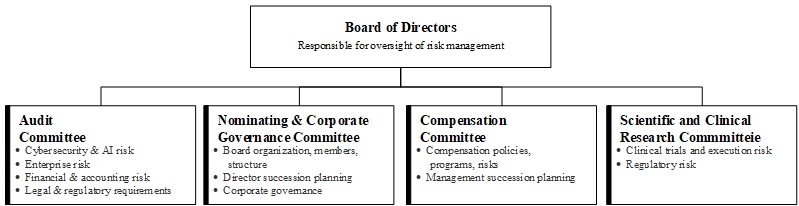
Director Qualifications and Nominations
The Board of Directors seeks to ensure that the Board is composed of members whose particular expertise, experience, qualifications, attributes and skills, when taken together, will allow the Board to satisfy its oversight responsibilities effectively. To this end, the Nominating and Corporate Governance Committee uses a board composition matrix which identifies the professional experience and skill sets represented on the current Board of Directors and compares them to the skill sets that the Nominating and Corporate Governance Committee believes are important to have represented among the directors at any given time in light of the Company’s current business, strategy, risks and opportunities. Any gaps become focus areas for director development or search efforts.
New director candidates are nominated by the Board after evaluation and recommendation by the Nominating and Corporate Governance Committee.
In identifying director candidates, the Nominating and Corporate Governance Committee and the Board take into account the following:
|
● |
the comments and recommendations of Board members regarding the qualifications and effectiveness of the existing Board, or additional qualifications that may be required when selecting new Board members; |
|
● |
the requisite expertise and sufficiently diverse backgrounds of the Board’s overall membership composition; |
|
● |
the independence of outside directors and other possible conflicts of interest between existing and potential members of the Board; and |
|
● |
any other factors they consider appropriate. |
When considering director nominees, the Nominating and Corporate Governance Committee and the Board of Directors focuses primarily on the information discussed in director individual biographies, personal interviews and recommendations.
The Nominating and Corporate Governance Committee will consider director candidates recommended by our shareholders. Those candidates must be qualified and exhibit the experience and expertise required of the Board’s own pool of candidates, as well as have an interest in our business and demonstrate the ability to attend and prepare for Board, committee, and shareholder meetings. Any candidate must provide a written statement, in advance, affirming his or her willingness and interest in serving on the Board. Candidates should represent the interests of all shareholders and not those of a special interest group. The Nominating and Corporate Governance Committee will evaluate candidates recommended by shareholders using the same criteria it uses to evaluate candidates recommended by others as described above. A shareholder that desires to nominate a person for election to the Board of Directors at a meeting of shareholders must follow the specified advance notice requirements and provide the specific information as required by our Articles and British Columbia’s Business Corporations Act (BCBCA). See additional information below under “Shareholder Proposals for 2027 Annual General Meeting of Shareholders.”
Code of Business Conduct and Ethics
We have adopted a Code of Business Conduct and Ethics applicable to all of our directors, officers and employees, in accordance with Section 406 of the Sarbanes-Oxley Act of 2002, the rules of the SEC promulgated thereunder and the Nasdaq Listing Rules. We monitor employee and director compliance with our Code of Business Conduct and Ethics through employee and director reporting. Violations may be reported to supervisors, the Chief Financial Officer or, alternatively, to the Chair of the Audit Committee via e-mail. We investigate all reported violations and discipline as appropriate. In the event that any changes are made or any waivers from the provisions of the Code of Business Conduct and Ethics are made, these events would be disclosed on our website or in a Current Report on Form 8-K filed with the SEC within four business days of such event.
Complaint Procedures
The Audit Committee has established procedures for the receipt, retention and treatment of complaints received by DiaMedica regarding accounting, internal accounting controls or auditing matters. These procedures provide for the submission by our employees, on a confidential and anonymous basis, of concerns regarding questionable accounting or auditing matters. Our personnel with such concerns are encouraged to discuss their concerns with our compliance officer, outside legal counsel or Audit Committee Chair.
Process Regarding Shareholder Communications with Board of Directors
Shareholders may communicate with the Board of Directors or any one particular director by sending correspondence, addressed to DiaMedica’s Corporate Secretary, DiaMedica Therapeutics Inc., 301 Carlson Parkway, Suite 210, Minneapolis, Minnesota 55305 with an instruction to forward the communication to the Board of Directors or one or more particular directors. DiaMedica’s Corporate Secretary will promptly forward all such shareholder communications to the Board of Directors or the one or more particular directors, with the exception of any advertisements, solicitations for periodical or other subscriptions and other similar communications.
Committee Charters and Other Governance Documents
The charters of all four of our standing Board committees and our Corporate Governance Guidelines and Code of Business Conduct and Ethics can be found on the “Investor Relations—Governance” section of our corporate website www.diamedica.com. The Board reviews each of these documents on an annual basis. Printed copies of any of these documents are available upon written request directed to Corporate Secretary, DiaMedica Therapeutics Inc., 301 Carlson Parkway, Suite 210, Minneapolis, Minnesota 55305.
Delinquent Section 16(a) Reports
Section 16(a) of the Exchange Act requires our directors and executive officers and persons who beneficially own more than ten percent of our common stock to file with the SEC reports showing ownership of and changes in ownership of our common stock and other equity securities. Based on a review of reports filed by these reporting persons on the SEC’s electronic filing, or EDGAR, system and written representations by our directors and executive officers, we believe that all of our directors, executive officers and greater than 10% owners complied with all filing requirements applicable to them during fiscal 2025, except that (i) Julie Krop filed one late Form 3 and one late Form 4 with respect to one transaction, and (ii) Trill AB and Jan Stahlberg, as the board member and sole owner of Trill AB, filed two late Form 4s with respect to nine and seven transactions, respectively.
Insider Trading Policy
We have
Audit and Non-Audit Fees
The following table presents the aggregate fees billed to us by Baker Tilly US, LLP for the fiscal years ended December 31, 2025 and 2024.
|
Fiscal Year Ended December 31, |
||||||||
|
2025 |
2024 |
|||||||
|
Audit Fees(a) |
$ | 266,354 | $ | 201,184 | ||||
|
Audit-Related Fees |
— | — | ||||||
|
Tax Fees |
— | — | ||||||
|
All Other Fees |
— | — | ||||||
|
Total |
$ | 266,354 | $ | 201,184 | ||||
|
(a) |
These fees consisted of the audit of our annual consolidated financial statements for 2025 and 2024, review of quarterly condensed consolidated financial statements and other services normally provided in connection with statutory and regulatory filings or engagements. |
Audit Committee Pre-Approval Policies and Procedures
All services rendered by Baker Tilly US, LLP to DiaMedica were permissible under applicable laws and regulations and all services provided to DiaMedica, other than de minimis non-audit services allowed under applicable law, were approved in advance by the Audit Committee. The Audit Committee’s formal written charter requires the Audit Committee to pre-approve all auditing services and permitted non-audit services, including fees for such services, and permits the Audit Committee to establish pre-approval policies and procedures. The Audit Committee has delegated to the Audit Committee Chair the authority to pre-approve certain services up to $25,000.
Report of the Audit Committee
One of the purposes of the Audit Committee is to oversee DiaMedica’s accounting and financial reporting processes and the audit of DiaMedica’s annual consolidated financial statements. DiaMedica’s management is responsible for the preparation and presentation of complete and accurate financial statements. DiaMedica’s independent registered public accounting firm, Baker Tilly US, LLP, is responsible for performing an independent audit of DiaMedica’s annual consolidated financial statements in accordance with the standards of the Public Company Accounting Oversight Board (United States) and for issuing a report on their audit.
In performing its oversight role, the Audit Committee has reviewed and discussed DiaMedica’s audited consolidated financial statements for the year ended December 31, 2025 with DiaMedica’s management. Management represented to the Audit Committee that DiaMedica’s financial statements were prepared in accordance with generally accepted accounting principles. The Audit Committee has discussed with Baker Tilly US, LLP the matters required to be discussed under Public Company Accounting Oversight Board standards and Securities and Exchange Commission rules. The Audit Committee has received the written disclosures and the letter from Baker Tilly US, LLP required by applicable requirements of the Public Company Accounting Oversight Board regarding Baker Tilly US, LLP’s communications with the Audit Committee concerning independence. The Audit Committee has discussed with Baker Tilly US, LLP its independence and concluded that the independent registered public accounting firm is independent from DiaMedica and DiaMedica’s management.
Based on the review and discussions of the Audit Committee described above, in reliance on the unqualified opinion of Baker Tilly US, LLP regarding DiaMedica’s audited consolidated financial statements, and subject to the limitations on the role and responsibilities of the Audit Committee discussed above and in the Audit Committee’s charter, the Audit Committee recommended to the Board of Directors that DiaMedica’s audited consolidated financial statements for the fiscal year ended December 31, 2025 be included in its Annual Report on Form 10-K for the year ended December 31, 2025 for filing with the Securities and Exchange Commission.
James Parsons, Chair
Daniel O’Connor
Charles Semba, M.D.
The information contained in the above Audit Committee report shall not be deemed to be “soliciting material” or to be “filed” with the SEC, or subject to Regulation 14A or to the liabilities of Section 18 of the Exchange Act, nor shall it be deemed to be incorporated by reference into any filing under the Securities Act of 1933, as amended, or the Exchange Act.
DIRECTOR COMPENSATION
Our non-employee directors currently consist of Michael Giuffre, M.D., Richard Kuntz, M.D., M.Sc., Tanya Lewis, Daniel O’Connor, James Parsons and Charles Semba, M.D. We use a combination of cash and long-term equity-based incentive compensation in the form of annual stock option grants to attract and retain qualified candidates to serve on the Board of Directors. In addition, non-employee directors may receive either deferred stock units or restricted stock units in lieu of cash retainers.
Cash Retainers
The following table sets forth the annual cash retainers paid to our non-employee directors during fiscal 2025:
|
Description |
Annual Cash Retainer |
|||
|
Board Member |
$ | 40,000 | ||
|
Chairman of the Board |
30,000 | |||
|
Audit Committee Chair |
15,000 | |||
|
Audit Committee Member (Excluding Chair) |
7,500 | |||
|
Compensation Committee Chair |
10,000 | |||
|
Compensation Committee Member (Excluding Chair) |
5,000 | |||
|
Nominating and Corporate Governance Committee Chair |
8,000 | |||
|
Nominating and Corporate Governance Committee Member (Excluding Chair) |
4,000 | |||
|
Scientific and Clinical Research Committee Chair |
8,000 | |||
|
Scientific and Clinical Research Committee Member (Excluding Chair) |
4,000 | |||
Annual Stock Options
Under the Non-Employee Director Compensation Program, each non-employee director each year is granted a stock option to purchase a number of common shares equal to 0.075% of our outstanding shares and the Chairman of the Board is granted an additional stock option to purchase a number of common shares equal to 0.02% of our outstanding shares, in each case rounding down to the nearest whole share. These annual stock options are granted effective as of June 1st each year. All of these stock options have a term of 10 years, a per share exercise price equal to 100% of the fair market value of a common share on the date of grant, and vest and become exercisable in four equal quarterly installments over one year, and in each case so long as the non-employee director is a director of DiaMedica as of such date. Accordingly, on June 1, 2025, each of our then non-employee directors received an option to purchase 32,162 common shares at an exercise price equal to $4.11 per share and Mr. Parsons as our then Chairman of the Board received an additional 8,577 common shares at an exercise price equal to $4.11 per share. These options expire on May 31, 2035.
Our Non-Employee Director Compensation Program also provides that each new non-employee director will be granted a stock option to purchase a number of common shares equal to 0.15% of our outstanding shares, rounding down to the nearest whole share, effective as of the new director’s first day as a director. This initial equity award is in lieu of an annual equity award for the first year of service. This initial stock option has a term of 10 years, a per share exercise price equal to 100% of the fair market value of a common share on the date of grant and vests and becomes exercisable in 12 equal quarterly installments over three years, and in each case so long as the non-employee director is a director of DiaMedica as of such date.
Deferred Stock Units or Restricted Stock Units in Lieu of Annual Cash Retainers
We provide our non-employee directors the opportunity to elect to receive DSUs or RSUs in lieu of up to 100% of their annual cash retainers payable for services to be rendered as a non-employee director, chairman and chair or member of any board committee. Effective as of the first trading day of each year, each non-employee director who elected to receive DSUs or RSUs in lieu of all or a portion of such director’s annual cash retainers is be granted a DSU or RSU award under the 2019 Plan or any other shareholder-approved plan covering that number of shares as determined based on the following formula (rounding down to the nearest whole share):
|
● |
the aggregate dollar amount of the elected portion of the annual cash retainers that otherwise would have been payable to the non-employee director, divided by |
|
● |
the 10-trading day average closing sale price of our common shares, as reported by The Nasdaq Capital Market, and as determined on the third trading day prior to the anticipated grant date of the award. |
Such DSU and RSU awards vest in four equal quarterly installments, on March 31, June 30, September 30 and December 31, (or prorated from the first date as a director in the case of new directors) in each case so long as the non-employee director is a director of DiaMedica as of such date. DSU awards are settled following a separation from service by such director and RSU awards are settled immediately upon vesting or, if earlier, the death of the director.
If a non-employee director who elected to receive a DSU or RSU award in lieu of all or a portion of such director’s annual cash retainers is no longer a director of DiaMedica before such director’s interest in all of the shares underlying the DSU or RSU award have vested, the director will forfeit his or her rights to receive all of such unvested shares on the day his or her status as a director of DiaMedica terminates. However, shares underlying the DSU or RSU award corresponding to the elected cash retainers for such quarter in which the director’s status changed will vest ratably for such quarter based on the number of days of service as a director of DiaMedica during such quarter.
Director Compensation Table
The table below provides summary information concerning the compensation of each individual who served as a director of DiaMedica during the fiscal year ended December 31, 2025, other than Rick Pauls, our President and Chief Executive Officer, who was not compensated separately for serving on the Board of Directors during fiscal 2025. His compensation for serving as an executive officer is set forth under “Executive Compensation—Summary Compensation Table.”
|
Name |
Fees Earned or Paid in Cash(a) |
Option Awards(b)(c) |
Stock Awards(d)(e) |
All Other Compensation(f) |
Total |
|||||||||||||||
|
Michael Giuffre, M.D. |
$ | 58,000 | $ | 88,574 | $ | 1,844 | $ | — | $ | 148,418 | ||||||||||
|
Richard Kuntz, M.D. |
53,000 | 88,574 | 1,687 | — | 143,261 | |||||||||||||||
|
Tanya Lewis |
53,000 | 88,574 | — | — | 141,574 | |||||||||||||||
|
James Parsons |
85,000 | 112,195 | 2,703 | — | 199,898 | |||||||||||||||
|
Daniel O’Connor |
56,104 | 302,169 | — | — | 358,273 | |||||||||||||||
|
Charles Semba, M.D. |
56,500 | 88,574 | 898 | — | 145,972 | |||||||||||||||
|
(a) |
The following directors elected to receive DSUs or RSUs in exchange for all or part of their cash retainers: Dr. Giuffre ($58,000 was paid in the form of 10,861 DSUs); Dr. Kuntz ($53,000 was paid in the form of 9,925 RSUs); Mr. Parsons ($85,000 was paid in the form of 15,917 DSUs) and Dr. Semba ($28,250 was paid in the form of 5,290 RSUs). |
|
(b) |
Amounts reflect the grant date fair value for option awards granted to each non-employee director computed in accordance with Financial Accounting Standards Board (FASB) Accounting Standards Codification (ASC) Topic 718. |
|
(c) |
The following current directors held the following option awards as of December 31, 2025: Dr. Giuffre (32,162 options); Dr. Kuntz (32,162 options); Ms. Lewis (32,162 options); Mr. Parsons (40,739 options); Mr. O’Connor (64,242 options) and Dr. Semba (32,162 options). |
|
(d) |
Represents the difference between the grant date fair value of the DSUs or RSUs received by the director, using the grant date fair value of $5.51 per underlying share, and the dollar amount of retainers elected to be received in DSUs or RSUs, calculated using the average stock price of $5.34 per share as determined under the terms of our non-employee director compensation plan. |
|
(e) |
The following current directors held the following unvested stock awards (all in the form of DSUs) as of December 31, 2025: Dr. Giuffre (DSU – 99,162); Dr. Kuntz (0); Ms. Lewis (0); Mr. Parsons (73,604); Mr. O’Connor (0) and Dr. Semba (0). |
|
(f) |
We do not provide perquisite and other personal benefits to our non-employee directors. |
Director Indemnification
Our Articles provide that, subject to the BCBCA, we will indemnify a director or a former director (each an “eligible party”) and his or her heirs and legal representatives, against all eligible penalties to which such person is liable. DiaMedica must pay the expenses actually and reasonably incurred by such person in respect of any eligible proceeding either as they are incurred in advance of the final disposition of the proceeding or after the final disposition of a proceeding. Our Articles define an “eligible penalty” as a judgment, penalty or fine awarded or imposed in, or an amount paid in settlement of, an eligible proceeding. Our Articles define an “eligible proceeding” as a legal proceeding or investigative action, whether current, threatened, pending or completed, in which an eligible party or any of the heirs and legal personal representatives of the eligible party, by reason of the eligible party being or having been a director of DiaMedica: (i) is or may be joined as a party; or (ii) is or may be liable for or in respect of a judgment, penalty or fine in, or expenses related to, the proceeding.
We entered into indemnification agreements with all of our directors, which are nearly identical to the indemnification agreements with our executive officers as described under “Executive Compensation—Executive Compensation Overview—Indemnification Agreements.”
At present, there is no pending litigation or proceeding involving any of our directors or executive officers as to which indemnification is required or permitted, and we are not aware of any threatened litigation or proceeding that may result in a claim for indemnification.
Insofar as indemnification for liabilities arising under the United States Securities Act of 1933, as amended (Securities Act) may be permitted to directors, executive officers or persons controlling us, we have been informed that, in the opinion of the SEC, such indemnification is against public policy as expressed in the Securities Act and is therefore unenforceable.
EXECUTIVE COMPENSATION
This section describes the compensation of the executive officers named in the Summary Compensation Table on page 46, which individuals consist of our President and Chief Executive Officer and the two most highly compensated executive officers for the year ended December 31, 2025:
|
● |
Rick Pauls, our President and Chief Executive Officer (CEO); |
|
● |
Julie Krop, M.D., our Chief Medical Officer (CMO), effective August 11, 2025; and |
|
● |
Scott Kellen, our Chief Financial Officer and Corporate Secretary (CFO). |
These executive officers are collectively referred to as our named executive officers, or NEOs.
When reading this Executive Compensation Overview, please note we are a smaller reporting company and are not required to provide a “Compensation Discussion and Analysis” of the type required by Item 402 of SEC Regulation S-K. This Executive Compensation Overview is intended to supplement the SEC-required disclosure, which is included in this section, and it is not a Compensation Discussion and Analysis.
Compensation Philosophy
The Compensation Committee generally targets executive compensation at the 50th percentile of our peer group, as discussed below under “—Elements of Our Executive Compensation Program.”
Use of Market Data
We strive to compensate our executive officers competitively relative to other companies that are similar to us in market capitalization, revenue, number of employees and stage of clinical development. To ensure reasonableness and competitiveness of our executive compensation packages relative to our peer companies, the Compensation Committee evaluates our peer group with the aid of our independent compensation consultant and with input from management.
The peer group used to help determine 2025 compensation was approved by the Compensation Committee in December 2024 and includes the following 18 companies:
|
Acumen Pharmaceuticals, Inc. |
Alto Neuroscience, Inc. |
Anavex Life Sciences Corp. |
|
Annovis Bio, Inc. |
Applied Therapeutics, Inc. |
Clene Inc. |
|
Fulcrum Therapeutics, Inc. |
Galectin Therapeutics Inc. |
Gossamer Bio, Inc. |
|
Immunic, Inc. |
Inozyme Pharma, Inc. |
Lineage Cell Therapeutics, Inc. |
|
MediciNova, Inc. |
Mineralys Therapeutics, Inc. |
Ovid Therapeutics Inc |
|
PepGen Inc. |
Tourmaline Bio, Inc. |
Vigil Neuroscience, Inc. |
Data from this peer group, therefore, was considered in the compensation benchmarking process as one input in helping us determine appropriate pay levels for our executives.
Use of Consultants
The Compensation Committee has the authority to engage the services of outside experts and advisors as it deems necessary or appropriate to carry out its duties and responsibilities, and prior to doing so, assesses the independence of such experts and advisors from management. The Compensation Committee has retained Alpine Rewards, LLC to conduct executive officer and non-employee director compensation analyses every other year. Alpine Rewards, LLC did not provide any services to our Company other than those for which it was retained by the Compensation Committee.
Elements of Our Executive Compensation Program
During 2025, our executive compensation program consisted of several key elements, which are described in the table below, along with the key characteristics of, and the purpose for, each element and key 2025 changes.
|
Element |
Key Characteristics |
Purpose |
Key 2025 Changes |
|
Base Salary
(Fixed, Cash) |
A fixed amount, paid in cash periodically throughout the year and reviewed annually and, if appropriate, adjusted. |
Provides source of fixed income that is market competitive and reflects scope and responsibility of the position held. |
Our CEO and CFO each received a base salary increase of 10%.
Our CMO joined in August 2025 with an initial annual base salary of $525,000. |
|
Short-Term Incentive (STI)
(Variable, Cash) |
A variable, short-term element |
Motivates and rewards our executives for achievement of annual corporate and other objectives. |
Target incentive payout for 2025 was 50% of base salary for CEO and 40% of base salary for CFO, both unchanged from last year.
Target incentive payout for our new CMO was 40% of base salary. |
|
Long-Term Incentives (LTI)
(Variable, Equity-Based Awards) |
A variable, long-term element of compensation that is provided in the form of time-vested stock option awards. |
Aligns the interests of our executives with our shareholders; encourages our executives to focus on our long-term performance; promotes retention; and encourages significant share ownership. |
NEOs received stock option awards, with 25% vesting on one-year anniversary of grant date and remaining 75% vesting in 12 equal quarterly installments thereafter. The awards for our CEO and CFO were annual awards; whereas, the award for our CMO was a new hire award. |
|
Retirement Benefits |
A 401(k) plan with a discretionary company match. |
Provides an opportunity for employees to save and prepare financially for retirement. |
No changes. |
We describe each key element of our executive compensation program in more detail in the following pages, along with the compensation decisions made in 2025. The compensation paid to our named executive officers is governed, in part, by written employment agreements with them, which are described below under “—Employment Agreements.” The named executive officers also have termination and change in control benefits as set forth in their respective employment agreements. See “—Post-Termination Severance and Change in Control Arrangements.”
Pay for Performance and Pay Mix
We seek to motivate management to achieve corporate objectives and increase shareholder value through incentive plans that reward higher performance with increased incentive payouts and hold management accountable for performance that falls below targeted levels by paying reduced or no incentive payouts. Accordingly, in general, our executive compensation program emphasizes variable at-risk pay elements as a significant portion of each executive’s total compensation package.
The breakdown of variable at-risk pay (broken out between target short-term incentives and actual long-term incentives) compared to fixed pay (i.e., base salary) reported for 2025 in the Summary Compensation Table for our CEO and the average for our other named executive officers is as follows:
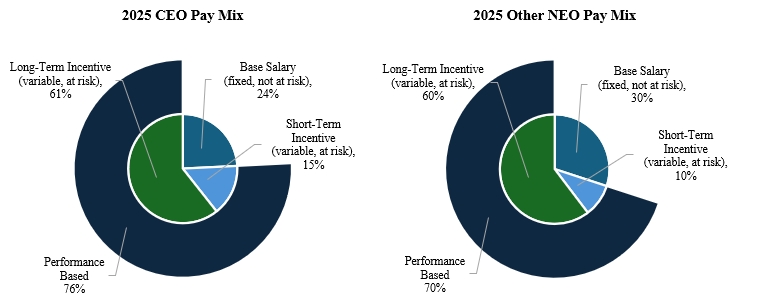
Base Salary
We provide a base salary for our named executive officers, which is a fixed and constant form of compensation. We recognize the need for most executives to receive at least a portion of their total compensation in the form of a guaranteed base salary that is paid in cash regularly throughout the year. The base salaries set for our named executive officers are intended to provide a steady income regardless of share price performance, allowing executives to focus on both near-term and long-term goals and objectives without undue reliance on short-term share price performance or market fluctuations.
We initially fix base salaries for our executives at a level that we believe enables us to hire and retain them in a competitive environment and to reward satisfactory individual performance and a satisfactory level of contribution to our overall business objectives. The Compensation Committee reviews and approves any increases in base salaries for our named executive officers.
The base salaries for our named executive officers for the last two fiscal years were as follows:
|
Name |
2025 |
2024 |
% Change |
|||||||||
|
Rick Pauls |
$ | 660,000 | $ | 600,000 |
+10% |
|||||||
|
Julie Krop |
525,000 | — | N/A | |||||||||
|
Scott Kellen |
418,000 | 380,000 |
+10% |
|||||||||
In March 2025, the Compensation Committee approved base salary increases of approximately 10% for each of our CEO and CFO. Our CMO was appointed in August 2025. The base salary increases for our CEO and CFO were intended to provide for cost-of-living adjustments and bring their base salaries closer to our target positioning in our peer group.
Annual Short-Term Incentive Compensation
In addition to base compensation, we provide our named executive officers the opportunity to earn short-term incentive (STI) compensation based on the achievement of certain annual corporate and individual performance goals. Our STI program directly aligns the interests of our executive officers and shareholders by providing an incentive for the achievement of key corporate and individual performance objectives that are critical to the success of our Company and linking a significant portion of each executive’s annual compensation to the achievement of such objectives.
Under the 2025 STI program, each named executive officer had a target incentive payout that was a percentage of their base salary.
2025 STI payouts were based primarily on corporate objectives, which had a 75% weighting, and to a lesser extent, individual objectives, which had a 25% weighting. The corporate objectives related to our ReMEDy2 trial, our preeclampsia program, manufacturing, and raising additional capital, and were determined by the Compensation Committee to have been achieved at 100.0% of target. The individual objectives varied by executive and related to developing people and organization, evidence development for our product candidate DM199, accounting and financial reporting, regulatory and business development. The individual objectives were determined by the Compensation Committee to have been achieved at 100-150% of target for our CEO, CMO and CFO. 2025 individual performance payouts reflected recognition for each NEOs significant contributions to advancing the Company’s preeclampsia program and the recent expansion in analyst coverage for DiaMedica.
The following sets forth each executive’s target bonus opportunity and actual STI payout for 2025:
|
Officer Name and Position |
2025 Base Salary |
Target |
2025 Actual Payout |
|||||||||||||||||
|
% Base Salary |
Dollars |
% Target |
Dollars |
|||||||||||||||||
|
Rick Pauls |
$ | 660,000 | 50 | % | $ | 330,000 | 125 | % | $ | 412,500 | ||||||||||
|
Julie Krop, M.D.(a) |
198,979 | 40 | % | 79,592 | 100 | % | 79,592 | |||||||||||||
|
Scott Kellen |
418,000 | 40 | % | 167,200 | 110 | % | 183,920 | |||||||||||||
|
(a) |
Dr. Krop’s 2025 base salary, target bonus opportunity and actual payout were prorated to reflect days of service after her August 11, 2025 start date. |
Long-Term Equity-Based Incentive Compensation
The long-term equity-based incentive compensation component consists of stock options granted under the DiaMedica Therapeutics Inc. Amended and Restated 2019 Omnibus Incentive Plan, and in the case of certain new hire grants, under the DiaMedica Therapeutics Inc. 2021 Employment Inducement Incentive Plan. Long-term equity-based incentives are intended to comprise a significant portion of each executive’s compensation package, consistent with our executive compensation objective to align the interests of our executives with the interests of our shareholders.
The Compensation Committee believes that stock options effectively incentivize executives to maximize Company performance over the long-term, as the value of awards is directly tied to an appreciation in the value of our common shares. Stock options also provide an effective retention mechanism because of vesting provisions. An important objective of our long-term equity-based incentive program is to strengthen the relationship between the long-term value of our common shares and the potential financial gain for our executives. Stock options provide recipients with the opportunity to purchase our common shares at a price fixed on the grant date regardless of future market price. Because stock options become valuable only if the share price increases above the exercise price and the option holder remains employed during the period required for the option to vest, they provide an incentive for an executive to remain employed. In addition, stock options link a portion of an executive’s compensation to the interests of our shareholders by providing an incentive to achieve corporate goals and increase the market price of our common shares over time.
The table below sets forth the stock options that we granted to our named executive officers in 2025, which options vest with respect to 25% of the underlying common shares on the one-year anniversary of the grant date, and with respect to the remaining 75% of the underlying common shares in 12 as nearly equal as possible quarterly installments commencing after the one-year anniversary of the grant date:
|
Named Executive Officer |
Grant Date |
Shares Underlying Options (#) |
Exercise Price Per Share |
|
Rick Pauls |
6/1/2025 |
600,000 |
4.11 |
|
Julie Krop |
8/11/2025 |
450,000 |
4.58 |
|
Scott Kellen |
6/1/2025 |
225,000 |
4.11 |
The stock options expire after ten years. The number of stock options granted to our executives was determined based on a percent of outstanding Company common shares analysis as opposed to a value analysis. Dr. Krop’s option grant reflected a new hire grant, which typically includes a greater number of shares than an individual’s annual equity award.
Grants of Certain Equity Awards Close in Time to the Release of Material Nonpublic Information
We maintain an equity grant policy that provides guidance for the orderly granting of both annual and new hire equity awards. Consistent with our annual compensation cycle, the Compensation Committee has historically granted annual equity awards to our executive officers in June. As a result of the policy, the approximate dates for awards are often known up to a year in advance. The timing of any equity awards to executive officers in connection with new hires, promotions, or other nonroutine awards is tied to the event giving rise to the award (such as an executive officer’s commencement of employment or promotion effective date). In any case, the final timing of equity awards remains subject to sufficient available shares under our applicable equity incentive plans.
All Other Compensation
It is our policy not to extend perquisites to our executives that are not available to our employees generally. Our executives receive benefits that are also received by our other employees, including participation in the DiaMedica USA, Inc. 401(k) Plan and health, dental, disability and life insurance benefits.
Employment Agreements
We typically enter into employment agreements with our executive officers, which provide for an annual base salary, subject to periodic reviews, incentive-based compensation, equity-based compensation and benefits, in each case as determined by the Board of Directors (or a committee thereof) from time to time. The agreements contain standard confidentiality, non-competition, non-solicitation and assignment of intellectual property provisions. The agreements also contain standard severance and change in control provisions which are described under “—Post-Termination Severance and Change in Control Arrangements.”
Post Termination Severance and Change in Control Arrangements
Severance Arrangements. Under the terms of the employment agreements with each of our executive officers, if we terminate the executive’s employment without “cause”, the executive will be entitled to: (i) salary continuation payments for 12 months in the case of Mr. Pauls and nine months in the case of each of the other executives, (ii) Consolidated Omnibus Budget Reconciliation Act (COBRA) premium reimbursement during the salary continuation period, (iii) a pro rata portion of the executive’s target annual bonus for the year of termination, and (iv) immediate acceleration of the executive’s outstanding equity awards. These severance benefits are subject to the executive executing a separation agreement and release of claims. “Cause” is defined in the employment agreements as: (i) gross negligence or willful failure to perform the executive’s duties and responsibilities to DiaMedica; (ii) commission of any act of fraud, theft, embezzlement, financial dishonesty or any other willful misconduct that has caused or is reasonably expected to result in injury to DiaMedica; (iii) conviction of, or pleading guilty or nolo contendere to, any felony or a lesser crime involving dishonesty or moral turpitude; (iv) material breach by the executive of any of their obligations under the agreement or any written agreement or covenant with DiaMedica, including the policies adopted from time to time by DiaMedica applicable to all executives, that has not been cured within 30 days of notice of such breach; or (v) termination of the employment of the executive in connection with a liquidation, dissolution or winding down of DiaMedica. We believe that the form and amount of these severance benefits are fair and reasonable to both DiaMedica and our executives. The Compensation Committee reviews our severance arrangements periodically to ensure that they remain necessary and appropriate.
Change in Control Arrangements. To encourage continuity, stability and retention when considering the potential disruptive impact of an actual or potential corporate transaction, we have established change in control arrangements, including provisions in the 2019 Plan and executive employment agreements. These arrangements are designed to incentivize our executives to remain with our Company in the event of a change in control or potential change in control.
Under the terms of the 2019 Plan, subject to the terms of the applicable award agreement or an individual agreement between DiaMedica and a participant, upon a change in control (as defined in the 2019 Plan, as described in Proposal Four), the Board of Directors may, in its discretion, determine whether some or all outstanding options and stock appreciation rights shall become exercisable in full or in part, whether the restriction period and performance period applicable to some or all outstanding restricted stock awards and restricted stock unit awards shall lapse in full or in part and whether the performance measures applicable to some or all outstanding awards shall be deemed to be satisfied. The Board of Directors may further require that shares of stock of the corporation resulting from such a change in control, or a parent corporation thereof, be substituted for some or all of our common shares subject to an outstanding award and that any outstanding awards, in whole or in part, be surrendered to us by the holder, to be immediately cancelled by us, in exchange for a cash payment, shares of capital stock of the corporation resulting from or succeeding us or a combination of both cash and such shares of stock.
Under the terms of the employment agreements, if we terminate the executive’s employment without “cause” or the executive terminates their employment with “good reason” in connection with or within 12 months after a “change in control,” the executive will be entitled to: (i) salary continuation payments for 18 months in the case of Mr. Pauls and 12 months in the case of each of the other executives, (ii) COBRA premium reimbursement during the salary continuation period, (iii) a pro rata portion of their target annual bonus for the year of termination, and (iv) immediate acceleration of all of their outstanding equity awards. These severance benefits are subject to the executive executing a separation agreement and release of claims.
“Good reason” is defined in the employment agreements as the executive’s resignation within 30 days following the expiration of any cure period following the occurrence of one or more of the following, without the executive’s express written consent: (i) a material reduction of the executive’s duties, authority, reporting level, or responsibilities, relative to their duties, authority, reporting level, or responsibilities in effect immediately prior to such change in control; (ii) a material reduction in the executive’s base compensation; or (iii) DiaMedica’s requiring of the executive to change the principal location at which the executive is to perform services by more than 50 miles.
“Change in control” is defined in the employment agreements as the occurrence of any of the following: (i) the acquisition, other than from us, by any individual, entity or group of beneficial ownership of 50% or more of either our then outstanding common shares or the combined voting power of our then outstanding voting securities entitled to vote generally in the election of directors; (ii) the consummation of a reorganization, merger or consolidation of DiaMedica, in each case, with respect to which all or substantially all of the individuals and entities who were the respective beneficial owners of our common shares and voting securities immediately prior to such reorganization, merger or consolidation do not, following such reorganization, merger or consolidation, beneficially own, directly or indirectly, more than 50% of, respectively, of then outstanding common shares and the combined voting power of then outstanding voting securities entitled to vote generally in the election of directors, as the case may be, of the corporation resulting from such reorganization, merger or consolidation; or (iii) the sale or other disposition of all or substantially all of our assets.
We believe these change in control arrangements are an important part of our executive compensation program in part because they mitigate some of the risk for executives working in a smaller company where there is a meaningful risk that DiaMedica may be acquired. Change in control benefits are intended to attract and retain qualified executives who, absent these arrangements and in anticipation of a possible change in control of our Company, might consider seeking employment alternatives to be less risky than remaining with our Company through the transaction. We believe that the form and amount of these change in control benefits are fair and reasonable to both our Company and our executives. The Compensation Committee periodically reviews our change in control arrangements to ensure that they remain necessary and appropriate.
Clawback Policy
We maintain a clawback policy that provides for a mandatory clawback of incentive compensation paid to current and former executives under certain circumstances in the event a financial metric used to determine the vesting or payment of incentive compensation to an executive was calculated incorrectly and resulted in a financial restatement. This policy complies with applicable SEC and Nasdaq rules.
Executive Indemnification Agreements
We have entered into indemnification agreements with all of our executive officers. The indemnification agreements are governed exclusively by and construed according to the substantive laws of the BCBCA, without regard to conflicts-of-laws principles that would require the application of any other law, and provide, among other things, for indemnification, to the fullest extent permitted by law and our Articles, against any and all expenses (including attorneys’ fees) and liabilities, judgments, fines and amounts paid in settlement that are paid or incurred by the executive or on his or her behalf in connection with such action, suit or proceeding. We will be obligated to pay these amounts only if the executive acted in good faith and in a manner he or she reasonably believed to be in or not opposed to the best interests of our Company and, in the case of a criminal or administrative proceeding that is enforced by a monetary penalty, he or she had reasonable grounds for believing that his or her conduct was lawful. The indemnification agreements provide that the executive will not be indemnified and expenses advanced with respect to an action, suit or proceeding initiated by the executive unless (i) so authorized or consented to by the Board of Directors or DiaMedica has joined in such action, suit or proceeding or (ii) the action, suit or proceeding is one to enforce the executive’s rights under the indemnification agreement. Our indemnification and expense advance obligations are subject to the condition that an appropriate person or body not party to the particular action, suit or proceeding shall not have determined that the executive is not permitted to be indemnified under applicable law. The indemnification agreements also set forth procedures that apply in the event an executive requests indemnification or an expense advance.
Summary Compensation Table
The table below provides summary information concerning all compensation awarded to, earned by or paid to our named executive officers during our 2025 and 2024 fiscal years. Mr. Pauls did not receive any compensation related to his role as a director.
|
Name and Principal Position |
Year |
Salary |
Option Awards(a) |
Non-Equity Incentive Plan Compensation(b) |
All Other Compensation(c) |
Total |
|||||||||||||||
|
Rick Pauls |
2025 |
645,000 | 1,652,400 | 412,500 | 17,450 | 2,727,350 | |||||||||||||||
| President and Chief Executive Officer |
2024 |
593,250 | 633,510 | 306,975 | 17,250 | 1,550,985 | |||||||||||||||
|
Julie Krop, M.D.(d) |
2025 |
198,980 | 1,421,100 | 79,592 | 7,891 | 1,707,563 | |||||||||||||||
|
Scott Kellen |
2025 |
408,500 | 619,650 | 183,920 | 17,450 | 1,229,520 | |||||||||||||||
| Chief Financial Officer and Secretary |
2024 |
374,250 | 274,521 | 147,934 | 17,250 | 813,955 | |||||||||||||||
|
(a) |
Amounts reflect the grant-date fair value of stock options granted during the applicable year computed in accordance with ASC Topic 718, rather than the amounts paid to or realized by the named individual. The grant date fair value is determined based on the Black-Scholes option pricing model. The following table summarizes forth the assumptions used in the valuation of each such option award: |
|
Grant Date |
Grant Date Fair Value Per Share |
Risk Free Interest Rate |
Expected Life (in years) |
Expected Volatility |
Expected Dividend Yield |
|||||||||||||||
|
06/01/2025 |
$ | 4.11 | 3.97 | % | 5.43 | 77.1 | % | 0 | % | |||||||||||
|
08/11/2025 |
$ | 4.58 | 3.84 | % | 5.44 | 80.82 | % | 0 | % | |||||||||||
|
(b) |
Amounts reported represent awards earned for that year under our annual short-term incentive plan but paid during the following year. See “—Executive Compensation Overview—Annual Short-Term Incentive Compensation.” |
|
(c) |
The amounts shown in the “All Other Compensation” column for fiscal 2025 include the following with respect to each named executive officer: |
|
Name |
401(k) Match |
HSA Contribution |
Total |
|||||||||
|
Rick Pauls |
$ | 14,000 | $ | 3,450 | $ | 17,450 | ||||||
|
Julie Krop |
7,891 | — | 7,891 | |||||||||
|
Scott Kellen |
14,000 | 3,450 | 17,450 | |||||||||
|
(d) |
Dr. Krop joined the company as Chief Medical Officer effective August 11, 2025. |
Outstanding Equity Awards at Fiscal Year-End
The following table presents, for each named executive officer, information regarding outstanding equity awards held as of December 31, 2025.
|
Option Awards(a) |
||||||||||||||
|
Number of Securities Underlying Unexercised Options (#) |
Option Exercise |
Option |
||||||||||||
|
Exercisable |
Unexercisable |
Price ($) | Expiration Date(b) | |||||||||||
|
Rick Pauls |
11/28/2016 |
42,500 | – | 3.80(c) |
11/28/2026 |
|||||||||
|
6/19/2017 |
42,500 | – |
4.67(c) |
6/19/2027 |
||||||||||
|
4/17/2018 |
33,500 | – |
8.18(c) |
4/17/2028 |
||||||||||
|
6/24/2019 |
264,000 | – | 4.60 |
6/23/2029 |
||||||||||
|
6/1/2020 |
56,000 | – | 4.64 |
5/31/2030 |
||||||||||
|
7/28/2021 |
175,000 | – | 5.00 |
7/27/2031 |
||||||||||
|
6/1/2022 |
154,876 | 22,124(d) | 2.45 |
5/31/2032 |
||||||||||
|
6/1/2023 |
113,125 | 67,875(e) | 2.73 |
5/31/2033 |
||||||||||
|
6/1/2024 |
112,500 |
187,500(e) |
2.90 |
5/31/2034 |
||||||||||
|
6/1/2025 |
– |
600,000(e) |
4.11 |
5/31/2035 |
||||||||||
|
Julie Krop |
8/11/2025 |
– |
450,000(e) |
4.58 |
8/10/2035 |
|||||||||
|
Scott Kellen |
4/17/2018 |
50,250 | – |
8.18(c) |
4/17/2028 |
|||||||||
|
6/24/2019 |
99,750 | – | 4.60 |
6/23/2029 |
||||||||||
|
6/1/2020 |
35,000 | – | 4.64 |
5/31/2030 |
||||||||||
|
7/28/2021 |
60,000 | – | 5.00 |
7/27/2031 |
||||||||||
|
6/1/2022 |
52,500 |
7,500(d) |
2.45 |
5/31/2032 |
||||||||||
|
6/1/2023 |
41,875 |
25,125(e) |
2.73 |
5/31/2033 |
||||||||||
|
6/1/2024 |
48,750 |
81,250(e) |
2.90 |
5/31/2034 |
||||||||||
|
6/1/2025 |
– |
225,000(e) |
4.11 |
5/31/2035 |
||||||||||
|
(a) |
All reported options are scheduled to vest incrementally, with vesting eligible for acceleration under specified circumstances, including if the recipient’s employment or service relationship with our Company is involuntarily terminated. |
|
(b) |
Exercise price expressed in Canadian Dollars. Represents U.S. Dollar value as of December 31, 2025. |
|
(c) |
All stock options reported have a 10-year term but may terminate earlier if the recipient’s employment or service relationship with our Company terminates. |
|
(d) |
Eligible to vest with respect to 25% of the shares on the first anniversary of the grant date and the remaining 75% of the shares monthly in 36 substantially equal increments over the following three years commencing on the 15-month anniversary of the grant date. |
|
(e) |
Eligible to vest with respect to 25% of the shares on the first anniversary of the grant date and the remaining 75% of the shares quarterly in 12 equal increments over the following three years commencing on the 15-month anniversary of the grant date. |
Pay Versus Performance Disclosure
As required by Section 953(a) of the Dodd-Frank Act and Item 402(v) of SEC Regulation S-K, we are providing the following information about the relationship between “compensation actually paid” to our named executive officers, within the meaning of such rules, and certain financial performance measures of our Company.
The table below provides information regarding compensation actually paid (“CAP”) to our PEO (our CEO), and the average compensation actually paid to our other non-PEO named executive officers, during each of the past three fiscal years, as well as total shareholder return and net income (loss) for each of the past three fiscal years.
|
Year |
Summary Compensation Table Total for PEO(a) |
Compensation Actually Paid to PEO(b) |
Average Summary Compensation Table Total for Other NEOs(c) |
Average Compensation Actually Paid to Other NEOs(b) |
Value of Initial Fixed $100 Investment Based on TSR(d) |
Net Income (Loss)(e) (million $) |
||||||||||||||||||
|
2025 |
$ | $ | $ | $ | $ | ( |
) | |||||||||||||||||
|
2024 |
( |
) | ||||||||||||||||||||||
|
2023 |
( |
) | ||||||||||||||||||||||
|
(a) |
|
|
(b) |
SEC rules require certain adjustments be made to the Summary Compensation Table (“SCT”) totals to determine CAP as reported in the Pay Versus Performance Table. CAP amounts do not necessarily represent cash and/or equity value transferred to the applicable NEO without restriction, but rather is a value calculated under applicable SEC rules. A reconciliation of the SCT totals to CAP to our PEO and our Other NEOs (as an average) is shown below. Our NEOs do not participate in a pension plan; therefore, no adjustment from the SCT totals related to pension values were made for any periods presented. |
|
|
2025 |
|||||||
| Adjustments |
PEO |
Average of Other NEOs |
||||||
|
Total Compensation from SCT |
||||||||
|
Subtract SCT amounts for stock and option awards |
( |
) | ( |
) | ||||
|
Add fair value at year-end of awards granted during the covered fiscal year that are outstanding and unvested at year-end |
||||||||
|
+/- Difference between fair value of awards from the end of the prior fiscal year to the end of the covered fiscal year for awards granted in any prior fiscal year that are outstanding and unvested at the end of the covered fiscal year |
||||||||
|
+/- Change in fair value from the end of the prior fiscal year to the vesting date for awards granted in any prior fiscal year which vested during the covered fiscal year |
( |
) | ( |
) | ||||
|
Subtract fair value at end of prior fiscal year for awards granted in any prior fiscal year that fail to meet the applicable vesting conditions during the covered fiscal year |
||||||||
|
Compensation Actually Paid |
||||||||
|
(c) |
Our NEOs (other than PEO) were Dr. Krop and Mr. Kellen for 2025; Dr. Masuoka and Mr. Kellen for 2024; and Mr. Kellen, Julie Daves, and Kirsten Gruis, M.D. for 2023. |
|
(d) |
Total shareholder return is calculated based on a fixed investment of one hundred dollars measured from the market close on December 30, 2022 (the last trading day of fiscal 2022) through and including the end of each fiscal year reported in the table. |
|
(e) |
Amounts reported represent the amount of GAAP net income or loss reflected in our audited consolidated financial statements for the applicable year and is presented in thousands. |
Pay Versus Performance Relationship
In accordance with Item 402(v) of SEC Regulation S-K, we are providing the charts shown below, which present a graphical comparison of CAP to our PEO and the average CAP to our non-PEO named executive officers set forth in the Pay Versus Performance Table above, as compared against our total shareholder return (TSR) and net income (loss).
As demonstrated by the following graphs, there is a high degree of correlation between the amount of compensation actually paid to our NEOs and our cumulative TSR over the three years presented in the table. The alignment of compensation actually paid with our cumulative TSR over the period presented is because a significant portion of the compensation actually paid to our NEOs is comprised of equity awards, the value of which is driven by our share price.
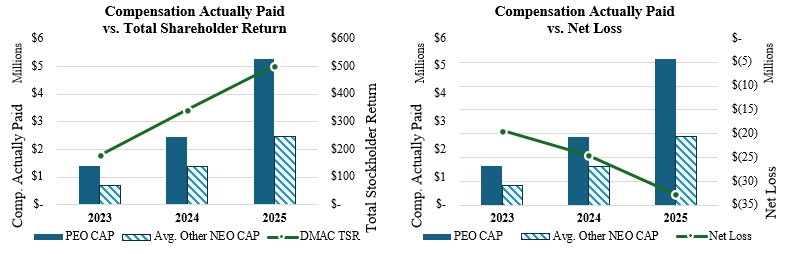
As a clinical-stage company we have incurred substantial losses since our inception and expect to continue to incur substantial losses for at least two or three years. Accordingly, we do not seek to achieve direct alignment between Compensation Actually Paid to our named executive officers and net income (loss).
The information contained in the “Pay Versus Performance Disclosure” section above shall not be deemed to be “soliciting material” or to be “filed” with the SEC, or subject to Regulation 14A or to the liabilities of Section 18 of the Exchange Act, nor shall it be deemed to be incorporated by reference into any filing under the Securities Act of 1933, as amended, or the Exchange Act.
Equity Compensation Plan Information
The following table summarizes outstanding options and other awards under our equity compensation plans as of December 31, 2025.
|
Plan Category |
Securities to be Issued Upon Exercise of Outstanding Options, Warrants and Rights |
Weighted-Average Exercise Price of Outstanding Options, Warrants and Rights(a) |
Number of Securities Remaining Available for Future Issuance Under Equity Compensation Plans(b) |
||||||
|
Equity compensation plans approved by security holders |
5,939,369(c) |
3.89 |
948,666 |
||||||
|
Equity compensation plans not approved by security holders(d) |
1,100,000 |
5.29 |
653,125 |
||||||
|
Total |
7,039,369 |
4.11 |
1,601,791 |
|
(a) |
Calculation excludes 164,770 shares subject to DSU awards under the 2019 Plan and 9,745 shares subject to DSU awards under the DSU Plan because they do not have an exercise price. |
|
(b) |
Amount includes 948,666 shares remaining available for future issuance under the 2019 Plan and 653,125 remaining available for future issuance under the Inducement Plan. |
|
(c) |
Amount includes 5,402,444 common shares issuable upon the exercise of stock options and 164,770 common shares issuable upon the settlement of DSU awards outstanding under the 2019 Plan, 362,410 common shares issuable upon the exercise of stock options under the Prior Plan and 9,745 common shares issuable under the DSU Plan. |
|
(d) |
On December 3, 2021, the Board adopted Inducement Plan to facilitate the granting of equity awards as an inducement material to new employees joining the Company. The Inducement Plan was adopted without shareholder approval pursuant to Nasdaq Listing Rule 5635(c)(4) and is administered by the Compensation Committee of the Board of Directors. The Board reserved 1,000,000 common shares of the Company for issuance under the Inducement Plan, which permits the grant of non-statutory options, stock appreciation rights, restricted stock awards, restricted stock units, performance awards and other share-based awards, to eligible recipients. The only persons eligible to receive awards under the Inducement Plan are individuals who are new employees and satisfy the standards for inducement grants under Nasdaq Listing Rule 5635(c)(4) or 5635(c)(3), as applicable. Also on December 3, 2021, the Compensation Committee adopted a form of notice of option grant and option award agreement for use under the Inducement Plan, which contains terms substantially identical to the form of notice of option grant and option award agreement for use under the shareholder-approved 2019 Plan. The Inducement Plan has a term of 10 years. The share reserve under the Inducement Plan may be increased at the discretion of and approval by the Board and, on July 31, 2025, the Board increased the number of common shares reserved for issuance under the plan to 2,000,000. As of December 31, 2025, 1,100,000 option awards were outstanding under the Inducement Plan. |
Anti-Hedging and Pledging Policy
DiaMedica has determined that there is a heightened legal risk and/or the appearance of improper or inappropriate conduct if officers, directors and employees engage in certain types of transactions in DiaMedica’s securities that hedge or offset, or are designed to hedge or offset, any decrease in the market value of DiaMedica’s equity securities. Therefore, DiaMedica’s Insider Trading Policy provides that officers, directors and employees must comply with the following policies with respect to certain transactions in DiaMedica’s securities:
|
● |
Short Sales. Short sales of DiaMedica’s securities evidence an expectation on the part of the seller that the securities will decline in value, and therefore signal to the market that the seller has no confidence in DiaMedica or its short-term prospects. In addition, short sales may reduce the seller’s incentive to improve DiaMedica’s performance. For these reasons, short sales of DiaMedica’s securities are prohibited. |
|
● |
Publicly Traded Options. A transaction in options is, in effect, a bet on the short-term movement of DiaMedica’s common shares and therefore creates the appearance that an officer, director or employee is trading based on inside information. Transactions in options also may focus an officer’s, director’s or employee’s attention on short-term performance at the expense of DiaMedica’s long-term objectives. Accordingly, transactions in puts, calls or other derivative securities involving DiaMedica’s equity securities, on an exchange or in any other organized market, are prohibited. |
|
● |
Hedging Transactions. Certain forms of hedging or monetization transactions, such as zero-cost collars and forward sale contracts, allow an officer, director or employee to lock in much of the value of his or her stock holdings, often in exchange for all or part of the potential for upside appreciation in the stock. These transactions allow the officer, director or employee to continue to own the covered securities, but without the full risks and rewards of ownership. When that occurs, the officer, director or employee may no longer have the same objectives as DiaMedica’s other shareholders. Therefore, such transactions involving DiaMedica’s equity securities are prohibited. |
|
● |
Purchases of DiaMedica’s Securities on Margin; Pledging DiaMedica’s Securities to Secure Margin or Other Loans. Purchasing on margin means borrowing from a brokerage firm, bank or other entity in order to purchase DiaMedica’s securities (other than in connection with a cashless exercise of stock options through a broker under DiaMedica’s equity plans). Margin purchases of DiaMedica’s securities are prohibited. Pledging DiaMedica’s securities as collateral to secure loans is also prohibited. This prohibition means, among other things, that directors, officers and employees cannot hold DiaMedica’s securities in a “margin account.” |
The information contained in this “Anti-Hedging and Pledging Policy” section shall not be deemed to be “soliciting material” or to be “filed” with the SEC, or subject to Regulation 14A or to the liabilities of Section 18 of the Exchange Act, nor shall it be deemed to be incorporated by reference into any filing under the Securities Act or the Exchange Act.
RELATED PERSON RELATIONSHIPS AND TRANSACTIONS
Related Party Transactions Disclosure
Below is a description of transactions that have occurred during the past two fiscal years, or any currently proposed transactions, to which we were or are a participant and in which:
|
● |
the amounts involved exceeded or will exceed the lesser of: $120,000 or one percent of the average of our total assets at year end for the last two completed fiscal years; and |
|
● |
a related person (including any director, director nominee, executive officer, holder of more than five percent of our common shares or any member of their immediate family) had or will have a direct or indirect material interest. |
Stock Purchases
On June 25, 2024, we issued and sold an aggregate 4,720,000 common shares pursuant to a securities purchase agreement at a purchase price of $2.50 per share in a private placement. As a result of the offering, we received gross proceeds of $11.8 million, which resulted in net proceeds to us of approximately $11.7 million, after deducting the offering expenses. The following beneficial owners of more than five percent of our common shares participated in the private placement:
|
Beneficial Owner |
Total Purchase Price |
Common Shares Purchased |
||||||
|
TomEnterprise AB |
$ | 3,000,000 | 1,200,000 | |||||
|
Trill AB |
3,000,000 | 1,200,000 | ||||||
In connection with the June 2024 private placement, we entered into a registration rights agreement with the investors pursuant to which we agreed to file with the SEC a registration statement registering the resale of the shares sold in the June 2024 private placement. This resale registration statement was filed with the SEC on July 10, 2024 and declared effective by the SEC on July 18, 2024. Under the terms of the registration rights agreement, we agreed to keep this resale registration statement effective at all times until the shares are no longer considered “Registrable Securities” under the registration rights agreement and if we fail to keep the resale registration statement effective, subject to certain permitted exceptions, we will be required to pay liquidated damages to the investors in an amount of up to 10% of the invested capital, excluding interest. We also agreed, among other things, to indemnify the selling holders under the resale registration statement from certain liabilities and to pay all fees and expenses incident to our performance of or compliance with the registration rights agreement.
Indemnification Agreements
We are party to indemnification agreements with all of our directors and executive officers. The indemnification agreements provide, among other things, for indemnification, to the fullest extent permitted by law and our Articles, against any and all expenses (including attorneys’ fees) and liabilities, judgments, fines and amounts paid in settlement that are paid or incurred by the executive or on his or her behalf in connection with such action, suit or proceeding. The indemnification agreements also set forth procedures that apply in the event an executive requests indemnification or an expense advance.
DiaMedica has not identified any arrangements or agreements relating to compensation provided by a third party to DiaMedica’s directors or director nominees in connection with their candidacy or board service as required to be disclosed pursuant to Nasdaq Rule 5250(b)(3).
Policies and Procedures for Related Party Transactions
The Board of Directors has delegated to the Audit Committee, pursuant to the terms of a written policy and the formal written charter of the Audit Committee, the authority to review, approve and ratify related party transactions. If it is not feasible for the Audit Committee to take an action with respect to a proposed related party transaction, the Board of Directors or another committee, may approve or ratify it. No member of the Board of Directors or any committee may participate in any review, consideration or approval of any related party transaction with respect to which such member or any of his or her immediate family members is the related party.
Our policy defines a “related party transaction” as a transaction, arrangement or relationship (or any series of similar transactions, arrangements or relationships) in which we (including any of our subsidiaries and affiliates) were, are or will be a participant and in which any related party had, has or will have a direct or indirect interest (other than solely as a result of being a director or less than 10 percent beneficial owner of another entity).
Prior to entering into or amending any related party transaction, the party involved must provide notice to our Chief Financial Officer of the facts and circumstances of the proposed transaction, including:
|
● |
the related party’s relationship to us and his or her interest in the transaction; |
|
● |
the material facts of the proposed related party transaction, including the proposed aggregate value of such transaction or, in the case of indebtedness, the amount of principal that would be involved; |
|
● |
the purpose and benefits of the proposed related party transaction with respect to us; |
|
● |
if applicable, the availability of other sources of comparable products or services; and |
|
● |
an assessment of whether the proposed related party transaction is on terms that are comparable to the terms available to an unrelated third party or to employees generally. |
If the Chief Financial Officer determines the proposed transaction is a related party transaction in which the amount involved will or may be expected to exceed $10,000 in any calendar year, the proposed transaction will be submitted to the Audit Committee for consideration. In determining whether to approve a proposed related party transaction, the Audit Committee, or where submitted to the Chair of the Audit Committee, the Chair of the Audit Committee, will consider, among other things, the following:
|
● |
the purpose of the transaction; |
|
● |
the benefits of the transaction to us; |
|
● |
the impact on a director’s independence in the event the related party is a non-employee director, an immediate family member of a non-employee director or an entity in which a non-employee director is a partner, shareholder or executive officer; |
|
● |
the availability of other sources for comparable products or services; |
|
● |
the terms of the transaction; and |
|
● |
the terms available to unrelated third parties or to employees generally. |
Under our policy, certain related party transactions as defined under our policy will be deemed to be pre-approved by the Audit Committee and will not be subject to these procedures.
SHAREHOLDER PROPOSALS
FOR THE NEXT ANNUAL GENERAL MEETING
Shareholders who, in accordance with Rule 14a-8 under the Exchange Act, wish to present proposals for inclusion in the Company’s proxy materials relating to its 2027 Annual General Meeting of Shareholders must submit their proposals so that they are received by us at our principal executive offices no later than the close of business on December 2, 2026, unless the date of the 2027 Annual General Meeting of Shareholders is delayed by more than 30 calendar days. The proposals must satisfy the requirements of the proxy rules promulgated by the SEC. Submission of any such proposal does not guarantee its inclusion in the Company’s proxy materials.
Any other shareholder proposals to be presented at the 2027 Annual General Meeting of Shareholders (other than a director nomination) must be given in writing to our Corporate Secretary and must be delivered to or mailed and received at our registered office no later than the close of business on February 20, 2027, which is the date that is three months before the anniversary of the previous year’s annual reference date. Any such proposal must satisfy the requirements of the BCBCA. Subject to the BCBCA, a registered owner or beneficial owner of one or more shares that carry the right to vote at general meetings and who has been a registered owner or beneficial owner of one or more such shares for an uninterrupted period of at least two years may submit to us a notice of any matter that the person wishes to have considered at our next annual general meeting.
A shareholder wishing to nominate a candidate for election to the Board of Directors at the 2027 Annual General Meeting of Shareholders must give notice to our Chief Executive Officer at our principal executive offices at 301 Carlson Parkway, Suite 210, Minneapolis, Minnesota 55305, or our registered office no earlier than January 20, 2027 (120 days prior to the one-year anniversary of the Annual Meeting) and not later than 5:00 p.m. (CDT) on February 19, 2027 (90 days prior to the one-year anniversary of the Annual Meeting).
In addition to satisfying the foregoing requirements, to comply with the universal proxy rules, shareholders who intend to solicit proxies in support of director nominees for election at the next annual meeting of shareholders, other than the Company’s nominees, must provide notice that sets forth the information required by Rule 14a-19 under the Exchange Act by March 22, 2027 (60 days prior to the one-year anniversary of the Annual Meeting).
We encourage shareholders who wish to submit a proposal or nomination to seek legal counsel. The Company reserves the right to reject, rule out of order, or take appropriate action with respect to any nomination that does not comply with these and other applicable requirements.
COPIES OF 2025 ANNUAL REPORT AND ADDITIONAL INFORMATION
We have sent or made electronically available to each of our shareholders a copy of our Annual Report on Form 10-K (without exhibits) for the fiscal year ended December 31, 2025. Our 2025 Annual Report includes our financial information included in our consolidated annual financial statements and the related Management’s Discussion and Analysis of Financial Condition and Results of Operations for the fiscal year ended December 31, 2025. Our 2025 Annual Report is electronically available on our website at www.diamedica.com, by accessing the SEC’s EDGAR filing database at www.sec.gov or on SEDAR+ at www.sedarplus.ca. The exhibits to our Form 10-K are available by accessing the SEC’s EDGAR filing database at www.sec.gov. We will furnish a copy of any exhibit to our Form 10-K upon receipt from any such person of a written request for such exhibits upon the payment of our reasonable expenses in furnishing the exhibits. This request should be sent to: DiaMedica Therapeutics Inc., 301 Carlson Parkway, Suite 210, Minneapolis, Minnesota 55305, Attention: Shareholder Information.
HOUSEHOLDING
We have adopted a procedure approved by the SEC called “householding,” by which certain shareholders who do not participate in electronic delivery of proxy materials but who have the same address and appear to be members of the same family receive only one copy of our annual report and proxy statement. Each shareholder participating in householding continues to receive a separate proxy card. Householding reduces both the environmental impact of our annual meetings and our mailing and printing expenses.
If you would like to change your householding election, request that a single copy of the proxy materials be sent to your address, or request a separate copy of the proxy materials, please contact Broadridge Financial Solutions, Inc., by calling (866) 540-7095 or by writing to Broadridge Householding Department, 51 Mercedes Way, Edgewood, New York 11717. We will promptly deliver the notice of internet availability or proxy materials to you upon receipt of your request. If you hold your shares in street name, please contact your bank, broker, or other record holder to request information about householding.
ADDITIONAL MATTERS
As of the date of this proxy statement, management knows of no matters that will be presented for determination at the annual meeting other than those referred to herein. If any other matters properly come before the annual meeting calling for a vote of shareholders, it is intended that the shares represented by the proxies solicited by the Board will be voted by the persons named therein in accordance with their best judgment.
Your vote is important. Whether or not you plan to attend the meeting in person, vote your shares of DiaMedica common shares by the Internet or telephone, or request a paper proxy card to sign, date, and return by mail so that your shares may be voted.
|
By Order of the Board of Directors 
James Parsons Chairman of the Board |
April 1, 2026
Minneapolis, Minnesota
Appendix A
to Proxy Statement
DIAMEDICA THERAPEUTICS INC.
AMENDED AND RESTATED
2019 OMNIBUS INCENTIVE PLAN
Table of Contents
Page
|
1 |
Purpose of Plan. |
A-2 |
|
2 |
Definitions. |
A-2 |
|
3 |
Plan Administration. |
A-6 |
|
4 |
Shares Available for Issuance. |
A-8 |
|
5 |
Participation. |
A-9 |
|
6 |
Options. |
A-9 |
|
7 |
Stock Appreciation Rights. |
A-11 |
|
8 |
Restricted Stock Awards, Restricted Stock Units and Deferred Stock Units. |
A-12 |
|
9 |
Performance Awards. |
A-13 |
|
10 |
Non-Employee Director Awards. |
A-15 |
|
11 |
Other Stock-Based Award |
A-15 |
|
12 |
Dividend Equivalents. |
A-16 |
|
13 |
Effect of Termination of Employment or other Service. |
A-16 |
|
14 |
Payment of Withholding Taxes. |
A-19 |
|
15 |
Change in Control. |
A-19 |
|
16 |
Rights of Eligible Recipients and Participants; Transferability. |
A-21 |
|
17 |
Securities Law and Other Restrictions. |
A-22 |
|
18 |
Deferred Compensation; Compliance with Section 409A. |
A-23 |
|
19 |
Amendment, Modification and Termination. |
A-23 |
|
20 |
Substituted Awards. |
A-24 |
|
21 |
Duration of the Plan. |
A-24 |
|
22 |
Miscellaneous. |
A-24 |
DIAMEDICA THERAPEUTICS INC.
AMENDED AND RESTATED 2019 OMNIBUS INCENTIVE PLAN
|
1. |
Purpose of Plan. |
The purpose of the DiaMedica Therapeutics Inc. Amended and Restated 2019 Omnibus Incentive Plan (this “Plan”) is to advance the interests of DiaMedica Therapeutics Inc. a corporation governed under the laws of British Columbia (the “Company”), and its shareholders by enabling the Company and its Subsidiaries to attract and retain qualified individuals to perform services for the Company and its Subsidiaries, providing incentive compensation for such individuals that is linked to the growth and profitability of the Company and increases in shareholder value and aligning the interests of such individuals with the interests of its shareholders through opportunities for equity participation in the Company. The original version of this Plan initially became effective upon its approval by the Company’s shareholders on May 22, 2019, and was subsequently effective May 18, 2022 and May 22, 2024.This further amendment and restatement has been approved by the Board on March 16, 2026 and shall become effective upon approval by the shareholders of the Company on May 20, 2026, which shall be considered the date of its adoption for purposes of Treasury Regulation §1.422-2(b)(2)(i). If the Company’s shareholders fail to approve this amendment and restatement of the Plan by December 31, 2026, this amendment and restatement will be of no further force or effect.
|
2. |
Definitions. |
The following terms will have the meanings set forth below, unless the context clearly otherwise requires. Terms defined elsewhere in this Plan will have the same meaning throughout this Plan.
2.1. “Adverse Action” means any action or conduct by a Participant that the Committee, in its sole discretion, determines to be injurious, detrimental, prejudicial or adverse to the interests of the Company or any Subsidiary, including: (a) disclosing confidential information of the Company or any Subsidiary to any person not authorized by the Company or Subsidiary to receive it, (b) engaging, directly or indirectly, in any commercial activity that in the judgment of the Committee competes with the business of the Company or any Subsidiary or (c) interfering with the relationships of the Company or any Subsidiary and their respective employees, independent contractors, customers, prospective customers and vendors.
2.2. “Affiliate” means, with respect to any Person, any other Person directly or indirectly controlling, controlled by or under common control with, such Person where “control” will have the meaning given such term under Rule 405 of the Securities Act.
2.3. “Applicable Law” means any applicable law, including without limitation, (a) provisions of the Code, the Securities Act, the Exchange Act and any rules or regulations thereunder; (b) corporate, securities, tax or other laws, statutes, rules, requirements or regulations, whether federal, state, provincial, local or foreign; and (c) rules of any securities exchange, national market system or automated quotation system on which the Shares are listed, quoted or traded.
2.4. “Award” means, individually or collectively, an Option, Stock Appreciation Right, Restricted Stock Award, Restricted Stock Unit, Deferred Stock Unit, Performance Award, Non-Employee Director Award, or Other Stock-Based Award, in each case granted to an Eligible Recipient pursuant to this Plan.
2.5. “Award Agreement” means either: (a) a written or electronic (as provided in Section 22.7) agreement entered into by the Company and a Participant setting forth the terms and provisions applicable to an Award granted under this Plan, including any amendment or modification thereof, or (b) a written or electronic (as provided in Section 22.7) statement issued by the Company to a Participant describing the terms and provisions of such an Award, including any amendment or modification thereof.
2.6. “Board” means the Board of Directors of the Company.
2.7. “Broker Exercise Notice” means a written notice pursuant to which a Participant, upon exercise of an Option, irrevocably instructs a broker or dealer to sell a sufficient number of Shares to pay all or a portion of the exercise price of the Option and/or any related withholding tax obligations and remit such sums to the Company and directs the Company to deliver Shares to be issued upon such exercise directly to such broker or dealer or its nominee.
2.8. “Cause” means, unless otherwise provided in an Award Agreement, (a) “Cause” as defined in any employment, consulting, severance or similar agreement between the Participant and the Company or one of its Subsidiaries or Affiliates (an “Individual Agreement”), or (b) if there is no such Individual Agreement or if it does not define Cause: (i) dishonesty, fraud, misrepresentation, embezzlement or deliberate injury or attempted injury, in each case related to the Company or any Subsidiary; (ii) any unlawful or criminal activity of a serious nature; (iii) any intentional and deliberate breach of a duty or duties that, individually or in the aggregate, are material in relation to the Participant’s overall duties; (iv) any material breach by a Participant of any employment, service, confidentiality, non-compete or non-solicitation agreement entered into with the Company or any Subsidiary; or (v) before a Change in Control, such other events as will be determined by the Committee. Before a Change in Control, the Committee will, unless otherwise provided in an Individual Agreement, have the sole discretion to determine whether “Cause” exists with respect to subclauses (i), (ii), (iii), (iv) or (v) above, and its determination will be final.
2.9. “Change in Control” means, unless otherwise provided in an Award Agreement or any Individual Agreement, and except as provided in Section 18, an event described in Section 15.1 of this Plan.
2.10. “Code” means the United States Internal Revenue Code of 1986, as amended. Any reference to a section of the Code herein will be deemed to include a reference to any applicable regulations thereunder and any successor or amended section of the Code.
2.11. “Committee” means the Board or, if the Board so delegates, the Compensation Committee of the Board or a subcommittee thereof, or any other committee delegated authority by the Board to administer this Plan. If the Board determines appropriate, such committee may be comprised solely of directors designated by the Board to administer this Plan who are (a) “non-employee directors” within the meaning of Rule 16b-3 under the Exchange Act, and (b) “independent directors” within the meaning of the rules of the Nasdaq Stock Market (or other applicable exchange or market on which the Common Shares may be traded or quoted). The members of the Committee will be appointed from time to time by and will serve at the discretion of the Board. Any action duly taken by the Committee will be valid and effective, whether or not the members of the Committee at the time of such action are later determined not to have satisfied the requirements of membership provided herein.
2.12. “Common Shares” or “Shares” means the voting common shares, no par value, of the Company, or the number and kind of shares of stock or other securities into which such Common Shares may be changed in accordance with Section 4.5 of this Plan.
2.13. “Company” means DiaMedica Therapeutics Inc., a corporation organized under the laws of British Columbia, and any successor thereto as provided in Section 22.5 of this Plan.
2.14. “Consultant” means a person engaged to provide consulting or advisory services (other than as an Employee or a Director) to the Company or any Subsidiary that: (a) are not in connection with the offer and sale of the Company’s securities in a capital raising transaction and (b) do not directly or indirectly promote or maintain a market for the Company’s securities.
2.15. “Deferred Stock Unit” means a right granted to an Eligible Recipient pursuant to Section 8 of this Plan to receive Shares (or the equivalent value in cash or other property if the Committee so provides) at a future time as determined by the Committee, or as determined by the Participant within guidelines established by the Committee in the case of voluntary deferral elections.
2.16. “Director” means a member of the Board.
2.17. “Disability” means, unless otherwise provided in an Award Agreement, with respect to a Participant who is a party to an Individual Agreement, which agreement contains a definition of “disability” or “permanent disability” (or words of like import) for purposes of termination of employment thereunder by the Company, “disability” or “permanent disability” as defined in the most recent of such agreements; or in all other cases, means the disability of the Participant such as would entitle the Participant to receive disability income benefits pursuant to the long-term disability plan of the Company or Subsidiary then covering the Participant or, if no such plan exists or is applicable to the Participant, the permanent and total disability of the Participant within the meaning of Section 22(e)(3) of the Code.
2.18. “Dividend Equivalents” has the meaning set forth in Section 3.2(l) of this Plan.
2.19. “Eligible Recipients” means all Employees, all Non-Employee Directors and all Consultants.
2.20. “Employee” means any individual performing services for the Company or a Subsidiary and designated as an employee of the Company or a Subsidiary on the payroll records thereof. An Employee will not include any individual during any period he or she is classified or treated by the Company or Subsidiary as an independent contractor, a consultant, or any employee of an employment, consulting or temporary agency or any other entity other than the Company or Subsidiary, without regard to whether such individual is subsequently determined to have been, or is subsequently retroactively reclassified as a common-law employee of the Company or Subsidiary during such period. An individual will not cease to be an Employee in the case of: (a) any leave of absence approved by the Company, or (b) transfers between locations of the Company or between the Company or any Subsidiaries. For purposes of Incentive Stock Options, no such leave may exceed ninety (90) days, unless reemployment upon expiration of such leave is guaranteed by statute or contract. If reemployment upon expiration of a leave of absence approved by the Company or a Subsidiary, as applicable, is not so guaranteed, then ninety (90) days following the ninety-first (91st) day of such leave, any Incentive Stock Option held by a Participant will cease to be treated as an Incentive Stock Option and will be treated for tax purposes as a Non-Statutory Stock Option. Neither service as a Director nor payment of a Director’s fee by the Company will be sufficient to constitute “employment” by the Company.
2.21. “Exchange Act” means the United States Securities Exchange Act of 1934, as amended. Any reference to a section of the Exchange Act herein will be deemed to include a reference to any applicable rules and regulations thereunder and any successor or amended section of the Exchange Act.
2.22. “Fair Market Value” means, with respect to the Common Shares, as of any date a price that is equal to the closing sale price of a Common Share as of the end of the regular trading session on such date, as reported by the Nasdaq Stock Market or any national securities exchange on which the Common Shares are then listed (or, if no shares were traded on such date, as of the next preceding date on which there was such a trade) or if the Common Shares are not so listed, admitted to unlisted trading privileges or reported on any national exchange, the closing sale price as of the immediately preceding trading date at the end of the regular trading session, as reported by OTC Markets Group or other comparable quotation service (or, if no shares were traded or quoted on such date, as of the next preceding date on which there was such a trade or quote). In the event the Common Shares are not publicly traded at the time a determination of its value is required to be made hereunder, the determination of Fair Market Value shall be made by the Committee in such manner as it deems appropriate and in good faith in the exercise of its reasonable discretion, and consistent with the definition of “fair market value” under Section 409A of the Code. If determined by the Committee, such determination will be final, conclusive and binding for all purposes and on all persons, including the Company, the shareholders of the Company, the Participants and their respective successors-in-interest. No member of the Committee will be liable for any determination regarding the fair market value of the Common Shares that is made in good faith.
2.23. “Grant Date” means the date an Award is granted to a Participant pursuant to this Plan and as determined pursuant to Section 5 of this Plan.
2.24. “Incentive Stock Option” means a right to purchase Common Shares granted to an Employee pursuant to Section 6 of this Plan that is designated as and intended to meet the requirements of an “incentive stock option” within the meaning of Section 422 of the Code.
2.25. “Individual Agreement” has the meaning set forth in Section 2.8 of this Plan.
2.26. “Non-Employee Director” means a Director who is not an Employee.
2.27. “Non-Employee Director Award” means any Award granted, whether singly, in combination, or in tandem, to an Eligible Recipient who is a Non-Employee Director, pursuant to such applicable terms, conditions and limitations as the Board or Committee may establish in accordance with this Plan, including any Non-Employee Director Option.
2.28. “Non-Employee Director Option” means a Non-Statutory Stock Option granted to a Non-Employee Director pursuant to Section 10 of this Plan.
2.29. “Non-Statutory Stock Option” means a right to purchase Common Shares granted to an Eligible Recipient pursuant to Section 6 of this Plan that is not intended to meet the requirements of or does not qualify as an Incentive Stock Option.
2.30. “Option” means an Incentive Stock Option or a Non-Statutory Stock Option, including a Non-Employee Director Option.
2.31. “Other Stock-Based Award” means an Award, denominated in Shares, not otherwise described by the terms of this Plan, granted pursuant to Section 11 of this Plan.
2.32. “Participant” means an Eligible Recipient who receives one or more Awards under this Plan.
2.33. “Performance Award” means a right granted to an Eligible Recipient pursuant to Section 9 of this Plan to receive an amount of cash, number of Shares, or a combination of both, contingent upon and the value of which at the time it is payable is determined as a function of the extent of the achievement of one or more Performance Goals during a specified Performance Period or the achievement of other objectives during a specified period.
2.34. “Performance Goals” mean with respect to any applicable Award, one or more targets, goals or levels of attainment required to be achieved during the specified Performance Period, as set forth in the related Award Agreement.
2.35. “Performance Period” means the period of time, as determined by the Committee, during which the Performance Goals must be met in order to determine the degree of payout or vesting with respect to an Award.
2.36. “Period of Restriction” means the period when a Restricted Stock Award or Restricted Stock Units are subject to a substantial risk of forfeiture (based on the passage of time, the achievement of Performance Goals, or upon the occurrence of other events as determined by the Committee, in its discretion), as provided in Section 8 of this Plan.
2.37. “Person” means an individual, partnership, corporation, limited liability company, business trust, joint stock company, trust, unincorporated association, joint venture, governmental authority or any other entity of whatever nature.
2.38. “Plan” means this DiaMedica Therapeutics Inc. Amended and Restated 2019 Omnibus Incentive Plan, as may be amended from time to time.
2.39. “Plan Year” means the Company’s fiscal year.
2.40. “Previously Acquired Shares” means Shares that are already owned by the Participant or, with respect to any Award, that are to be issued to the Participant upon the grant, exercise, vesting or settlement of such Award.
2.41. “Restricted Stock Award” means an award of Common Shares granted to an Eligible Recipient pursuant to Section 8 of this Plan that is subject to the restrictions on transferability and the risk of forfeiture imposed by the provisions of such Section 8.
2.42. “Restricted Stock Unit” means an award denominated in Shares granted to an Eligible Recipient pursuant to Section 8 of this Plan.
2.43. “Retirement,” means, unless otherwise defined in the Award Agreement or in an Individual Agreement between the Participant and the Company or one of its Subsidiaries or Affiliates, “Retirement” as defined from time to time for purposes of this Plan by the Committee or by the Company’s chief human resources officer or other person performing that function or, if not so defined, means voluntary termination of employment or service by the Participant on or after the date the Participant reaches age fifty-five (55) with the present intention to leave the Company’s industry or to leave the general workforce.
2.44. “Securities Act” means the United States Securities Act of 1933, as amended. Any reference to a section of the Securities Act herein will be deemed to include a reference to any applicable rules and regulations thereunder and any successor or amended section of the Securities Act.
2.45. “Stock Appreciation Right” means a right granted to an Eligible Recipient pursuant to Section 7 of this Plan to receive a payment from the Company upon exercise, in the form of Shares, cash or a combination of both, equal to the difference between the Fair Market Value of one or more Shares and the grant price of such shares under the terms of such Stock Appreciation Right.
2.46. “Stock-Based Award” means any Award, denominated in Shares, made pursuant to this Plan, including Options, Stock Appreciation Rights, Restricted Stock, Restricted Stock Units, Deferred Stock Units, Performance Awards or Other Stock-Based Awards.
2.47. “Subsidiary” means any corporation or other entity, whether domestic or foreign, in which the Company has or obtains, directly or indirectly, an interest of more than fifty percent (50%) by reason of stock ownership or otherwise.
2.48. “Tax Date” means the date any withholding or employment related tax obligation arises under the Code or any Applicable Law for a Participant with respect to an Award.
2.49. “Tax Laws” has the meaning set forth in Section 22.8 of this Plan.
|
3. |
Plan Administration. |
3.1. The Committee. This Plan will be administered by the Committee. The Committee will act by majority approval of the members at a meeting or by unanimous written consent, and a majority of the members of the Committee will constitute a quorum. The Committee may exercise its duties, power and authority under this Plan in its sole discretion without the consent of any Participant or other party, unless this Plan specifically provides otherwise. The Committee will not be obligated to treat Participants or Eligible Recipients uniformly, and determinations made under this Plan may be made by the Committee selectively among Participants or Eligible Recipients, whether or not such Participants and Eligible Recipients are similarly situated. Each determination, interpretation or other action made or taken by the Committee pursuant to the provisions of this Plan will be final, conclusive and binding for all purposes and on all persons, and no member of the Committee will be liable for any action or determination made in good faith with respect to this Plan or any Award granted under this Plan.
3.2. Authority of the Committee. In accordance with and subject to the provisions of this Plan, the Committee will have full and exclusive discretionary power and authority to take such actions as it deems necessary and advisable with respect to the administration of this Plan, including the following:
(a) To designate the Eligible Recipients to be selected as Participants;
(b) To determine the nature, extent and terms of the Awards to be made to each Participant, including the amount of cash or number of Shares to be subject to each Award, any exercise price or grant price, the manner in which Awards will vest, become exercisable, settled or paid out and whether Awards will be granted in tandem with other Awards, and the form of Award Agreement, if any, evidencing such Award;
(c) To determine the time or times when Awards will be granted;
(d) To determine the duration of each Award;
(e) To determine the terms, restrictions and other conditions to which the grant of an Award or the payment or vesting of Awards may be subject;
(f) To construe and interpret this Plan and Awards granted under it, and to establish, amend and revoke rules and regulations for its administration and in so doing, to correct any defect, omission, or inconsistency in this Plan or in an Award Agreement, in a manner and to the extent it will deem necessary or expedient to make this Plan fully effective;
(g) To determine Fair Market Value in accordance with Section 2.22 of this Plan;
(h) To amend this Plan or any Award Agreement, as provided in this Plan;
(i) To adopt subplans or special provisions applicable to Awards regulated by the laws of a jurisdiction other than, and outside of, the United States, which except as otherwise provided in this Plan, such subplans or special provisions may take precedence over other provisions of this Plan;
(j) To authorize any person to execute on behalf of the Company any Award Agreement or any other instrument required to effect the grant of an Award previously granted by the Committee;
(k) To determine whether Awards will be settled in Shares, cash or in any combination thereof;
(l) To determine whether Awards will be adjusted for dividend equivalents, with “Dividend Equivalents” meaning a credit, made at the discretion of the Committee, to the account of a Participant in an amount equal to the cash dividends paid on one Common Share for each Common Share represented by an Award held by such Participant, subject to Section 12 of this Plan and any other provision of this Plan, and which Dividend Equivalents may be subject to the same conditions and restrictions as the Awards to which they attach and may be settled in the form of cash, Shares, or in any combination of both; and
(m) To impose such restrictions, conditions or limitations as it determines appropriate as to the timing and manner of any resales by a Participant or other subsequent transfers by the Participant of any Shares, including restrictions under an insider trading policy, stock ownership guidelines, restrictions as to the use of a specified brokerage firm for such resales or other transfers and other restrictions designed to increase equity ownership by Participants or otherwise align the interests of Participants with the Company’s shareholders.
3.3. Delegation. To the extent permitted by Applicable Law, the Committee may delegate to one or more of its members or to one or more officers of the Company or any Subsidiary or to one or more agents or advisors such administrative duties or powers as it may deem advisable, and the Committee or any individuals to whom it has delegated duties or powers as aforesaid may employ one or more individuals to render advice with respect to any responsibility the Committee or such individuals may have under this Plan. The Committee may, by resolution, authorize one or more directors of the Company or one or more officers of the Company to do one or both of the following on the same basis as can the Committee: (a) designate Eligible Recipients to be recipients of Awards pursuant to this Plan; and (b) determine the size of any such Awards; provided, however, that (x) the Committee will not delegate such responsibilities to any such director(s) or officer(s) for any Awards granted to an Eligible Recipient: (i) who is a Non-Employee Director or who is subject to the reporting and liability provisions of Section 16 under the Exchange Act, or (ii) to whom authority to grant or amend Awards has been delegated hereunder; provided, further; that any delegation of administrative authority will only be permitted to the extent it is permissible under Applicable Law; (y) the resolution providing such authorization will set forth the type of Awards and total number of each type of Awards such director(s) or officer(s) may grant; and (z) such director(s) or officer(s) will report periodically to the Committee regarding the nature and scope of the Awards granted pursuant to the authority delegated. At all times, the delagatee appointed under this Section 3.3 will serve in such capacity at the pleasure of the Committee.
3.4. No Re-pricing. Notwithstanding any other provision of this Plan other than Section 4.5 of this Plan, the Committee may not, without prior approval of the Company’s shareholders, seek to effect any re-pricing of any previously granted, “underwater” Option or Stock Appreciation Right by: (a) amending or modifying the terms of the Option or Stock Appreciation Right to lower the exercise price or grant price; (b) canceling the underwater Option or Stock Appreciation Right in exchange for (i) cash; (ii) replacement Options or Stock Appreciation Rights having a lower exercise price or grant price; or (iii) other Awards; or (c) repurchasing the underwater Options or Stock Appreciation Rights and granting new Awards under this Plan. For purposes of this Section 3.4, an Option or Stock Appreciation Right will be deemed to be “underwater” at any time when the Fair Market Value of the Common Shares is less than the exercise price of the Option or grant price of the Stock Appreciation Right.
3.5. Participants Based Outside of the United States. In addition to the authority of the Committee under Section (i) and notwithstanding any other provision of this Plan, the Committee may, in its sole discretion, amend the terms of this Plan or Awards with respect to Participants resident outside of the United States or employed by a non-U.S. Subsidiary in order to comply with local legal requirements, to otherwise protect the Company’s or Subsidiary’s interests or to meet objectives of this Plan, and may, where appropriate, establish one or more sub-plans (including the adoption of any required rules and regulations) for the purposes of qualifying for preferred tax treatment under foreign tax laws. The Committee will have no authority, however, to take action pursuant to this Section 3.5: (a) to reserve Shares or grant Awards in excess of the limitations provided in Section 4.1 of this Plan; (b) to effect any re-pricing in violation of Section 3.4 of this Plan; (c) to grant Options or Stock Appreciation Rights having an exercise price or grant price less than one hundred percent (100%) of the Fair Market Value of one Share on the Grant Date in violation of Section 6.3 or Section 7.3 of this Plan; or (d) for which shareholder approval would then be required pursuant to Section 19.2 of this Plan.
|
4. |
Shares Available for Issuance. |
4.1. Maximum Number of Shares Available. Subject to adjustment as provided in Section 4.5 of this Plan, the maximum number of Shares that will be available for issuance under this Plan shall not exceed 10,500,000.
4.2. Limits on Incentive Stock Options and Non-Employee Director Compensation. Notwithstanding any other provisions of this Plan to the contrary and subject to adjustment as provided in Section 4.5 of this Plan,
(a) the maximum aggregate number of shares of Common Stock that will be available for issuance pursuant to Incentive Stock Options under this Plan may not exceed 2,000,000 shares; and
(b) the sum of any cash compensation, or other compensation, and the value (determined as of the grant date in accordance with Financial Accounting Standards Board Accounting Standards Codification Topic 718, or any successor thereto) of Awards granted to a Non-Employee Director as compensation for services as a Non-Employee Director during any fiscal year of the Company may not exceed $400,000 (increased to $600,000 with respect to any Non-Employee Director serving as Chairman of the Board or Lead Independent Director or in the fiscal year of a non-employee Director’s initial service as a Non-Employee Director) (with any compensation that is deferred counting towards this limit for the year in which the compensation is first earned, and not a later year of settlement).
4.3. Accounting for Awards. Shares that are issued under this Plan or that are subject to outstanding Awards will be applied to reduce the maximum number of Shares remaining available for issuance under this Plan only to the extent they are used; provided, however, that the full number of Shares subject to a stock-settled Stock Appreciation Right or other Stock-Based Award will be counted against the Shares authorized for issuance under this Plan, regardless of the number of Shares actually issued upon settlement of such Stock Appreciation Right or other Stock-Based Award. Furthermore, any Shares withheld to satisfy tax withholding obligations on Awards issued under this Plan, any Shares withheld to pay the exercise price or grant price of Awards under this Plan and any Shares not issued or delivered as a result of the “net exercise” of an outstanding Option pursuant to Section 6.5 or settlement of a Stock Appreciation Right in Shares pursuant to Section 7.7 will be counted against the Shares authorized for issuance under this Plan and will not be available again for grant under this Plan. Shares subject to Awards settled in cash will again be available for issuance pursuant to Awards granted under the Plan. Any Shares repurchased by the Company on the open market using the proceeds from the exercise of an Award will not increase the number of Shares available for future grant of Awards. Any shares of Common Stock related to Awards granted under this Plan that terminate by expiration, forfeiture, cancellation or otherwise without the issuance of the Shares, will be available again for grant under this Plan. To the extent permitted by Applicable Law, Shares issued in assumption of, or in substitution for, any outstanding awards of any entity acquired in any form of combination by the Company or a Subsidiary pursuant to Section 20 of this Plan or otherwise will not be counted against Shares available for issuance pursuant to this Plan. The Shares available for issuance under this Plan may be authorized and unissued shares or treasury shares.
4.4. Stock Distributed. Any Shares distributed pursuant to an Award may consist, in whole or in part, of authorized and unissued Common Shares, treasury Common Shares or Common Shares purchased on the open market.
4.5. Adjustments to Shares and Awards.
(a) In the event of any reorganization, merger, consolidation, recapitalization, liquidation, reclassification, stock dividend, stock split, combination of shares, rights offering, divestiture or extraordinary dividend (including a spin off) or any other similar change in the corporate structure or Shares the Company, the Committee (or, if the Company is not the surviving corporation in any such transaction, the board of directors of the surviving corporation) will make appropriate adjustment or substitutions (which determination will be conclusive) as to: (i) the number and kind of securities or other property (including cash) available for issuance or payment under this Plan, including the sub-limits set forth in Section 4.2 of this Plan, and (ii) in order to prevent dilution or enlargement of the rights of Participants, the number and kind of securities or other property (including cash) subject to outstanding Awards and the exercise price of outstanding Awards; provided, however, that this Section 4.5 will not limit the authority of the Committee to take action pursuant to Section 15 of this Plan in the event of a Change in Control. The determination of the Committee as to the foregoing adjustments and/or substitutions, if any, will be final, conclusive and binding on Participants under this Plan.
(b) Notwithstanding anything else herein to the contrary, without affecting the number of Shares reserved or available hereunder, the limits in Section 4.1 or 4.2 of this Plan, the Committee may authorize the issuance or assumption of benefits under this Plan in connection with any merger, consolidation, acquisition of property or stock or reorganization upon such terms and conditions as it may deem appropriate, subject to compliance with the rules under Sections 422, 424 and 409A of the Code, or any successor regulations, as and where applicable.
|
5. |
Participation. |
Participants in this Plan will be those Eligible Recipients who, in the judgment of the Committee, have contributed, are contributing or are expected to contribute to the achievement of the objectives of the Company or its Subsidiaries. Eligible Recipients may be granted from time to time one or more Awards, singly or in combination or in tandem with other Awards, as may be determined by the Committee in its sole discretion. Awards will be deemed to be granted as of the date specified in the grant resolution of the Committee, which date will be the Grant Date of any related Award Agreement with the Participant.
|
6. |
Options. |
6.1. Grant. An Eligible Recipient may be granted one or more Options under this Plan, and such Options will be subject to such terms and conditions, consistent with the other provisions of this Plan, as may be determined by the Committee in its sole discretion; provided, however, that any Option granted under this Plan shall comply with Applicable Law and applicable stock exchange rules. Incentive Stock Options may be granted solely to eligible Employees of the Company or a Subsidiary. The Committee shall designate whether an Option is to be considered an Incentive Stock Option or a Non-Statutory Stock Option. To the extent that any Incentive Stock Option (or portion thereof) granted under this Plan ceases for any reason to qualify as an “incentive stock option” for purposes of Section 422 of the Code, such Incentive Stock Option (or portion thereof) will continue to be outstanding for purposes of this Plan but will thereafter be deemed to be a Non-Statutory Stock Option. Options may be granted to an Eligible Recipient for services provided to a Subsidiary only if, with respect to such Eligible Recipient, the underlying Shares constitute “service recipient stock” within the meaning of Treas. Reg. Sec. 1.409A-1(b)(5)(iii) promulgated under the Code.
6.2. Award Agreement. Each Option grant will be evidenced by an Award Agreement that will specify the exercise price of the Option, the maximum duration of the Option, the number of Shares to which the Option pertains, the conditions upon which an Option will become vested and exercisable, and such other provisions as the Committee will determine which are not inconsistent with the terms of this Plan or applicable stock exchange rules. The Award Agreement also will specify whether the Option is intended to be an Incentive Stock Option or a Non-Statutory Stock Option.
6.3. Exercise Price. The per share price to be paid by a Participant upon exercise of an Option granted pursuant to this Section 6 will be determined by the Committee in its sole discretion at the time of the Option grant; provided, however, that such price will not be less than one hundred percent (100%) of the Fair Market Value of one Share on the Grant Date (one hundred and ten percent (110%) of the Fair Market Value if, at the time the Incentive Stock Option is granted, the Participant owns, directly or indirectly, more than ten percent (10%) of the total combined voting power of all classes of stock of the Company or any parent or subsidiary corporation of the Company).
6.4. Exercisability and Duration. An Option will become exercisable at such times and in such installments and upon such terms and conditions as may be determined by the Committee in its sole discretion at the time of grant, including (a) the achievement of one or more of the Performance Goals; or that (b) the Participant remain in the continuous employment or service with the Company or a Subsidiary for a certain period; provided, however, that no Option may be exercisable after ten (10) years from the Grant Date (five (5) years from the Grant Date in the case of an Incentive Stock Option that is granted to a Participant who owns, directly or indirectly, more than ten percent (10%) of the total combined voting power of all classes of stock of the Company or any parent or subsidiary corporation of the Company). Notwithstanding the foregoing, if the exercise of an Option that is exercisable in accordance with its terms is prevented by the provisions of Section 17 of this Plan, the Option will remain exercisable until thirty (30) days after the date such exercise first would no longer be prevented by such provisions, but in any event no later than the expiration date of such Option.
6.5. Payment of Exercise Price.
(a) The total purchase price of the Shares to be purchased upon exercise of an Option will be paid entirely in cash (including check, bank draft or money order); provided, however, that the Committee, in its sole discretion and upon terms and conditions established by the Committee, may allow such payments to be made, in whole or in part, by (i) tender of a Broker Exercise Notice; (ii) by tender, either by actual delivery or attestation as to ownership, of Previously Acquired Shares; (iii) a “net exercise” of the Option (as further described in paragraph (b), below); (iv) by a combination of such methods; or (v) any other method approved or accepted by the Committee in its sole discretion and permitted under applicable law. Notwithstanding any other provision of this Plan to the contrary, no Participant who is a Director or an “executive officer” of the Company within the meaning of Section 13(k) of the Exchange Act will be permitted to make payment with respect to any Awards granted under this Plan, or continue any extension of credit with respect to such payment with a loan from the Company or a loan arranged by the Company in violation of Section 13(k) of the Exchange Act.
(b) In the case of a “net exercise” of an Option, the Company will not require a payment of the exercise price of the Option from the Participant but will reduce the number of Shares issued upon the exercise by the largest number of whole shares that has a Fair Market Value on the exercise date that does not exceed the aggregate exercise price for the shares exercised under this method. Shares will no longer be outstanding under an Option (and will therefore not thereafter be exercisable) following the exercise of such Option to the extent of (i) shares used to pay the exercise price of an Option under the “net exercise,” (ii) shares actually delivered to the Participant as a result of such exercise and (iii) any shares withheld for purposes of tax withholding pursuant to Section 14 of this Plan.
(c) For purposes of such payment, Previously Acquired Shares tendered or covered by an attestation will be valued at their Fair Market Value on the exercise date of the Option.
6.6. Manner of Exercise. An Option may be exercised by a Participant in whole or in part from time to time, subject to the conditions contained in this Plan and in the Award Agreement evidencing such Option, by delivery in person, by facsimile or electronic transmission or through the mail of written notice of exercise to the Company at its principal executive office (or to the Company’s designee as may be established from time to time by the Company and communicated to Participants) and by paying in full the total exercise price for the Shares to be purchased in accordance with Section 6.5 of this Plan.
|
7. |
Stock Appreciation Rights. |
7.1. Grant. An Eligible Recipient may be granted one or more Stock Appreciation Rights under this Plan, and such Stock Appreciation Rights will be subject to such terms and conditions, consistent with the other provisions of this Plan, as may be determined by the Committee in its sole discretion. Stock Appreciation Rights may be granted to an Eligible Recipient for services provided to a Subsidiary only if, with respect to such Eligible Recipient, the underlying Shares constitute “service recipient stock” within the meaning of Treas. Reg. Sec. 1.409A-1(b)(5)(iii) promulgated under the Code.
7.2. Award Agreement. Each Stock Appreciation Right will be evidenced by an Award Agreement that will specify the grant price of the Stock Appreciation Right, the term of the Stock Appreciation Right, and such other provisions as the Committee will determine which are not inconsistent with the terms of this Plan.
7.3. Grant Price. The grant price of a Stock Appreciation Right will be determined by the Committee, in its discretion, at the Grant Date; provided, however, that such price may not be less than one hundred percent (100%) of the Fair Market Value of one Share on the Grant Date.
7.4. Exercisability and Duration. A Stock Appreciation Right will become exercisable at such times and in such installments as may be determined by the Committee in its sole discretion at the time of grant; provided, however, that no Stock Appreciation Right may be exercisable after ten (10) years from its Grant Date. Notwithstanding the foregoing, if the exercise of a Stock Appreciation Right that is exercisable in accordance with its terms is prevented by the provisions of Section 17 of this Plan, the Stock Appreciation Right will remain exercisable until thirty (30) days after the date such exercise first would no longer be prevented by such provisions, but in any event no later than the expiration date of such Stock Appreciation Right.
7.5. Manner of Exercise. A Stock Appreciation Right will be exercised by giving notice in the same manner as for Options, as set forth in Section 6.6 of this Plan, subject to any other terms and conditions consistent with the other provisions of this Plan as may be determined by the Committee in its sole discretion.
7.6. Settlement. Upon the exercise of a Stock Appreciation Right, a Participant will be entitled to receive payment from the Company in an amount determined by multiplying:
(a) The excess of the Fair Market Value of a Share on the date of exercise over the per share grant price; by
(b) The number of Shares with respect to which the Stock Appreciation Right is exercised.
7.7. Form of Payment. Payment, if any, with respect to a Stock Appreciation Right settled in accordance with Section 7.6 of this Plan will be made in accordance with the terms of the applicable Award Agreement, in cash, Shares or a combination thereof, as the Committee determines.
|
8. |
Restricted Stock Awards, Restricted Stock Units and Deferred Stock Units. |
8.1. Grant. An Eligible Recipient may be granted one or more Restricted Stock Awards, Restricted Stock Units or Deferred Stock Units under this Plan, and such Awards will be subject to such terms and conditions, consistent with the other provisions of this Plan, as may be determined by the Committee in its sole discretion. Restricted Stock Units will be similar to Restricted Stock Awards except that no Shares are actually awarded to the Participant on the Grant Date of the Restricted Stock Units. Restricted Stock Units and Deferred Stock Units will be denominated in Shares but paid in cash, Shares or a combination of cash and Shares as the Committee, in its sole discretion, will determine, and as provided in the Award Agreement.
8.2. Award Agreement. Each Restricted Stock Award, Restricted Stock Unit or Deferred Stock Unit grant will be evidenced by an Award Agreement that will specify the type of Award, the period(s) of restriction, the number of Shares subject to a Restricted Stock Award, or the number of Restricted Stock Units or Deferred Stock Units granted, and such other provisions as the Committee will determine that are not inconsistent with the terms of this Plan.
8.3. Conditions and Restrictions. Subject to the terms and conditions of this Plan, the Committee will impose such conditions or restrictions on a Restricted Stock Award, Restricted Stock Units or Deferred Stock Units granted pursuant to this Plan as it may deem advisable including a requirement that Participants pay a stipulated purchase price for each Share underlying a Restricted Stock Award, Restricted Stock Unit or Deferred Stock Unit, restrictions based upon the achievement of specific Performance Goals, time-based restrictions on vesting following the attainment of the Performance Goals, time-based restrictions, restrictions under Applicable Laws or holding requirements or sale restrictions placed on the Shares by the Company upon vesting of such Restricted Stock Award, Restricted Stock Units or Deferred Stock Units.
8.4. Voting Rights. Unless otherwise determined by the Committee and set forth in a Participant’s Award Agreement, to the extent permitted or required by Applicable Law, as determined by the Committee, Participants holding a Restricted Stock Award granted hereunder will be granted the right to exercise full voting rights with respect to the Shares underlying such Restricted Stock Award during the Period of Restriction. A Participant will have no voting rights with respect to any Restricted Stock Units or Deferred Stock Units granted hereunder.
8.5. Dividend Rights.
(a) Unless otherwise determined by the Committee and set forth in a Participant’s Award Agreement, to the extent permitted or required by Applicable Law, as determined by the Committee, Participants holding a Restricted Stock Award granted hereunder will have the same dividend rights as the Company’s other shareholders. Notwithstanding the foregoing any such dividends as to a Restricted Stock Award that is subject to vesting requirements will be subject to forfeiture and termination to the same extent as the Restricted Stock Award to which such dividends relate and the Award Agreement may require that any cash dividends be reinvested in additional Shares subject to the Restricted Stock Award and subject to the same conditions and restrictions as the Restricted Stock Award with respect to which the dividends were paid. In no event will dividends with respect to Restricted Stock Awards that are subject to vesting be paid or distributed until the vesting provisions of such Restricted Stock Award lapse.
(b) Unless otherwise determined by the Committee and set forth in a Participant’s Award Agreement, to the extent permitted or required by Applicable Law, as determined by the Committee, prior to settlement or forfeiture, any Restricted Stock Units or Deferred Stock Unit awarded under this Plan may, at the Committee’s discretion, carry with it a right to Dividend Equivalents. Such right entitles the Participant to be credited with an amount equal to all cash dividends paid on one Share while the Restricted Stock Unit or Deferred Stock Unit is outstanding. Dividend Equivalents may be converted into additional Restricted Stock Units or Deferred Stock Units and may (and will, to the extent required below) be made subject to the same conditions and restrictions as the Restricted Stock Units or Deferred Stock Units to which they attach. Settlement of Dividend Equivalents may be made in the form of cash, in the form of Shares, or in a combination of both. Dividend Equivalents as to Restricted Stock Units or Deferred Stock Units will be subject to forfeiture and termination to the same extent as the corresponding Restricted Stock Units or Deferred Stock Units as to which the Dividend Equivalents relate. In no event will Participants holding Restricted Stock Units or Deferred Stock Units be entitled to receive the payment of any Dividend Equivalents on such Restricted Stock Units or Deferred Stock Units until the vesting provisions of such Restricted Stock Units or Deferred Stock Units lapse.
8.6. Enforcement of Restrictions. To enforce the restrictions referred to in this Section 8, the Committee may place a legend on the stock certificates representing Restricted Stock Awards referring to such restrictions and may require the Participant, until the restrictions have lapsed, to keep the stock certificates, together with duly endorsed stock powers, in the custody of the Company or its transfer agent, or to maintain evidence of stock ownership, together with duly endorsed stock powers, in a certificateless book entry stock account with the Company’s transfer agent. Alternatively, Restricted Stock Awards may be held in non-certificated form pursuant to such terms and conditions as the Company may establish with its registrar and transfer agent or any third-party administrator designated by the Company to hold Restricted Stock Awards on behalf of Participants.
8.7. Lapse of Restrictions; Settlement. Except as otherwise provided in this Plan, including without limitation this Section 8 and 16.4 of this Plan, Shares underlying a Restricted Stock Award will become freely transferable by the Participant after all conditions and restrictions applicable to such shares have been satisfied or lapse (including satisfaction of any applicable tax withholding obligations). Upon the vesting of a Restricted Stock Unit, the Restricted Stock Unit will be settled, subject to the terms and conditions of the applicable Award Agreement, (a) in cash, based upon the Fair Market Value of the vested underlying Shares, (b) in Shares or (c) a combination thereof, as provided in the Award Agreement, except to the extent that a Participant has properly elected to defer income that may be attributable to a Restricted Stock Unit under a Company deferred compensation plan or arrangement.
8.8. Section 83(b) Election for Restricted Stock Award. If a Participant makes an election pursuant to Section 83(b) of the Code with respect to a Restricted Stock Award, the Participant must file, within thirty (30) days following the Grant Date of the Restricted Stock Award, a copy of such election with the Company and with the Internal Revenue Service, in accordance with the regulations under Section 83 of the Code. The Committee may provide in the Award Agreement that the Restricted Stock Award is conditioned upon the Participant’s making or refraining from making an election with respect to the award under Section 83(b) of the Code.
9. Performance Awards.
9.1. Grant. An Eligible Recipient may be granted one or more Performance Awards under this Plan, and such Awards will be subject to such terms and conditions, consistent with the other provisions of this Plan, as may be determined by the Committee in its sole discretion, including the achievement of one or more Performance Goals.
9.2. Award Agreement. Each Performance Award will be evidenced by an Award Agreement that will specify the amount of cash, Shares, other Awards, or combination of both to be received by the Participant upon payout of the Performance Award, any Performance Goals upon which the Performance Award is subject, any Performance Period during which any Performance Goals must be achieved and such other provisions as the Committee will determine which are not inconsistent with the terms of this Plan.
9.3. Vesting. Subject to the terms of this Plan, the Committee may impose such restrictions or conditions, not inconsistent with the provisions of this Plan, to the vesting of such Performance Awards as it deems appropriate, including the achievement of one or more of the Performance Goals.
9.4. Earning of Performance Award Payment. Subject to the terms of this Plan and the Award Agreement, after the applicable Performance Period has ended, the holder of Performance Awards will be entitled to receive payout on the value and number of Performance Awards earned by the Participant over the Performance Period, to be determined as a function of the extent to which the corresponding Performance Goals have been achieved and such other restrictions or conditions imposed on the vesting and payout of the Performance Awards has been satisfied.
9.5. Form and Timing of Performance Award Payment. Subject to the terms of this Plan, after the applicable Performance Period has ended, the holder of Performance Awards will be entitled to receive payment on the value and number of Performance Awards earned by the Participant over the Performance Period, to be determined as a function of the extent to which the corresponding Performance Goals have been achieved. Payment of earned Performance Awards will be as determined by the Committee and as evidenced in the Award Agreement. Subject to the terms of this Plan, the Committee, in its sole discretion, may pay earned Performance Awards in the form of cash, in Shares or other Awards (or in a combination thereof) equal to the value of the earned Performance Awards at the close of the applicable Performance Period. Payment of any Performance Award will be made as soon as practicable after the Committee has determined the extent to which the applicable Performance Goals have been achieved and not later than the fifteenth (15th) day of the third (3rd) month immediately following the later of the end of the Company’s fiscal year in which the Performance Period ends and any additional vesting restrictions are satisfied or the end of the calendar year in which the Performance Period ends and any additional vesting restrictions are satisfied, except to the extent that a Participant has properly elected to defer payment that may be attributable to a Performance Award under a Company deferred compensation plan or arrangement. The determination of the Committee with respect to the form and time of payment of Performance Awards will be set forth in the Award Agreement pertaining to the grant of the Performance Award. Any Shares or other Awards issued in payment of earned Performance Awards may be granted subject to any restrictions deemed appropriate by the Committee, including that the Participant remain in the continuous employment or service with the Company or a Subsidiary for a certain period.
9.6. Evaluation of Performance. The Committee may provide in any such Award Agreement including Performance Goals that any evaluation of performance may include or exclude any of the following events that occurs during a Performance Period: (a) items related to a change in accounting principles; (b) items relating to financing activities; (c) expenses for restructuring or productivity initiatives; (d) other non-operating items; (e) items related to acquisitions; (f) items attributable to the business operations of any entity acquired by the Company during the Performance Period; (g) items related to the disposal of a business or segment of a business; (h) items related to discontinued operations that do not qualify as a segment of a business under applicable accounting standards; (i) items attributable to any stock dividend, stock split, combination or exchange of stock occurring during the Performance Period; (j) any other items of significant income or expense which are determined to be appropriate adjustments; (k) items relating to unusual or extraordinary corporate transactions, events or developments; (l) items related to amortization of acquired intangible assets; (m) items that are outside the scope of the Company’s core, on-going business activities; (n) items related to acquired in-process research and development; (o) items relating to changes in tax laws; (p) items relating to major licensing or partnership arrangements; (q) items relating to asset impairment charges; (r) items relating to gains or losses for litigation, arbitration and contractual settlements; (s) foreign exchange gains and losses; or (t) items relating to any other unusual or nonrecurring events or changes in applicable laws, accounting principles or business conditions.
9.7. Adjustment of Performance Goals, Performance Periods or other Vesting Criteria. The Committee may amend or modify the vesting criteria (including any Performance Goals or Performance Periods) of any outstanding Awards based in whole or in part on the financial performance of the Company (or any Subsidiary or division, business unit or other sub-unit thereof) in recognition of unusual or nonrecurring events (including the events described in Sections 9.6 or (a) of this Plan) affecting the Company or the financial statements of the Company or of changes in applicable laws, regulations or accounting principles, whenever the Committee determines that such adjustments are appropriate in order to prevent unintended dilution or enlargement of the benefits or potential benefits intended to be made available under this Plan. The determination of the Committee as to the foregoing adjustments, if any, will be final, conclusive and binding on Participants under this Plan.
9.8. Dividend Rights. Participants holding Performance Awards granted under this Plan will not receive any cash dividends or Dividend Equivalents based on the dividends declared on Shares that are subject to such Performance Awards during the period between the date that such Performance Awards are granted and the date such Performance Awards are settled.
10. Non-Employee Director Awards.
10.1. Automatic and Non-Discretionary Awards to Non-Employee Directors. Subject to such terms and conditions, consistent with the other provisions of this Plan, the Committee at any time and from time to time may approve resolutions providing for the automatic grant to Non-Employee Directors of Non-Employee Director Awards granted under this Plan and may grant to Non-Employee Directors such discretionary Non-Employee Director Awards on such terms and conditions, consistent with the other provisions of this Plan, as may be determined by the Committee in its sole discretion, and set forth in an applicable Award Agreement.
10.2. Deferral of Award Payment; Election to Receive Award in Lieu of Retainers. The Committee may permit Non-Employee Directors the opportunity to defer the payment of an Award pursuant to such terms and conditions as the Committee may prescribe from time to time. In addition, the Committee may permit Non-Employee Directors to elect to receive, pursuant to the procedures established by the Board or a committee of the Board, all or any portion of their annual retainers, meeting fees, or other fees in Restricted Stock, Restricted Stock Units, Deferred Stock Units or other Stock-Based Awards as contemplated by this Plan in lieu of cash.
11. Other Stock-Based Award
11.1. Other Stock-Based Awards. Subject to such terms and conditions, consistent with the other provisions of this Plan, as may be determined by the Committee in its sole discretion, the Committee may grant Other Stock-Based Awards to Eligible Recipients not otherwise described by the terms of this Plan (including the grant or offer for sale of unrestricted Shares) in such amounts and subject to such terms and conditions as the Committee will determine. Such Awards may involve the transfer of actual Shares to Participants as a bonus or in lieu of obligations to pay cash or deliver other property under this Plan or under other plans or compensatory arrangements, or payment in cash or otherwise of amounts based on the value of Shares, and may include Awards designed to comply with or take advantage of the applicable local laws of jurisdictions other than the United States.
11.2. Value of Other Stock-Based Awards. Each Other Stock-Based Award will be expressed in terms of Shares or units based on Shares, as determined by the Committee. The Committee may establish Performance Goals in its discretion for any Other Stock-Based Award. If the Committee exercises its discretion to establish Performance Goals for any such Awards, the number or value of Other Stock-Based Awards that will be paid out to the Participant will depend on the extent to which the Performance Goals are met.
11.3. Payment of Other Stock-Based Awards. Payment, if any, with respect to an Other Stock-Based Award will be made in accordance with the terms of the Award, in cash or Shares for any Other Stock-Based Award, as the Committee determines, except to the extent that a Participant has properly elected to defer payment that may be attributable to an Other Stock-Based Award under a Company deferred compensation plan or arrangement.
12. Dividend Equivalents.
Subject to the provisions of this Plan and any Award Agreement, any Participant selected by the Committee may be granted Dividend Equivalents based on the dividends declared on Shares that are subject to any Award (including any Award that has been deferred), to be credited as of dividend payment dates, during the period between the date the Award is granted and the date the Award is exercised, vests, settles, is paid or expires, as determined by the Committee. Such Dividend Equivalents will be converted to cash or additional Shares by such formula and at such time and subject to such limitations as may be determined by the Committee and the Committee may provide that such amounts (if any) will be deemed to have been reinvested in additional Shares or otherwise reinvested. Notwithstanding the foregoing, the Committee may not grant Dividend Equivalents based on the dividends declared on Shares that are subject to an Option or Stock Appreciation Right or unvested Performance Awards; and further, no dividend or Dividend Equivalents will be paid out with respect to any unvested Awards.
13. Effect of Termination of Employment or other Service.
13.1. Termination Due to Cause. Unless otherwise expressly provided by the Committee in its sole discretion in an Award Agreement or the terms of an Individual Agreement between the Participant and the Company or one of its Subsidiaries or Affiliates or a plan or policy of the Company applicable to the Participant specifically provides otherwise, and subject to Sections 13.4 and 13.5 of this Plan, in the event a Participant’s employment or other service with the Company or any Subsidiary is terminated for Cause:
(a) All outstanding Options and Stock Appreciation Rights held by the Participant as of the effective date of such termination will be immediately terminated and forfeited;
(b) All outstanding but unvested Restricted Stock Awards, Restricted Stock Units, Performance Awards and Other Stock-Based Awards held by the Participant as of the effective date of such termination will be terminated and forfeited; and
(c) All other outstanding Awards to the extent not vested will be immediately terminated and forfeited.
13.2. Termination Due to Death, Disability or Retirement. Unless otherwise expressly provided by the Committee in its sole discretion in an Award Agreement between the Participant and the Company or one of its Subsidiaries or Affiliates or the terms of an Individual Agreement or a plan or policy of the Company applicable to the Participant specifically provides otherwise, and subject to Sections 13.4, 13.5 and 15 of this Plan, in the event a Participant’s employment or other service with the Company and all Subsidiaries is terminated by reason of death or Disability of a Participant, or in the case of a Participant that is an Employee, Retirement:
(a) All outstanding Options (excluding Non-Employee Director Options in the case of Retirement) and Stock Appreciation Rights held by the Participant as of the effective date of such termination or Retirement will, to the extent exercisable as of the date of such termination or Retirement, remain exercisable for a period of one (1) year after the date of such termination or Retirement (but in no event after the expiration date of any such Option or Stock Appreciation Right) and Options and Stock Appreciation Rights not exercisable as of the date of such termination or Retirement will be terminated and forfeited;
(b) All outstanding unvested Restricted Stock Awards held by the Participant as of the effective date of such termination or Retirement will be terminated and forfeited; and
(c) All outstanding unvested Restricted Stock Units, Performance Awards, and Other Stock-Based Awards held by the Participant as of the effective date of such termination or Retirement will be terminated and forfeited; provided, however, that with respect to any such Awards the vesting of which is based on the achievement of Performance Goals, if a Participant’s employment or other service with the Company or any Subsidiary, as the case may be, is terminated prior to the end of the Performance Period of such Award, but after the conclusion of a portion of the Performance Period (but in no event less than one year), the Committee may, in its sole discretion, cause Shares to be delivered or payment made (except to the extent that a Participant has properly elected to defer income that may be attributable to such Award under a Company deferred compensation plan or arrangement) with respect to the Participant’s Award, but only if otherwise earned for the entire Performance Period and only with respect to the portion of the applicable Performance Period completed at the date of such event, with proration based on the number of months or years that the Participant was employed or performed services during the Performance Period. The Committee will consider the provisions of Section 13.5 of this Plan and will have the discretion to consider any other fact or circumstance in making its decision as to whether to deliver such Shares or other payment, including whether the Participant again becomes employed.
13.3. Termination for Reasons Other than Death, Disability or Retirement. Unless otherwise expressly provided by the Committee in its sole discretion in an Award Agreement or the terms of an Individual Agreement between the Participant and the Company or one of its Subsidiaries or Affiliates or a plan or policy of the Company applicable to the Participant specifically provides otherwise, and subject to Sections 13.4, 13.5 and 15 of this Plan, in the event a Participant’s employment or other service with the Company and all Subsidiaries is terminated for any reason other than for Cause or death or Disability of a Participant, or in the case of a Participant that is an Employee, Retirement:
(a) All outstanding Options (including Non-Employee Director Options) and Stock Appreciation Rights held by the Participant as of the effective date of such termination will, to the extent exercisable as of such termination, remain exercisable for a period of three (3) months after such termination (but in no event after the expiration date of any such Option or Stock Appreciation Right) and Options and Stock Appreciation Rights not exercisable as of such termination will be terminated and forfeited. If the Participant dies within the three (3) month period referred to in the preceding sentence, the Option or Stock Appreciation Right may be exercised by those entitled to do so under the Participant’s will or by the laws of descent and distribution within a period of one (1) year following the Participant’s death (but in no event after the expiration date of any such Option or Stock Appreciation Right).
(b) All outstanding unvested Restricted Stock Awards held by the Participant as of the effective date of such termination will be terminated and forfeited;
(c) All outstanding unvested Restricted Stock Units, Performance Awards, and Other Stock-Based Awards held by the Participant as of the effective date of such termination will be terminated and forfeited; provided, however, that with respect to any such Awards the vesting of which is based on the achievement of Performance Goals, if a Participant’s employment or other service with the Company or any Subsidiary, as the case may be, is terminated by the Company without Cause prior to the end of the Performance Period of such Award, but after the conclusion of a portion of the Performance Period (but in no event less than one year), the Committee may, in its sole discretion, cause Shares to be delivered or payment made (except to the extent that a Participant has properly elected to defer income that may be attributable to such Award under a Company deferred compensation plan or arrangement) with respect to the Participant’s Award, but only if otherwise earned for the entire Performance Period and only with respect to the portion of the applicable Performance Period completed at the date of such event, with proration based on the number of months or years that the Participant was employed or performed services during the Performance Period.
13.4. Modification of Rights upon Termination. Notwithstanding the other provisions of this Section 13, upon a Participant’s termination of employment or other service with the Company or any Subsidiary, as the case may be, the Committee may, in its sole discretion (which may be exercised at any time on or after the Grant Date, including following such termination) cause Options or Stock Appreciation Rights (or any part thereof) held by such Participant as of the effective date of such termination to terminate, become or continue to become exercisable or remain exercisable following such termination of employment or service, and Restricted Stock, Restricted Stock Units, Deferred Stock Units, Performance Awards, Non-Employee Director Awards, and Other Stock-Based Awards held by such Participant as of the effective date of such termination to terminate, vest or become free of restrictions and conditions to payment, as the case may be, following such termination of employment or service, in each case in the manner determined by the Committee; provided, however, that (a) no Option or Stock Appreciation Right may remain exercisable beyond its expiration date; and (b) any such action by the Committee adversely affecting any outstanding Award will not be effective without the consent of the affected Participant (subject to the right of the Committee to take whatever action it deems appropriate under Section 4.5, 13.5, 15 or 19 of this Plan).
13.5. Additional Forfeiture Events.
(a) Effect of Actions Constituting Cause or Adverse Action. Notwithstanding anything in this Plan to the contrary and in addition to the other rights of the Committee under this Plan, including this Section 13.5, if a Participant is determined by the Committee, acting in its sole discretion, to have taken any action that would constitute Cause or an Adverse Action during or within one (1) year after the termination of employment or other service with the Company or a Subsidiary, irrespective of whether such action or the Committee’s determination occurs before or after termination of such Participant’s employment or other service with the Company or any Subsidiary and irrespective of whether or not the Participant was terminated as a result of such Cause or Adverse Action, (i) all rights of the Participant under this Plan and any Award Agreements evidencing an Award then held by the Participant will terminate and be forfeited without notice of any kind, and (ii) the Committee in its sole discretion will have the authority to rescind the exercise, vesting or issuance of, or payment in respect of, any Awards of the Participant that were exercised, vested or issued, or as to which such payment was made, and to require the Participant to pay to the Company, within ten (10) days of receipt from the Company of notice of such rescission, any amount received or the amount of any gain realized as a result of such rescinded exercise, vesting, issuance or payment (including any dividends paid or other distributions made with respect to any Shares subject to any Award). The Company may defer the exercise of any Option or Stock Appreciation Right for a period of up to six (6) months after receipt of the Participant’s written notice of exercise or the issuance of share certificates upon the vesting of any Award for a period of up to six (6) months after the date of such vesting in order for the Committee to make any determination as to the existence of Cause or an Adverse Action. The Company will be entitled to withhold and deduct from future wages of the Participant (or from other amounts that may be due and owing to the Participant from the Company or a Subsidiary) or make other arrangements for the collection of all amounts necessary to satisfy such payment obligations. Unless otherwise provided by the Committee in an applicable Award Agreement, this Section (a) will not apply to any Participant following a Change in Control.
(b) Forfeiture or Clawback of Awards Under Applicable Law and Company Policy. If the Company is required to prepare an accounting restatement due to the material noncompliance of the Company, as a result of misconduct, with any financial reporting requirement under the securities laws, then any Participant who is one of the individuals subject to automatic forfeiture under Section 304 of the Sarbanes-Oxley Act of 2002 will reimburse the Company for the amount of any Award received by such individual under this Plan during the 12-month period following the first public issuance or filing with the Securities and Exchange Commission, as the case may be, of the financial document embodying such financial reporting requirement. The Company also may seek to recover any Award made as required by the provisions of the Dodd-Frank Wall Street Reform and Consumer Protection Act or any other clawback, forfeiture or recoupment provision required by Applicable Law or under the requirements of any stock exchange or market upon which the Shares are then listed or traded. In addition, all Awards under this Plan will be subject to forfeiture or other penalties pursuant to any clawback or forfeiture policy of the Company, as in effect from time to time, and such forfeiture and/or penalty conditions or provisions as determined by the Committee and set forth in the applicable Award Agreement.
|
14. |
Payment of Withholding Taxes. |
14.1. General Rules. The Company is entitled to (a) withhold and deduct from future wages of the Participant (or from other amounts that may be due and owing to the Participant from the Company or a Subsidiary), or make other arrangements for the collection of, all amounts the Company reasonably determines are necessary to satisfy any and all federal, foreign, state, provincial and local withholding and employment related tax requirements attributable to an Award, including the grant, exercise, vesting or settlement of, or payment of dividends with respect to, an Award or a disqualifying disposition of stock received upon exercise of an Incentive Stock Option, or (b) require the Participant promptly to remit the amount of such withholding to the Company before taking any action, including issuing any Shares, with respect to an Award. When withholding Shares for taxes is effected under this Plan, it will be withheld only up to an amount based on the maximum statutory tax rates in the Participant’s applicable tax jurisdiction or such other rate that will not trigger a negative accounting impact on the Company.
14.2. Special Rules. The Committee may, in its sole discretion and upon terms and conditions established by the Committee, permit or require a Participant to satisfy, in whole or in part, any withholding or employment related tax obligation described in Section 14.1 of this Plan by withholding Shares underlying an Award, by electing to tender, or by attestation as to ownership of, Previously Acquired Shares, by delivery of a Broker Exercise Notice or a combination of such methods. For purposes of satisfying a Participant’s withholding or employment-related tax obligation, Shares withheld by the Company or Previously Acquired Shares tendered or covered by an attestation will be valued at their Fair Market Value on the Tax Date.
|
15. |
Change in Control. |
15.1. Definition of Change in Control. Unless otherwise provided in an Award Agreement or Individual Agreement between the Participant and the Company or one of its Subsidiaries or Affiliates, a “Change in Control” will mean the occurrence of any of the following:
(a) The acquisition, other than from the Company, by any individual, entity or group (within the meaning of Section 13(d)(3) or 14(d)(2) of the Exchange Act) of beneficial ownership (within the meaning of Rule 13d-3 promulgated under the Exchange Act) of fifty percent (50%) or more of either the then outstanding Shares of the Company or the combined voting power of the then outstanding voting securities of the Company entitled to vote generally in the election of directors; or
(b) The consummation of a reorganization, merger or consolidation of the Company, in each case, with respect to which all or substantially all of the individuals and entities who were the respective beneficial owners of the Common Shares and voting securities of the Company immediately prior to such reorganization, merger or consolidation do not, following such reorganization, merger or consolidation, beneficially own, directly or indirectly, more than fifty percent (50%) of, respectively, the then outstanding Shares and the combined voting power of the then outstanding voting securities entitled to vote generally in the election of directors, as the case may be, of the corporation resulting from such reorganization, merger or consolidation; or
(c) a complete liquidation or dissolution of the Company or the sale or other disposition of all or substantially all of the assets of the Company.
15.2. Effect of Change in Control. Subject to the terms of the applicable Award Agreement or an Individual Agreement, in the event of a Change in Control, the Committee (as constituted prior to such Change in Control) may, in its discretion:
(a) require that shares of stock of the corporation resulting from such Change in Control, or a parent corporation thereof, be substituted for some or all of the Shares subject to an outstanding Award, with an appropriate and equitable adjustment to such Award as shall be determined by the Board in accordance with Section 4.5;
(b) provide that (i) some or all outstanding Options shall become exercisable in full or in part, either immediately or upon a subsequent termination of employment, (ii) the restrictions or vesting applicable to some or all outstanding Restricted Stock Awards and Restricted Stock Units shall lapse in full or in part, either immediately or upon a subsequent termination of employment, (iii) the Performance Period applicable to some or all outstanding Awards shall lapse in full or in part, and/or (iv) the Performance Goals applicable to some or all outstanding Awards shall be deemed to be satisfied at the target or any other level; and/or
(c) require outstanding Awards, in whole or in part, to be surrendered to the Company by the holder, and to be immediately cancelled by the Company, and to provide for the holder to receive (A) a cash payment in an amount determined pursuant to Section 15.3 below; (B) shares of capital stock of the corporation resulting from or succeeding to the business of the Company pursuant to such Change in Control, or a parent corporation thereof, having a fair market value not less than the amount determined under clause 15.3 above; or (C) a combination of the payment of cash pursuant to clause (A) above and the issuance of shares pursuant to clause (B) above.
15.3. Alternative Treatment of Incentive Awards. In connection with a Change in Control and subject to Section 18, the Committee, in its sole discretion, either in an Award Agreement at the time of grant of an Award or at any time after the grant of such an Award, in lieu of providing a substitute award to a Participant pursuant to Section 15.2(a), may determine that any or all outstanding Awards granted under this Plan, whether or not exercisable or vested, as the case may be, will be canceled and terminated and that in connection with such cancellation and termination the holder of such Award will receive for each Share subject to such Award a cash payment (or the delivery of shares of stock, other securities or a combination of cash, stock and securities with a fair market value (as determined by the Committee in good faith) equivalent to such cash payment) equal to the difference, if any, between the consideration received by shareholders of the Company in respect of a Share in connection with such Change in Control and the purchase price per share, if any, under the Award, multiplied by the number of Shares subject to such Award (or in which such Award is denominated); provided, however, that if such product is zero ($0) or less or to the extent that the Award is not then exercisable, the Award may be canceled and terminated without payment therefor. If any portion of the consideration pursuant to a Change in Control may be received by holders of Shares on a contingent or delayed basis, the Committee may, in its sole discretion, determine the fair market value per share of such consideration as of the time of the Change in Control on the basis of the Committee’s good faith estimate of the present value of the probable future payment of such consideration. Notwithstanding the foregoing, any Shares issued pursuant to an Award that immediately prior to the effectiveness of the Change in Control are subject to no further restrictions pursuant to this Plan or an Award Agreement (other than pursuant to the securities laws) will be deemed to be outstanding Shares and receive the same consideration as other outstanding Shares in connection with the Change in Control.
15.4. Limitation on Change in Control Payments. Notwithstanding anything in this Section 15 to the contrary, if, with respect to a Participant, the acceleration of the vesting of an Award or the payment of cash in exchange for all or part of a Stock-Based Award (which acceleration or payment could be deemed a “payment” within the meaning of Section 280G(b)(2) of the Code), together with any other “payments” that such Participant has the right to receive from the Company or any corporation that is a member of an “affiliated group” (as defined in Section 1504(a) of the Code without regard to Section 1504(b) of the Code) of which the Company is a member, would constitute a “parachute payment” (as defined in Section 280G(b)(2) of the Code), then the “payments” to such Participant pursuant to Section 15.2 or Section 15.3 of this Plan will be reduced (or acceleration of vesting eliminated) to the largest amount as will result in no portion of such “payments” being subject to the excise tax imposed by Section 4999 of the Code; provided, however, that such reduction will be made only if the aggregate amount of the payments after such reduction exceeds the difference between (a) the amount of such payments absent such reduction minus (b) the aggregate amount of the excise tax imposed under Section 4999 of the Code attributable to any such excess parachute payments; and provided, further that such payments will be reduced (or acceleration of vesting eliminated) by first eliminating vesting of Options with an exercise price above the then Fair Market Value of a Share that have a positive value for purposes of Section 280G of the Code, followed by reducing or eliminating payments or benefits pro rata among Awards that are deferred compensation subject to Section 409A of the Code, and, if a further reduction is necessary, by reducing or eliminating payments or benefits pro rata among Awards that are not subject to Section 409A of the Code. Notwithstanding the foregoing sentence, if a Participant is subject to a separate agreement with the Company or a Subsidiary that expressly addresses the potential application of Section 280G or 4999 of the Code, then this Section 15.4 will not apply and any “payments” to a Participant pursuant to Section 15 of this Plan will be treated as “payments” arising under such separate agreement; provided, however, such separate agreement may not modify the time or form of payment under any Award that constitutes deferred compensation subject to Section 409A of the Code if the modification would cause such Award to become subject to the adverse tax consequences specified in Section 409A of the Code.
15.5. Exceptions. Notwithstanding anything in this Section 15 to the contrary, individual Award Agreements or Individual Agreements between a Participant and the Company or one of its Subsidiaries or Affiliates may contain provisions with respect to vesting, payment or treatment of Awards upon the occurrence of a Change in Control, and the terms of any such Award Agreement or Individual Agreement will govern to the extent of any inconsistency with the terms of this Section 15. The Committee will not be obligated to treat all Awards subject to this Section 15 in the same manner. The timing of any payment under this Section 15 may be governed by any election to defer receipt of a payment made under a Company deferred compensation plan or arrangement.
|
16. |
Rights of Eligible Recipients and Participants; Transferability. |
16.1. Employment. Nothing in this Plan or an Award Agreement will interfere with or limit in any way the right of the Company or any Subsidiary to terminate the employment or service of any Eligible Recipient or Participant at any time, nor confer upon any Eligible Recipient or Participant any right to continue employment or other service with the Company or any Subsidiary.
16.2. No Rights to Awards. No Participant or Eligible Recipient will have any claim to be granted any Award under this Plan.
16.3. Rights as a Shareholder. Except as otherwise provided in the Award Agreement, a Participant will have no rights as a shareholder with respect to Shares covered by any Stock-Based Award unless and until the Participant becomes the holder of record of such Shares and then subject to any restrictions or limitations as provided herein or in the Award Agreement.
16.4. Restrictions on Transfer.
(a) Except pursuant to testamentary will or the laws of descent and distribution or as otherwise expressly permitted by subsections (b) and (c) below, no right or interest of any Participant in an Award prior to the exercise (in the case of Options or Stock Appreciation Rights) or vesting, issuance or settlement of such Award will be assignable or transferable, or subjected to any lien, during the lifetime of the Participant, either voluntarily or involuntarily, directly or indirectly, by operation of law or otherwise.
(b) A Participant will be entitled to designate a beneficiary to receive an Award upon such Participant’s death, and in the event of such Participant’s death, payment of any amounts due under this Plan will be made to, and exercise of any Options or Stock Appreciation Rights (to the extent permitted pursuant to Section 13 of this Plan) may be made by, such beneficiary. If a deceased Participant has failed to designate a beneficiary, or if a beneficiary designated by the Participant fails to survive the Participant, payment of any amounts due under this Plan will be made to, and exercise of any Options or Stock Appreciation Rights (to the extent permitted pursuant to Section 13 of this Plan) may be made by, the Participant’s legal representatives, heirs and legatees. If a deceased Participant has designated a beneficiary and such beneficiary survives the Participant but dies before complete payment of all amounts due under this Plan or exercise of all exercisable Options or Stock Appreciation Rights, then such payments will be made to, and the exercise of such Options or Stock Appreciation Rights may be made by, the legal representatives, heirs and legatees of the beneficiary.
(c) Upon a Participant’s request, the Committee may, in its sole discretion, permit a transfer of all or a portion of a Non-Statutory Stock Option, other than for value, to such Participant’s child, stepchild, grandchild, parent, stepparent, grandparent, spouse, former spouse, sibling, niece, nephew, mother-in-law, father-in-law, son-in-law, daughter-in-law, brother-in-law, or sister-in-law, any person sharing such Participant’s household (other than a tenant or employee), a trust in which any of the foregoing have more than fifty percent (50%) of the beneficial interests, a foundation in which any of the foregoing (or the Participant) control the management of assets, and any other entity in which these persons (or the Participant) own more than fifty percent (50%) of the voting interests. Any permitted transferee will remain subject to all the terms and conditions applicable to the Participant prior to the transfer. A permitted transfer may be conditioned upon such requirements as the Committee may, in its sole discretion, determine, including execution or delivery of appropriate acknowledgements, opinion of counsel, or other documents by the transferee.
(d) The Committee may impose such restrictions on any Shares acquired by a Participant under this Plan as it may deem advisable, including minimum holding period requirements, restrictions under applicable federal securities laws, under the requirements of any stock exchange or market upon which the Common Shares are then listed or traded, or under any blue sky or state securities laws applicable to such Shares or the Company’s insider trading policy.
16.5. Non-Exclusivity of this Plan. Nothing contained in this Plan is intended to modify or rescind any previously approved compensation plans or programs of the Company or create any limitations on the power or authority of the Board to adopt such additional or other compensation arrangements as the Board may deem necessary or desirable.
|
17. |
Securities Law and Other Restrictions. |
Notwithstanding any other provision of this Plan or any Award Agreements entered into pursuant to this Plan, the Company will not be required to issue any Shares under this Plan, and a Participant may not sell, assign, transfer or otherwise dispose of Shares issued pursuant to Awards granted under this Plan, unless (a) there is in effect with respect to such Shares a registration statement under the Securities Act and any applicable securities laws of a state or foreign jurisdiction or an exemption from such registration under the Securities Act and applicable state or foreign securities laws, and (b) there has been obtained any other consent, approval or permit from any other U.S. or foreign regulatory body which the Committee, in its sole discretion, deems necessary or advisable. The Company may condition such issuance, sale or transfer upon the receipt of any representations or agreements from the parties involved, and the placement of any legends on certificates representing Shares, as may be deemed necessary or advisable by the Company in order to comply with such securities law or other restrictions.
|
18. |
Deferred Compensation; Compliance with Section 409A. |
It is intended that all Awards issued under this Plan be in a form and administered in a manner that will comply with the requirements of Section 409A of the Code, or the requirements of an exception to Section 409A of the Code, and the Award Agreements and this Plan will be construed and administered in a manner that is consistent with and gives effect to such intent. The Committee is authorized to adopt rules or regulations deemed necessary or appropriate to qualify for an exception from or to comply with the requirements of Section 409A of the Code. With respect to an Award that constitutes a deferral of compensation subject to Code Section 409A: (a) if any amount is payable under such Award upon a termination of service, a termination of service will be treated as having occurred only at such time the Participant has experienced a Separation from Service; (b) if any amount is payable under such Award upon a Disability, a Disability will be treated as having occurred only at such time the Participant has experienced a “disability” as such term is defined for purposes of Code Section 409A; (c) if any amount is payable under such Award on account of the occurrence of a Change in Control, a Change in Control will be treated as having occurred only at such time a “change in the ownership or effective control of the corporation or in the ownership of a substantial portion of the assets of the corporation” as such terms are defined for purposes of Code Section 409A; (d) if any amount becomes payable under such Award on account of a Participant’s Separation from Service at such time as the Participant is a “specified employee” within the meaning of Code Section 409A, then no payment will be made, except as permitted under Code Section 409A, prior to the first business day after the earlier of (i) the date that is six months after the date of the Participant’s Separation from Service or (ii) the Participant’s death; and (e) no amendment to or payment under such Award will be made except and only to the extent permitted under Code Section 409A.
|
19. |
Amendment, Modification and Termination. |
19.1. Generally. Subject to other subsections of this Section 19 and Sections 3.4 and 19.3 of this Plan, the Board at any time may suspend or terminate this Plan (or any portion thereof) or terminate any outstanding Award Agreement and the Committee, at any time and from time to time, may amend this Plan or amend or modify the terms of an outstanding Award. The Committee’s power and authority to amend or modify the terms of an outstanding Award includes the authority to modify the number of Shares or other terms and conditions of an Award, extend the term of an Award, accept the surrender of any outstanding Award or, to the extent not previously exercised or vested, authorize the grant of new Awards in substitution for surrendered Awards; provided, however that the amended or modified terms are permitted by this Plan as then in effect and that any Participant adversely affected by such amended or modified terms has consented to such amendment or modification.
19.2. Shareholder Approval. No amendments to this Plan will be effective without approval of the Company’s shareholders if: (a) shareholder approval of the amendment is then required pursuant to Section 422 of the Code, the rules of the primary stock exchange or stock market on which the Common Shares are then traded, applicable corporate laws or regulations, or other Applicable Law, and the applicable laws of any foreign country or jurisdiction where Awards are, or will be, granted under this Plan; or (b) such amendment would: (i) modify Section 3.4 of this Plan; (ii) materially increase benefits accruing to Participants; (iii) increase the aggregate number of Shares issued or issuable under this Plan; (iv) increase any limitation set forth in this Plan on the number of Shares which may be issued or the aggregate value of Awards which may be made, in respect of any type of Award to any single Participant during any specified period; (v) modify the eligibility requirements for Participants in this Plan; or (vi) reduce the minimum exercise price or grant price as set forth in Sections 6.3 and 7.3 of this Plan.
19.3. Awards Previously Granted. Notwithstanding any other provision of this Plan to the contrary, no termination, suspension or amendment of this Plan may adversely affect any outstanding Award without the consent of the affected Participant; provided, however, that this sentence will not impair the right of the Committee to take whatever action it deems appropriate under Sections 4.5, 9.7, 13, 15, 18 or 19.4 of this Plan.
19.4. Amendments to Conform to Law. Notwithstanding any other provision of this Plan to the contrary, the Committee may amend this Plan or an Award Agreement, to take effect retroactively or otherwise, as deemed necessary or advisable for the purpose of conforming this Plan or an Award Agreement to any present or future law relating to plans of this or similar nature, and to the administrative regulations and rulings promulgated thereunder. By accepting an Award under this Plan, a Participant agrees to any amendment made pursuant to this Section 19.4 to any Award granted under this Plan without further consideration or action.
|
20. |
Substituted Awards. |
The Committee may grant Awards under this Plan in substitution for stock and stock-based awards held by employees of another entity who become employees of the Company or a Subsidiary as a result of a merger or consolidation of the former employing entity with the Company or a Subsidiary or the acquisition by the Company or a Subsidiary of property or stock of the former employing corporation. The Committee may direct that the substitute Awards be granted on such terms and conditions as the Committee considers appropriate in the circumstances.
|
21. |
Duration of the Plan. |
This Plan will terminate at midnight on May 19, 2036, and may be terminated prior to such time by Board action. No Award will be granted after termination of this Plan, but Awards outstanding upon termination of this Plan will remain outstanding in accordance with their applicable terms and conditions and the terms and conditions of this Plan.
|
22. |
Miscellaneous. |
22.1. Usage. In this Plan, except where otherwise indicated by clear contrary intention, (a) any masculine term used herein also will include the feminine, (b) the plural will include the singular, and the singular will include the plural, (c) “including” (and with correlative meaning “include”) means including without limiting the generality of any description preceding such term, and (d) “or” is used in the inclusive sense of “and/or”.
22.2. Relationship to Other Benefits. Neither Awards made under this Plan nor Shares or cash paid pursuant to such Awards under this Plan will be included as “compensation” for purposes of computing the benefits payable to any Participant under any pension, retirement (qualified or non-qualified), savings, profit sharing, group insurance, welfare, or benefit plan of the Company or any Subsidiary unless provided otherwise in such plan.
22.3. Fractional Shares. No fractional Shares will be issued or delivered under this Plan or any Award. The Committee will determine whether cash, other Awards or other property will be issued or paid in lieu of fractional Shares or whether such fractional Shares or any rights thereto will be forfeited or otherwise eliminated by rounding up or down.
22.4. Governing Law. Except to the extent expressly provided herein or in connection with other matters of corporate governance and authority (all of which will be governed by the laws of the Company’s jurisdiction of incorporation), the validity, construction, interpretation, administration and effect of this Plan and any rules, regulations and actions relating to this Plan will be governed by and construed exclusively in accordance with the laws of the State of Delaware, notwithstanding the conflicts of laws principles of any jurisdictions.
22.5. Successors. All obligations of the Company under this Plan with respect to Awards granted hereunder will be binding on any successor to the Company, whether the existence of such successor is the result of a direct or indirect purchase, merger, consolidation or otherwise, of all or substantially all of the business or assets of the Company.
22.6. Construction. Wherever possible, each provision of this Plan and any Award Agreement will be interpreted so that it is valid under the Applicable Law. If any provision of this Plan or any Award Agreement is to any extent invalid under the Applicable Law, that provision will still be effective to the extent it remains valid. The remainder of this Plan and the Award Agreement also will continue to be valid, and the entire Plan and Award Agreement will continue to be valid in other jurisdictions.
22.7. Delivery and Execution of Electronic Documents. To the extent permitted by Applicable Law, the Company may: (a) deliver by email or other electronic means (including posting on a Web site maintained by the Company or by a third party under contract with the Company) all documents relating to this Plan or any Award hereunder (including prospectuses required by the Securities and Exchange Commission) and all other documents that the Company is required to deliver to its security holders (including annual reports and proxy statements), and (b) permit Participants to use electronic, internet or other non-paper means to execute applicable Plan documents (including Award Agreements) and take other actions under this Plan in a manner prescribed by the Committee.
22.8. No Representations or Warranties Regarding Tax Effect. Notwithstanding any provision of this Plan to the contrary, the Company and its Subsidiaries, the Board, and the Committee neither represent nor warrant the tax treatment under any federal, state, local, or foreign laws and regulations thereunder (individually and collectively referred to as the “Tax Laws”) of any Award granted or any amounts paid to any Participant under this Plan including, but not limited to, when and to what extent such Awards or amounts may be subject to tax, penalties, and interest under the Tax Laws.
22.9. Unfunded Plan. Participants will have no right, title or interest whatsoever in or to any investments that the Company or its Subsidiaries may make to aid it in meeting its obligations under this Plan. Nothing contained in this Plan, and no action taken pursuant to its provisions, will create or be construed to create a trust of any kind, or a fiduciary relationship between the Company and any Participant, beneficiary, legal representative, or any other individual. To the extent that any individual acquires a right to receive payments from the Company or any Subsidiary under this Plan, such right will be no greater than the right of an unsecured general creditor of the Company or the Subsidiary, as the case may be. All payments to be made hereunder will be paid from the general funds of the Company or the Subsidiary, as the case may be, and no special or separate fund will be established and no segregation of assets will be made to assure payment of such amounts except as expressly set forth in this Plan.
22.10. Indemnification. Subject to any limitations and requirements of British Columbia’s Business Corporations Act or other Applicable Law, each individual who is or will have been a member of the Board, or a Committee appointed by the Board, or an officer or Employee of the Company to whom authority was delegated in accordance with Section 3.3 of this Plan, will be indemnified and held harmless by the Company against and from any loss, cost, liability or expense that may be imposed upon or reasonably incurred by him or her in connection with or resulting from any claim, action, suit or proceeding to which he or she may be a party or in which he or she may be involved by reason of any action taken or failure to act under this Plan and against and from any and all amounts paid by him or her in settlement thereof, with the Company’s approval, or paid by him or her in satisfaction of any judgment in any such action, suit or proceeding against him or her, provided he or she will give the Company an opportunity, at its own expense, to handle and defend the same before he or she undertakes to handle and defend it on his/her own behalf. The foregoing right of indemnification will not be exclusive of any other rights of indemnification to which such individuals may be entitled under the Company’s Articles, as a matter of law, or otherwise, or pursuant to any agreement with the Company, or any power that the Company may have to indemnify them or hold them harmless.